The world is set for a historic 2026 FIFA World Cup—the first to feature 48 teams—after Iraq clinched the final berth with a dramatic 2-1 victory over Bolivia in Monterrey, Mexico.
This result not only concludes a global qualifying campaign that lasted over two and a half years, but also locks in the expanded tournament’s group stage lineup and full match schedule.
Haiti, which qualified for the World Cup for the first time since 1974, is confirmed in Group C alongside Brazil, Morocco, and Scotland.
The Grenadiers will open their campaign against Scotland on June 14 before facing Brazil and Morocco in a group that represents one of the most demanding draws in the tournament.
Following the confirmation of group allocations, a schedule adjustment announced with the finalized bracket directly affects Haiti’s second group match. The Brazil vs. Haiti match in Philadelphia has been moved 30 minutes earlier to 8:30 p.m. ET on June 19. The change was made in conjunction with a time adjustment to the Türkiye vs. Paraguay match in the San Francisco Bay Area on the same date.
The Final Six
The last six spots in the tournament were decided Tuesday in a dramatic day of playoffs across Europe and Mexico.
Iraq returned to the World Cup for the first time since 1986 with its victory over Bolivia. DR Congo secured a place with a 1-0 extra-time win over Jamaica in Guadalajara.
The biggest shock came from Europe, where Bosnia and Herzegovina eliminated four-time champion Italy on penalties after a 1-1 draw — confirming Italy’s third consecutive failure to qualify for the World Cup. The remaining European spots went to Czechia, which defeated Denmark on penalties, Türkiye, which beat Kosovo, and Sweden, which edged Poland on a late goal from Arsenal striker Viktor Gyökeres.
Italy’s elimination has triggered a political and institutional crisis in Italian football. Sports minister Andrea Abodi called for the sport to be rebuilt from the ground up, while Lazio president and senator Claudio Lotito launched a Senate petition calling on the Italian Football Federation president Gabriele Gravina to resign.
The Groups
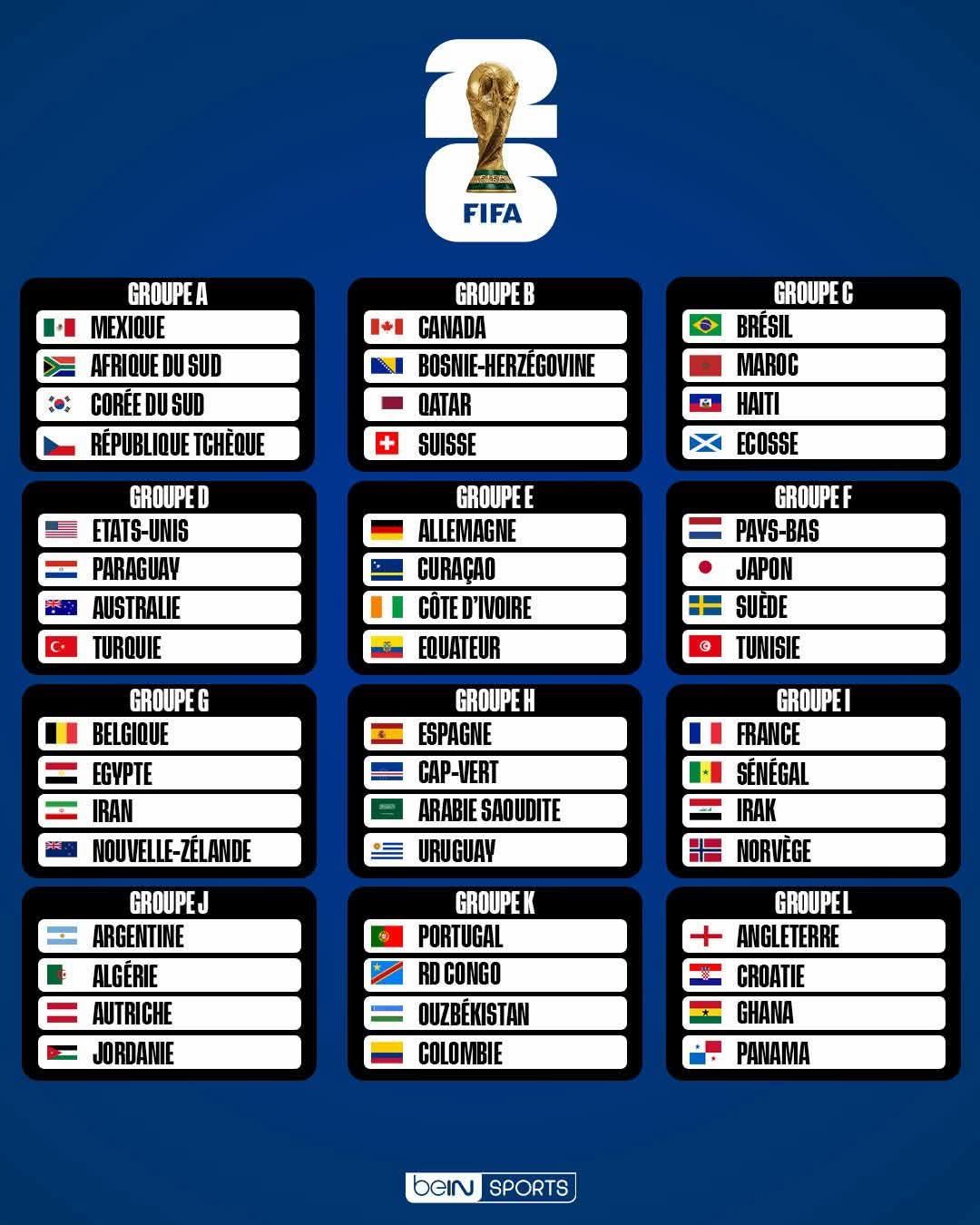
With the field finalized, the group stage lineup for the 48-team format is set. Among the notable groupings:
Group A: Mexico, South Africa, South Korea, and Czechia. Group B: Canada, Bosnia and Herzegovina, Qatar, Switzerland. Group C: Brazil, Morocco, Haiti, Scotland. Group D: United States, Paraguay, Australia, Türkiye. Group F: Netherlands, Japan, Sweden, Tunisia. Group I: France, Senegal, Iraq, Norway. Group K: Portugal, DR Congo, Uzbekistan, Colombia.
Boston Stadium and the Local Schedule
In Foxborough, Massachusetts, Gillette Stadium — which will be referred to as “Boston Stadium” under FIFA rules that prohibit commercial naming — will host seven World Cup matches from June 13 to July 9, including a quarterfinal. Iraq is scheduled to face Norway on June 16 in Group I play at the venue.
The stadium is undergoing a FIFA-mandated transformation that includes covering New England Patriots Super Bowl banners and all non-approved commercial branding. Preparations are also advancing across the region. Cambridge recently received a $65,000 state tourism grant from Governor Healey’s administration to fund free neighborhood watch parties throughout the tournament window.
Amnesty International Raises Concerns
The finalization of the field comes amid growing scrutiny of the tournament’s human rights dimensions. Amnesty International issued a warning this week that millions of fans heading to the World Cup face significant risks, describing the United States — which will host three-quarters of the 104 matches — as being in a “human rights emergency” driven by mass deportations, immigration enforcement, and restrictions on protest.
Amnesty called on FIFA to use its leverage with the Trump administration to guarantee that no immigration enforcement operations take place around stadiums, fan zones, watch parties, or other World Cup events. The organization also flagged concerns about security deployments in Mexico and the displacement of homeless populations in Canadian host cities.
For the Haitian diaspora in the United States, where hundreds of thousands of TPS holders and CBP One parolees face ongoing legal uncertainty over their immigration status, the intersection of a World Cup that features Haiti’s national team and an intensified federal enforcement climate creates a situation unlike any previous tournament.
The 2026 FIFA World Cup will run from June 11 to July 19 across 16 host cities in the United States, Canada, and Mexico, featuring 104 matches. The opening match is set for June 11 in Mexico City, with Mexico facing South Africa.
It will be the first World Cup played under the expanded 48-team format and the first co-hosted by three nations.
For Haiti, the tournament represents a return to the world stage after a 52-year absence — the longest gap between World Cup appearances in the current field.

https://ctninfo.com/?p=41644&preview=true
https://www.facebook.com/CaribbeanNewsMedia
Source: New York Times
https://ctninfo.com/?p=41644&preview=true
https://www.facebook.com/CaribbeanNewsMedia
Source: New York Times