


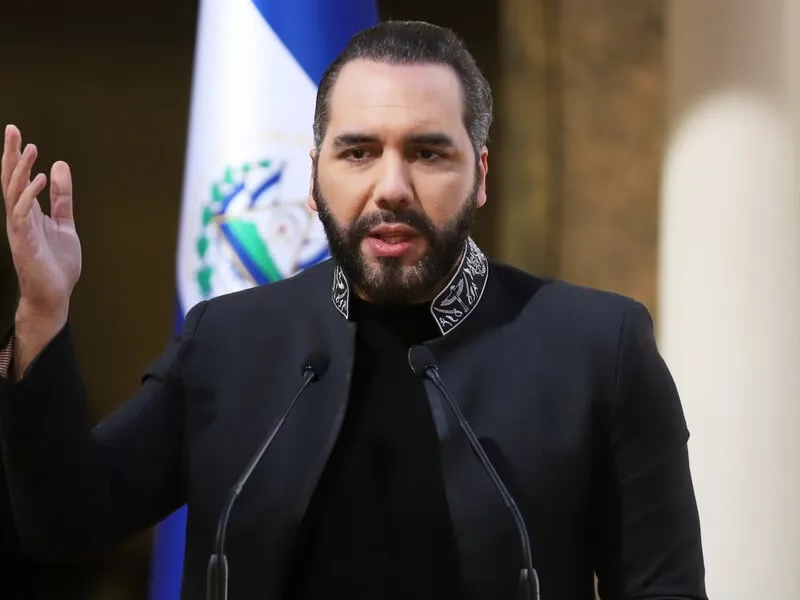
In a post on his X account, written in Haitian Creole, Salvadoran President Nayib Bukele addressed the Haitian people directly to denounce the internal complicity that fuels gang violence. The message, which comes amid a massive Salvadoran military deployment in Haiti, compares collaborators with armed groups to the traitors who assassinated Jean-Jacques Dessalines, the father of Haitian independence. It is a speech that combines historical references, a call for collective responsibility, and a promise of liberation.
At the heart of his argument, Nayib Bukele invokes the memory of Dessalines. He recalls that while the liberator freed Haiti from colonial rule, he was betrayed and killed by those at his side—men who spoke the same language but did not share his principles. For the Salvadoran president, the heirs of those traitors are still at work today. According to him, they are found among gang members, but also among those who finance them, supply them with weapons, or obstruct the freedom of the Haitian people.
Bukele does not limit his accusations to the gangs alone. He attacks a widely held idea in Haiti: that the current crisis is exclusively attributable to foreign interference. While acknowledging that foreign powers have plundered the country, he stresses that this exploitation would not have been possible without the collaboration of many Haitians. “Who puts the weapons in your hands? Who kills the people we love? Who steals your homes and your property, if not the same kind of traitorous bandits as those who assassinated Dessalines?” he asks. It is a way of pointing to the responsibility of local economic and political elites who, according to him, profit from chaos or instrumentalize armed groups to preserve their interests.
A Call for Collective Mobilization
The message is also intended as a call to action. Bukele urges the population to “rise up,” to “take back control of their communities,” and to “bring under control” those who inflict unspeakable suffering on the people. He assures that El Salvador stands “on the same side” as Haitians and promises to help them reconquer their country from the hands of those who betray Dessalines’s legacy. He concludes with a declaration of faith: “And, in the end, Haiti will be free.”

This explosive outburst comes as El Salvador has deployed more than 2,000 soldiers in Haiti, officially to find four Salvadoran technicians missing since October 18. Bukele rejects any idea of invasion and states that his country is bearing 90% of the operation’s costs. He justifies this intervention by citing the Salvadoran experience, recalling that his country experienced violence “even more terrible” than that which Haiti endures today.
While some see in it sincere support and a necessary shock, others perceive it as disguised foreign interference and an attempt to transpose the Salvadoran security model, which has been widely criticized for its authoritarian excesses. The comparison with Dessalines, a sacred figure of emancipation, also risks offending part of Haitian public opinion, which could see it as a moral lesson given by a foreign leader. Regardless, Bukele’s message has the merit of raising an uncomfortable question: the liberation of Haiti cannot be solely a matter of external intervention; it also requires a break with the internal complicity that feeds violence.
https://ctninfo.com/who-is-selling-y…st-haitis-elites/
https://www.facebook.com/CaribbeanNewsMedia