



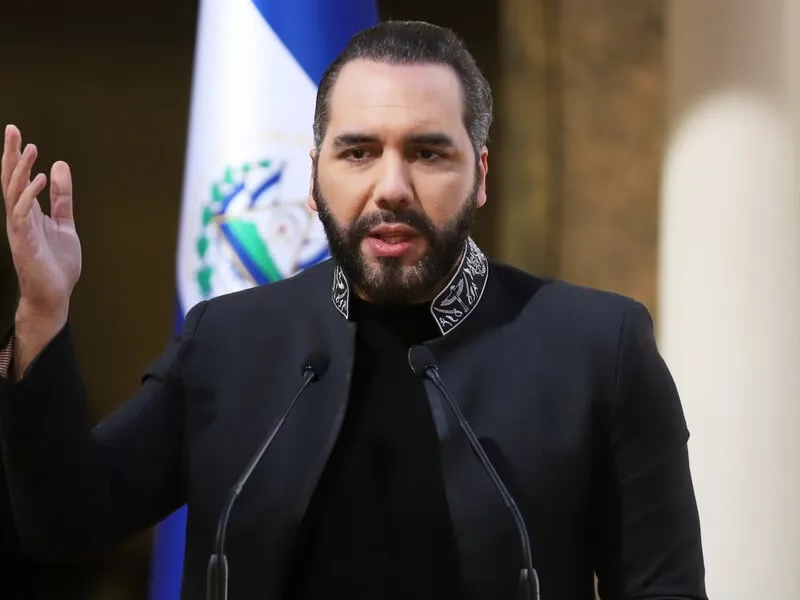
In a message written directly in Haitian Creole on his X account, El Salvador’s president says his troops are in Haiti only to recover four missing aviation technicians and to fight the gangs — not to dominate or loot the country.
By Manny Paul — Caribbean Television Network (CTN)
As he continues to deploy soldiers and equipment in Haiti in an effort to recover four missing Salvadoran troops, President Nayib Bukele has sought to reassure the Haitian population.
In a message posted directly in Haitian Creole on his X account on October 29, the Salvadoran president said his soldiers have not come to invade Haiti or to seize what little remains of its resources, but only to help the people and to find his missing men.
The four aviation technicians have been unaccounted for since October 18, when they went missing after a gang ambush on the outskirts of Port-au-Prince. El Salvador has deployed about 2,000 soldiers to Haiti since the attack, according to Reuters.
Bukele opened his message with a direct assurance to the Haitian public. “Sa a se pa yon operasyon kont pèp ayisyen an, ni yon envazyon peyi Ayiti,” he wrote. (“This is not an operation against the Haitian people, nor an invasion of Haiti.”) He described El Salvador as “yon peyi modès k ap devlope” (“a modest, developing country”) with no designs on Haiti: “Nou pa gen okenn enterè ni pou nou vin domine pèp ayisyen an, ni pou nou mete men sou richès Ayiti.” (“We have no interest in dominating the Haitian people, nor in seizing Haiti’s wealth.”)

According to Bukele, the mission has two clear aims.
“Sèl sa nou vle, se pou kat teknisyen avyasyon nou yo tounen lakay yo,” he wrote. (“All we want is for our four aviation technicians to return home.”) The second aim, he said, is directed at the armed groups: “Epi n ap bay gang yo yon leson, gang sa yo k ap fè pèp ayisyen an soufri, ki touye moun pèp la renmen yo, k ap anpeche l viv yon lavi nòmal, lib, san laperèz.” (“And we will teach the gangs a lesson — these gangs that make the Haitian people suffer, that kill the people’s loved ones, and that keep them from living a normal, free life without fear.”)
On the cost of the operation, Bukele said his country is carrying nearly all of it. “Menmsi nou resevwa yon ti èd lojistik nan men kèk lòt peyi, se ak pwòp ti kès nou n ap kouvri 90% nan depans yo,” he wrote. (“Even though we receive some logistical help from a few other countries, we are covering 90% of the costs out of our own modest treasury.”) He justified the expense with a single line: “jistis ak lapè pa gen pri.” (“Justice and peace have no price.”)
In the message, Bukele drew a parallel between Haiti’s situation and what his own country endured.
He recalled that El Salvador had lived through “yon beny san ki te pi terib toujou pase sa pèp ayisyen an ap sibi kounye a” (“a bloodbath even more terrible than what the Haitian people are enduring now”), and said his country is today “peyi ki gen plis sekirite sou kontinan an” (“the most secure country on the continent”). He said he understands what Haitians are living through: “viv nan laperèz, pa fè politisyen konfyans, pa kwè okenn moun ki pwomèt l ap ede w.” (“Living in fear, not trusting politicians, not believing anyone who promises to help you.”)
The president insisted his soldiers are not in Haiti for any financial gain. “Nou pa vin ann Ayiti pou nou touche lajan, paske pèsonn pa peye nou pou sa. Nou vin ann Ayiti pou nou goumen kont mechan yo,” he wrote. (“We did not come to Haiti to earn money, because no one is paying us for this. We came to Haiti to fight the wicked.”)
Bukele closed with a religious appeal to the Haitian people: “fè nou konfyans, lapriyè sèl vrè Bondye a, epi mande L pou L geri Ayiti.” (“Trust us, pray to the one true God, and ask Him to heal Haiti.”) He cited the biblical verse 2 Chronicles 7:14, which speaks of a people who humble themselves before God and seek forgiveness so that their land may be restored.

Finally, the president said his troops’ presence would be temporary. “Lè misyon nou an fini, n ap tounen lakay nou,” he wrote. (“When our mission is over, we will return home.”) He added a hope that “jenerasyon Ayisyen k ap vini yo ap sonje nou kòm zanmi ki te vin ede yon lè.” (“Future generations of Haitians will remember us as friends who once came to help.”)
As of his message, the four Salvadoran soldiers remained missing, and no gang had claimed responsibility for the ambush, according to news reports.
https://ctninfo.com/?p=45131&preview=true
Source: https://x.com/nayibbukele
AI Use Policy:
Some of CTN’s journalists are not native English speakers and draft their work in French or Haitian Creole. We then use AI-assisted translation software to produce the English versions, and traces of machine-generated phrasing may occasionally remain. Every article — in any language — is written, reviewed, and edited by CTN’s staff writers and editors, who remain responsible for its accuracy. CTN also uses AI to convert text into audio.