


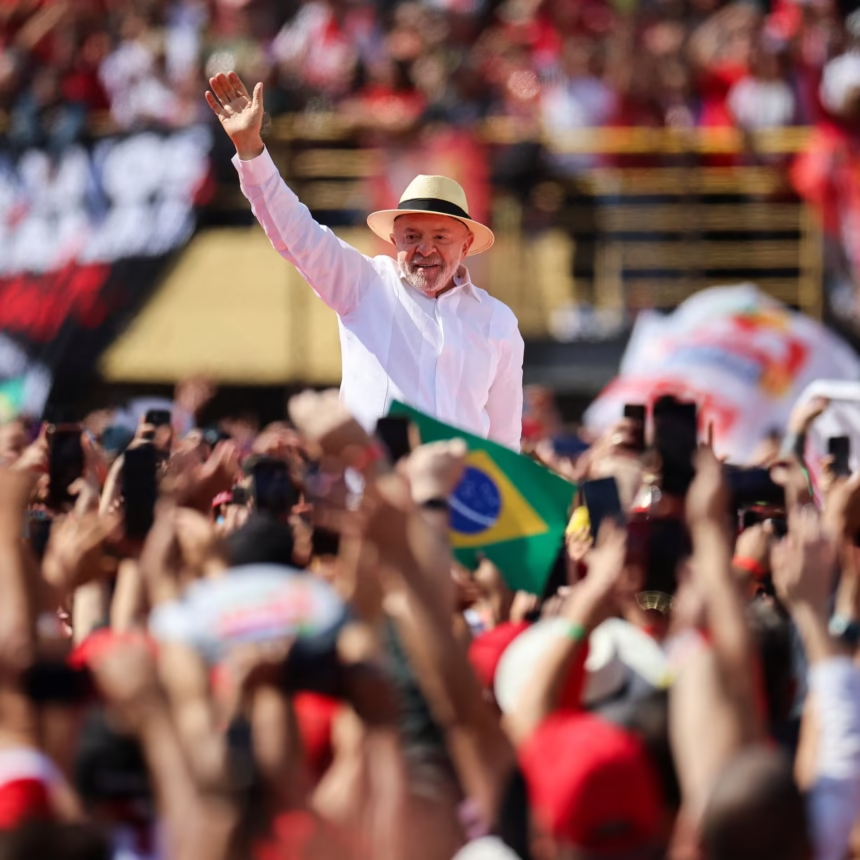
President Luiz Inácio Lula da Silva has won a fourth term leading Brazil, defeating Senator Flávio Bolsonaro in Sunday’s runoff, according to official results reported by NPR with more than 96 percent of the vote counted.
Lula took more than 51 percent to Bolsonaro’s more than 48 percent, a narrow margin in Latin America’s largest democracy.
The victory returns Lula, a veteran of the Brazilian left, to the presidency he has now held across four nonconsecutive terms, and turns back a Bolsonaro political dynasty that had campaigned on closer ties with President Trump.
Flávio Bolsonaro, 45, is the son of former President Jair Bolsonaro, NPR reported in an account by Catherine Osborn from Brasília.
The balloting did not end cleanly.
Around midday, Lula’s campaign asked election authorities to extend voting hours, arguing that some local governments had cut bus service and made it harder for voters to reach polling stations. Bolsonaro’s side also sought more time, citing heavy rain in some states. Supreme Court Justice Cristiano Zanin ordered voting extended by two hours past the normal 5 p.m. close.
But the order arrived at some polling places only after officials had already deactivated their electronic voting machines, so balloting could not resume there, according to NPR.
In Rio de Janeiro, Manuela Tunas, a 36-year-old accountant who reached a polling station shortly after 6 p.m. following a delayed flight, was turned away. “This is absurd,” she told NPR. “If some people can vote, and others can’t, it’s unfair.”

The race had drawn international attention well beyond Brazil’s borders, bound up with the fortunes of a rising right-wing movement across Latin America, the future of the Amazon rainforest and the durability of a Brazilian democracy roughly four decades removed from military rule.
Hanging over the contest was the fate of the elder Bolsonaro.
Jair Bolsonaro narrowly lost to Lula in 2022 and is serving a 27-year prison sentence for plotting a coup to overturn that defeat. His son had pledged to pardon him if elected. That history gave the runoff an intensity its early months had lacked: with two well-established camps facing off, Brazilians showed little appetite for street campaigning until Bolsonaro’s first-place finish in the October 4 first round energized both sides, filling rallies and flooding social media in the final stretch.
In the end, NPR reported, Lula’s message of continuity and his focus on social spending carried the day. “I think people woke up about the risk of a Bolsonaro government after the first round, and the mobilization made a difference,” said Alessandra Miguel, a 35-year-old spa worker who voted for Lula in Rocinha, a favela in Rio de Janeiro.
Lula will govern a country split down the middle. The Brazilian political scientist Jairo Nicolau, who studies presidential elections, said one of the most striking features of this year’s vote was how fixed Brazilians’ political loyalties had become. Unlike in past years, he told NPR, “people’s identity of belonging to a tribe became more important than how they view different policy options.”
Under Brazil’s constitution, the winner of the presidential election is inaugurated on January 1. Lula is due to begin his new term then. This remains a developing story, and official results were still being finalized as the count neared completion on Sunday night.

Lula has cast himself as one of Haiti’s more vocal advocates on the international stage.
In his address to the United Nations General Assembly on September 22, 2026, he singled out the country, declaring that “the crisis in Haiti continues to test the limits of the international community’s indifference.” He has pressed the point elsewhere: at the Brazil–Caribbean Summit in June 2025, Lula said Haiti — the first independent nation in the Americas — “cannot be punished eternally,” condemned the “abandonment and indifference” it faces today, urged the international community to get behind a national development plan, and said Brazil supported the United Nations taking on part of the financing of the multinational security mission in Haiti. On that occasion, he also announced that Brazil’s federal police would train 400 members of Haiti’s national police.
https://ctninfo.com/lula-wins-fourth…-in-tight-runoff/
https://www.facebook.com/CaribbeanNewsMedia
Source: NPR
AI Use Policy:
Some of CTN’s journalists are not native English speakers and draft their work in French or Haitian Creole. We then use AI-assisted translation software to produce the English versions, and traces of machine-generated phrasing may occasionally remain. Every article — in any language — is written, reviewed, and edited by CTN’s staff writers and editors, who remain responsible for its accuracy. CTN also uses AI to convert text into audio.
