


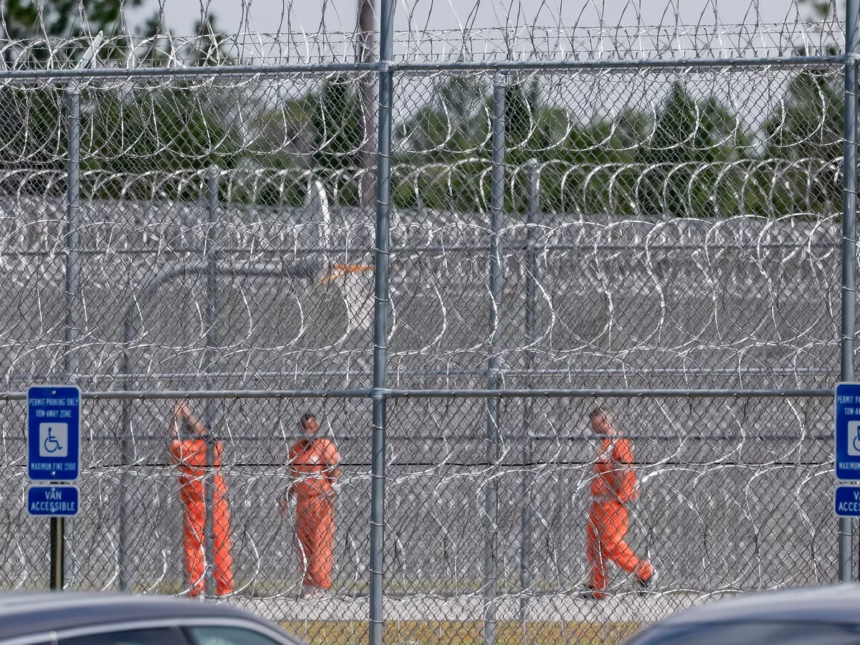
A man held in immigration detention died early Friday at a sprawling detention complex in Folkston, Georgia — the 60th person to die in custody of Immigration and Customs Enforcement since President Trump’s second term began, according to figures reported by The Guardian.
The death came at a facility already under national scrutiny over a hunger strike that detainees have sustained for weeks.
The man was Luis Sandoval, 48, a citizen of El Salvador, ICE said in a statement reported by The Guardian.
Facility staff found Sandoval with a ligature around his neck at about 1:46 a.m. Friday, the agency said, and he was pronounced dead less than an hour later. He had been arrested by ICE earlier this month and transferred to the Folkston facility on October 8. ICE said he had prior convictions for aggravated assault and other offenses and that his death was under investigation. It was not known whether Sandoval had taken part in the hunger strike, and the authorities have not said how he died.
Sandoval died inside the D Ray James facility, which sits next to the Folkston ICE Processing Center; together the two make up one large detention complex operated under federal contract by the GEO Group, a private prison company.

GEO referred all questions to ICE, The Guardian reported.
The Georgia Bureau of Investigation confirmed that the local sheriff’s office had asked it to conduct an “in-custody death investigation” at the facility. ICE and the Department of Homeland Security did not respond to The Guardian’s requests for comment about the death or the hunger strike.
Sandoval’s death lands amid a rate of fatalities in immigration custody that researchers describe as unprecedented. Austin Kocher, president of Relevant Research, which studies the immigration enforcement system, and a research fellow at American University, told The Guardian that so far this year there has been an average of one death every 10 days in ICE custody — a count that includes people who die inside detention centers or in nearby hospitals while still held by the agency.
Kocher tied the pattern to the posture of the current administration. “Even in the past, there has not been such an overt dehumanization and overt view that migrants’ lives are expendable,” he said. “I worry that that tone has a tendency towards neglect and viewing migrants as disposable.” Tens of thousands of people have been arrested and held as they fight their immigration and asylum cases, Kocher noted, with the agency escalating its operations in recent months even as its street presence has grown less conspicuous.
The hunger strike at the center of the scrutiny began about three weeks ago.
Andrei Gerdiukov, a Russian asylum seeker held at the complex, said he and dozens of others stopped eating to demand that their legal cases be processed faster and to protest the conditions of their confinement. The strikers were placed in solitary confinement, Gerdiukov and attorneys said.
The protest grew large. Georgia Public Broadcasting reported earlier this month that roughly 500 people across the Coastal Georgia complex were refusing food, citing figures from activists and relatives — about 372 men in Folkston’s F building and K5 pod as of October 8, with an estimated 150 more elsewhere. In an audio recording obtained by the station, one detainee said: “We are not serving criminal sentences. We are asking the United States for protection.” Samantha Hamilton of Asian Americans Advancing Justice–Atlanta told GPB there was “nothing illegal about seeking asylum.”

By this week, at least 12 strikers were still participating despite the toll on their bodies, Gerdiukov told The Guardian, with several fainting. “I feel tired, I feel dizzy. Every move, it is hard,” he said by phone from detention on Saturday. He had heard of Sandoval’s death but did not know him.
What has drawn the sharpest alarm this week are allegations that federal officials and contractors have threatened the strikers with force-feeding — accounts given to The Guardian by a detained striker, his wife, attorneys and advocates.
On Friday, Gerdiukov said the strikers were moved to a nearby unit where medical staff “wearing combat boots” took their vital signs, which he said raised fears that force-feeding was imminent. “They threatened us that they were going to force-feed us,” he said. It was not clear whether or when the authorities intended to carry it out.
Force-feeding is a secretive process, often carried out under sealed court records. A judge must approve it; detention guards then restrain the striker while medical staff push tubing through the nose and down the throat to pump nutritional liquid into the stomach. Medical ethicists and human rights organizations have called the practice torture. In court filings, ICE generally argues that force-feeding is necessary to maintain “good order” in its facilities and to keep detainees alive.
Advocates placed responsibility for Sandoval’s death on the government and the company that runs the complex. “This was a preventable tragedy,” said Azadeh Shahshahani, legal and advocacy director for Project South, a Georgia-based social justice organization. “We hold ICE and the private prison corporation fully responsible for any harm that migrants suffer at Folkston. We call for an immediate independent investigation into this tragic death and for accountability. Folkston must be shut down immediately.” As of Saturday, the Bureau of Investigation said it could not release further details while its inquiry remained active.
https://ctninfo.com/man-dies-in-ice-…id-hunger-strike/
Source: The Guardian
AI Use Policy:
Some of CTN’s journalists are not native English speakers and draft their work in French or Haitian Creole. We then use AI-assisted translation software to produce the English versions, and traces of machine-generated phrasing may occasionally remain. Every article — in any language — is written, reviewed, and edited by CTN’s staff writers and editors, who remain responsible for its accuracy. CTN also uses AI to convert text into audio.
