

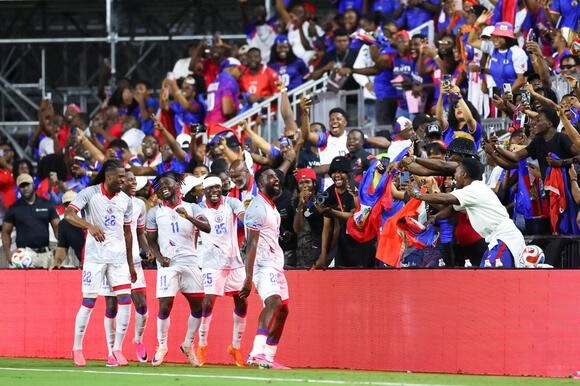
Previously scheduled in Jamaica, Haiti’s Nov. 14 Nations League quarterfinal against the United States will be played at Miami’s Nu Stadium, home to a huge Haitian fan base
By Caribbean Television Network (CTN)
Haitian fans in South Florida will get to see their national team play a competitive match close to home next month.
Concacaf has approved moving Haiti’s Nations League quarterfinal first leg against the United States from Kingston, Jamaica, to Miami’s Nu Stadium.
The match is set for Saturday, Nov. 14, at 4:30 p.m. ET. Haiti remains the designated home team, and it will now play in the region with the largest Haitian community in the United States.
The Guardian reported that nearly half a million people of Haitian birth or descent live in South Florida.
The move came at the request of the Haitian Football Federation (FHF).
Concacaf announced Thursday that its Council had approved what it called an “exceptional hosting arrangement” for the federation. The second leg will be played on Tuesday, Nov. 17, at TQL Stadium in Cincinnati, where the U.S. will be the home side.

A sold-out crowd, then and now
Haiti’s supporters have already filled this building once. In June, before the World Cup, Haiti played Peru in the first international friendly ever held at Nu Stadium, and it drew a sellout crowd of 26,700, according to The Guardian’s Jeff Rueter.
Kingston would have looked very different. The Guardian reported that Haiti’s two Nations League matches at Sabina Park this cycle drew an average of 297 fans. Sabina Park is a cricket ground that served as Jamaica’s national team home until 1962.
The new venue is a major upgrade. Fox Sports reported that Nu Stadium, the roughly $1 billion home of Inter Miami, opened earlier this year.
For families in Little Haiti, North Miami, Miramar and across Broward and Palm Beach counties, the quarterfinal is now a drive away instead of a flight to Jamaica. Supporters in Haitian communities farther up the East Coast, from New York to Boston, can now travel domestically, with no international trip needed.
How Haiti got here
This will be the first time the two countries have met in Nations League play, SBI Soccer noted. The United States has won the last three meetings, each by a single goal, including a 2-1 result at the 2025 Gold Cup, Fox Sports reported. Haiti last beat the Americans in 1973, the same year it won the Concacaf Championship and qualified for its first World Cup.

The trade-off is on the field: Mauricio Pochettino’s U.S. side now plays both legs on American soil. Sports Illustrated noted that the U.S. has not played a match away from home in two years. Haiti’s coaching staff, though, can expect the stands in Miami to be dominated by blue and red.
The November trip will be Haiti’s first return to the United States since this summer’s World Cup, its first appearance at the tournament in 52 years. The Grenadiers lost all three Group C matches: 1-0 to Scotland at Boston Stadium, 3-0 to Brazil in Philadelphia, and 4-2 to Morocco at Atlanta Stadium. In the Morocco game, Haiti twice took the lead, first on an own goal and then on a strike from Wilson Isidore.
The results did not match the atmosphere. The Guardian noted the strong backing Haiti received from fans in Massachusetts, Philadelphia and Atlanta, where diaspora supporters turned each match into a celebration of Haitian identity.
Why Haiti plays abroad
Haiti has not been able to host a home international since July 2021, the month President Jovenel Moïse was assassinated, The Guardian reported. The paper cited a United Nations estimate that gangs control roughly 90% of Port-au-Prince, including the area around the national stadium, Stade Sylvio Cator. During 2026 World Cup qualifying, Haiti played its home games in Curaçao, Aruba and Barbados.
Concacaf rules currently require Haiti’s home matches to stay within the Caribbean. That is how the federation ended up at Sabina Park, after scheduling conflicts left Curaçao and Jamaica hosting their own quarterfinals the same night. Concacaf’s schedule shows Jamaica playing Mexico at Kingston’s National Stadium that evening.
The new arrangement changes that. The FHF may now request to play designated home matches “in the territory of its opponents,” Concacaf said, and the same option applies to Haitian clubs in Concacaf competitions. Each match needs its own approval from the Concacaf Administration, the opposing federation’s agreement, and a stadium that meets Concacaf standards.
“This flexibility will remain in place for as long as the security situation in Haiti persists,” the confederation said. The Council may amend or withdraw the measure at any time.
Under the new arrangement, the Grenadiers can request future home dates in cities where their supporters already live, starting with Miami on Nov. 14.
Sources: Concacaf official statement (Oct. 22, 2026); The Guardian, reporting by Jeff Rueter; Fox Sports; Sports Illustrated; SBI Soccer; Telemundo Deportes; Concacaf match reports.