


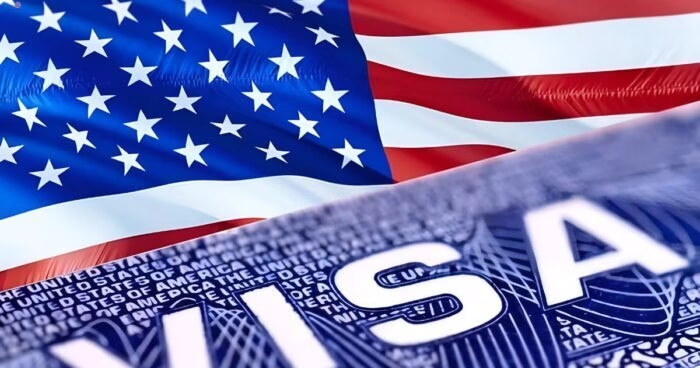
A federal judge has struck down the Trump administration policy that suspended immigrant visas for nationals of 75 countries, including Haiti, ruling that the State Department broke federal law when it began refusing applicants based on nothing more than where they were born. The decision reopens a legal path that had been closed for months to Haitian families and to the American citizens and residents trying to bring their relatives to the United States.
U.S. District Judge Jeannette A. Vargas, who sits in Manhattan, issued the ruling Friday, calling the policy “patently unlawful” and finding that it conflicted with the Immigration and Nationality Act and exceeded the authority of Secretary of State Marco Rubio. She vacated the policy outright and ordered that any immigrant visa refused solely because of it be returned to consular officers for a fresh, individual review. The suspension, Vargas wrote, “represents a direct abrogation of this statutory scheme.”
The policy had been in force since January.
The State Department announced it on Jan. 14 and put it into effect on Jan. 21, pausing the issuance of immigrant visas, the permanent-residence visas granted to people joining family members or taking jobs in the United States, for nationals of countries it said posed a high risk of relying on public assistance.
Officials framed the measure as a way to keep out immigrants who would, in the department’s words, “take welfare and public benefits.” The pause did not touch temporary visas such as those for tourists or students.

For Haiti, the practical effect was severe.
Haitian nationals with approved petitions, and U.S. citizens who had spent years and considerable money sponsoring parents, spouses and children still in Haiti, found their cases frozen at the consular stage, refused not on the merits, but because of their nationality.
The suspension swept in roughly 40 percent of the world’s countries, and Vargas noted that it blocked those nationals regardless of whether they individually qualified under U.S. law.
At the center of the ruling is a provision of federal immigration law that bars discrimination in issuing immigrant visas on the basis of race, sex, nationality, place of birth, or place of residence. The judge found the suspension collided directly with that guarantee. She rejected the government’s argument that the Supreme Court’s 2018 decision in Trump v. Hawaii, which upheld a nationality-based restriction on entry to the country, gave the administration cover. That case turned on the difference between admission and visa issuance, Vargas said, and the anti-discrimination rule applies to the latter.
Ordinarily, an applicant can be turned away as a likely “public charge”, someone expected to depend on government support, only after a consular officer weighs that person’s own finances, age, health, skills and family situation.
The January policy short-circuited that individualized judgment. According to the cable Rubio sent to diplomatic posts, which was entered into the court record, officers were instructed to refuse applicants from the designated countries even when an applicant provided evidence that overcame any public-charge concern. Vargas found that the mandate was incompatible with the law. “The outcome is predetermined,” she wrote. “The visa will be refused.” The policy, she added, stripped consular officers of the role Congress had assigned them.
The judge also held that Rubio had overstepped. Federal law makes the secretary of state responsible for administering immigration functions carried out by diplomatic and consular officials, but it expressly carves out the officers’ authority to grant or refuse individual visas. By ordering that officers “must refuse” applicants of certain nationalities, the court found, the policy displaced a decision Congress had reserved for those officers.

Judge Vargas made it clear that consular officers keep the power to deny applications on legitimate grounds, and that refusals resting on other legal bases remain in place even if they also cited the now-void policy.
The decision restores the officers’ obligation to weigh each case on its own facts. The judge declined to send the policy back to the State Department for revision, writing that its legal defects were too fundamental to cure, and she granted a declaration that the nationality-based suspension was unlawful. She ruled against the challengers on one point, finding that the department had not been required to put the policy through formal notice-and-comment rulemaking.
The case, Catholic Legal Immigration Network Inc. v. Rubio, was brought by immigrant-advocacy organizations, including the Catholic Legal Immigration Network and African Communities Together, along with visa applicants and U.S. citizens seeking to reunite with relatives abroad. The court brushed aside the government’s contention that a doctrine shielding individual consular decisions from review barred the lawsuit, holding that the challenge targeted a departmentwide policy rather than any single visa denial.
Haiti was one of two Caribbean nations swept into the suspension, alongside Jamaica. The rest spanned much of the globe: Afghanistan, Bangladesh, Bhutan, Cambodia, Nepal and Pakistan in Asia; Nigeria, Somalia and others across Africa; Iran, Syria and Yemen in the Middle East; Colombia, Brazil and Uruguay in Latin America; and Russia and Balkan states such as Bosnia and Albania in Europe.
For Haitian immigrants, the decision lands at a punishing moment.
The administration has ended Temporary Protected Status for more than 350,000 Haitians, resumed deportation flights to a country the U.S. government itself deems too dangerous to visit, and intensified immigration arrests. Family-based immigration had been one of the few legal channels still open, and the January policy had closed it. Friday’s ruling pries it back open, though what comes next is uncertain: the judge ordered both sides to report by Sept. 11 on how the case should proceed, and the government could appeal.
Source: NepYork
https://ctninfo.com/?p=44322&preview=true
https://www.facebook.com/CaribbeanNewsMedia
This article was originally written in English. Other language versions are produced using AI translation software, and errors are possible — the English version is authoritative. CTN also uses AI to convert text into audio.