


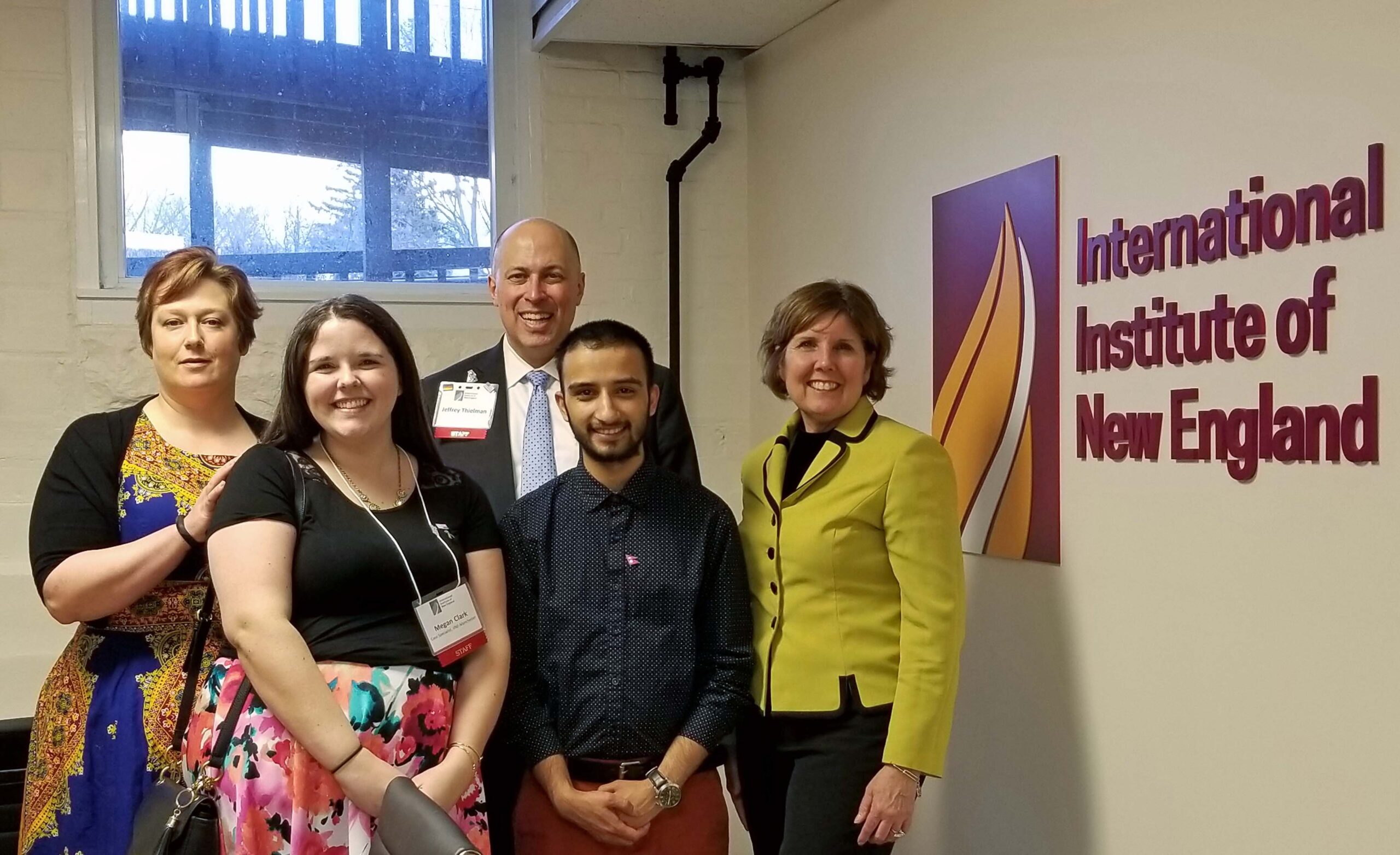
The International Institute of New England (IINE) provides free immigration, education, and workforce services to refugees, asylum seekers, parolees, and other newcomers across Massachusetts and New Hampshire.
Over the past five years alone, more than 20,000 Haitians have received support through the organization, according to Jeffrey Thielman, IINE’s president and chief executive officer.
For many of those families, IINE is the first stable American institution they encounter — one that does not bill them, does not turn them away, and does not require them to navigate a foreign legal system on their own.
“What makes IINE different is that our services are completely free to our clients,” said Rodeney Pierre, a case manager who has served at IINE for more than three years and now works in a management capacity. Pierre is one of several Haitian-American staff members the organization has hired in recent years as the share of Haitian clients has grown.

IINE was founded more than 100 years ago to serve immigrants arriving in New England — a region whose economy and identity have been shaped by successive waves of newcomers. Today, the organization operates from three principal locations: Boston and Lowell in Massachusetts, and Manchester in New Hampshire.
Each office offers a comprehensive bundle of services designed to help newly arrived immigrants do what mainstream institutions are rarely set up to help them do: legalize their status, learn English, find work, and build a life.
In its Massachusetts offices, Haitians are now the largest client group — a reflection of the sustained migration that has reshaped the demographics of Boston, Brockton, Mattapan, Randolph, and Lowell over the past decade.

Immigration legal services, free of charge
The heart of IINE’s work is immigration legal services. The organization’s attorneys and accredited representatives help clients file applications for the protections U.S. immigration law makes available to people fleeing persecution, violence, instability, or family separation. These include applications for asylum, work authorization, Temporary Protected Status (TPS), humanitarian parole, family reunification, lawful permanent residence (the green card), and eventually U.S. citizenship.

For many Haitian families arriving today, the legal terrain is unfamiliar and frequently misunderstood. The terms describing newcomers — refugee, asylum seeker, parolee, TPS recipient — are not interchangeable. Each carries its own legal definition, rights, and pathway to permanent status.
Among the most important distinctions:
Refugees are people who have left their home countries and cannot safely return because of a well-founded fear of persecution on the basis of race, religion, nationality, membership in a particular social group, or political opinion. Refugee status is generally determined before a person arrives in the United States, often by the U.S. government or the United Nations High Commissioner for Refugees. Refugees can work legally and have a clear pathway to lawful permanent residence and citizenship.
Asylum seekers are individuals who arrive at or cross the U.S. border and apply for the same protections refugees receive, but from inside the country. Their application must demonstrate the same kind of persecution or fear of persecution. Asylum cases can take years to adjudicate. While their case is pending, asylum seekers can apply for work authorization. Those granted asylum — known as asylees — also have a pathway to a green card and eventually citizenship.
Temporary Protected Status (TPS) is granted to nationals of countries that the U.S. government has designated as unsafe for return due to armed conflict, natural disasters, or extraordinary conditions. Haiti has been designated for TPS for over a decade. TPS allows recipients to live and work legally in the U.S. while the designation is in effect, but it does not, in itself, provide a pathway to citizenship. TPS recipients, however, can apply for asylum or other humanitarian protections separately.
Humanitarian Parolees are admitted to the United States temporarily — usually for one year at a time — for urgent humanitarian reasons. Under the Cuban, Haitian, Nicaraguan, and Venezuelan (CHNV) Parole program, individuals from those four countries can be admitted for two years if they have a U.S.-based sponsor committed to providing financial and housing support. Like TPS, parole does not, in itself, lead to citizenship, but parolees can apply for asylum or other statuses while in the country.
For Haitian families in particular, the practical distinctions between these statuses have become urgent in recent years. As legal challenges over Haitian TPS have moved through the federal courts, and as immigration enforcement has intensified, the difference between holding the correct legal status and holding the wrong one — or none at all — can determine whether a family stays together.
This is precisely the kind of guidance that families struggle to obtain elsewhere. Private immigration attorneys are expensive. Online information is often outdated or misleading. IINE’s free legal services close that gap.
Beyond immigration: preparing newcomers for the workforce
IINE’s services do not stop at legal paperwork. The organization also offers free English for Speakers of Other Languages (ESOL) classes, Certified Nursing Assistant (CNA) training, and other workforce development programs designed to help newly arrived immigrants enter the U.S. labor market, Thielman explained.
The bundling matters. Legal status without language is incomplete. Language without job skills is incomplete. IINE’s approach is to help clients move forward on all three fronts at once — legal, linguistic, and economic — so that the path from arrival to self-sufficiency is shorter and more stable.
Recognizing that Haitians make up the majority of its Massachusetts client base, IINE has deliberately built a staff that reflects the community it serves. A substantial portion of the organization’s personnel is Haitian-American, with several serving in management roles. Pierre, the case manager who has been with IINE for more than three years, is among them.
For Haitian clients arriving from Limbé, Port-au-Prince, Gonaïves, or Cap-Haïtien — or arriving from intermediate stops in the Dominican Republic, Brazil, Chile, or Mexico — being met by a case manager who speaks Haitian Creole, who understands the family pressures of remittances and reunification, and who has walked similar streets is more than convenience. It is the difference between feeling like a file number and feeling like a person.
IINE operates three primary offices:
- Boston, Massachusetts
- Lowell, Massachusetts
- Manchester, New Hampshire
The organization can be reached through its website at iine.org, where prospective clients can learn about specific programs, find office contact information, and request services. All services described in this article are provided at no cost to the client.
For Haitian families navigating an unfamiliar legal system at the most vulnerable moment of their lives, IINE is one of the institutions making a difference quietly, one case at a time, over the course of more than a hundred years.
https://www.facebook.com/CaribbeanNewsMedia
https://ctninfo.com/?p=43034&preview=true