

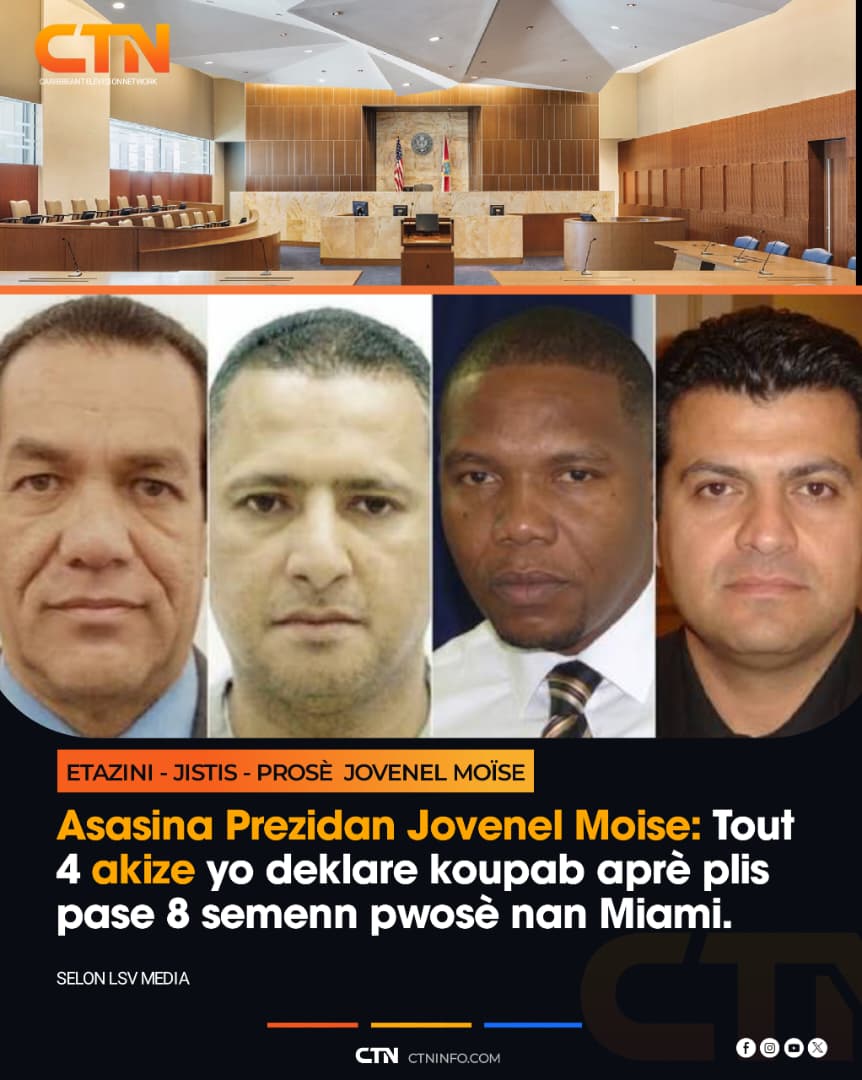
A federal jury in South Florida has convicted four men accused of helping drive the operation that ended with the assassination of Haitian President Jovenel Moïse, closing an eight-week-plus trial that placed Miami at the center of one of Haiti’s most traumatic modern political crimes.
The four defendants — Arcangel Pretel Ortiz, Antonio Intriago, Walter Veintemilla, and James Solages — were all found guilty on Friday in Miami federal court.
According to reporting by NBC6 South Florida, LSV Media, and the Associated Press, jurors convicted them on charges that included conspiracy to kill or kidnap Moïse, providing material support connected to the plot, and violating the U.S. Neutrality Act.
The verdict is one of the most significant legal outcomes so far in the international investigation into Moïse’s killing. The Haitian president was assassinated on July 7, 2021, when heavily armed men entered his residence near Port-au-Prince in the early morning. His wife, Martine Moïse, survived the attack after being wounded and was later taken to the United States for medical care, according to the NBC6/AP report.
Federal prosecutors argued that the plan to remove Moïse was not simply a Haitian political operation.
They presented South Florida as a major hub of planning and financing, where business figures, security contractors, and political actors allegedly worked to replace Haiti’s elected leader with someone favorable to their interests.

At the center of the case were two South Florida-based security companies linked to the Counter Terrorist Unit (CTU). Prosecutors said Pretel Ortiz and Intriago were principals of CTU-related companies, while Veintemilla was tied to Worldwide Capital Lending Group, which prosecutors described as a financial backer of the operation. Solages, a Haitian American, was described by investigators as a CTU representative in Haiti.
According to court documents cited by NBC6 and AP, the conspirators initially supported Christian Sanon, a Haitian-American figure whom they expected to install after Moïse was removed from power. Prosecutors said meetings in South Florida included discussions of future government contracts involving infrastructure, security services and military equipment if Sanon became Haiti’s leader.
The government also said Worldwide Capital provided financial support to CTU, including a line of credit and funds that were sent to Haiti to help purchase ammunition. Colombian nationals with military backgrounds were also brought into the operation, initially under the explanation that they would provide security for Sanon.
But prosecutors said the plan changed as the conspirators lost confidence in Sanon’s ability to legally or politically assume power. They later shifted their support to Wendelle Coq Thélot, a former Haitian judge who remained wanted in connection with the case until her death in January 2025, according to NBC6 and AP.
Defense attorneys tried to cast doubt on the government’s narrative, arguing that the investigation was flawed and that their clients were being used as scapegoats for a deeper internal Haitian power struggle. They also told jurors the defendants believed they were operating under a valid Haitian legal order, rather than participating in an assassination plot.

The jury did not accept that defense.
The four men are scheduled to be sentenced on July 28. Each faces the possibility of life in prison. NBC6 and AP reported that at least five other people connected to the broader conspiracy have already pleaded guilty and are serving life sentences.
The convictions come as Haiti continues to live with the consequences of Moïse’s assassination. His killing deepened a political vacuum that has never been fully resolved and coincided with the rapid expansion of armed gangs, the weakening of state institutions, and a justice system unable to fully prosecute the case inside Haiti.
While the Miami trial has produced convictions, the Haitian side of the investigation remains troubled. NBC6 and AP reported that 20 people, including 17 Colombian soldiers, still face charges in Haiti, where violence, threats, and institutional collapse have slowed the judicial process.
For many Haitians, Friday’s verdict may answer some questions about the international network behind the assassination. But it does not fully explain how a sitting president could be killed inside his own home, why Haiti’s security apparatus failed so dramatically, or who ultimately carried the greatest political responsibility for the crime.
https://ctninfo.com/?p=42642&preview=true
Source: LSV Media, NBC6, and Associated Press.