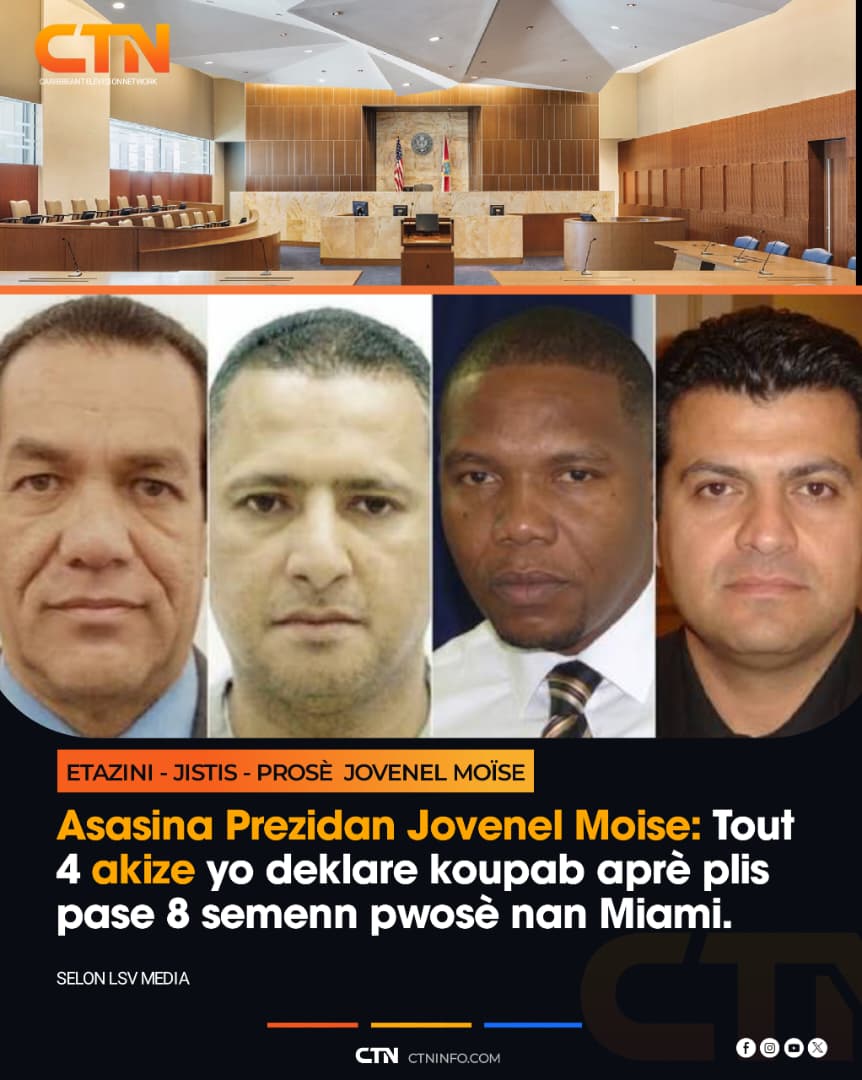


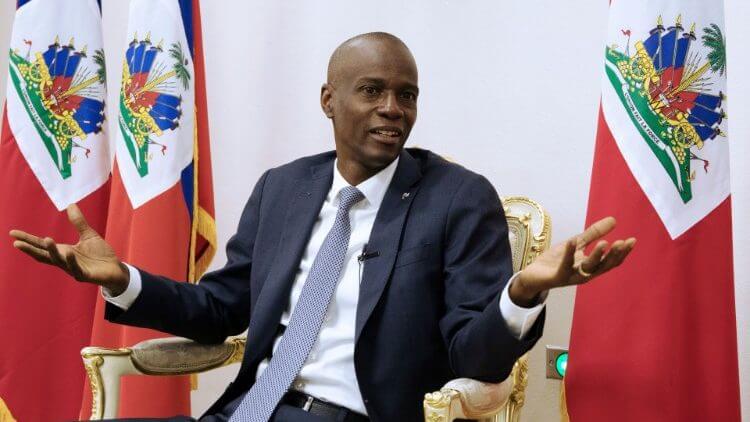
The four defendants – Arcángel Pretel Ortiz, Antonio “Tony” Intriago (owners of the CTU), James Solages (an employee of the CTU), and Walter Veintemilla (a mortgage broker from the Broward area) – have been found guilty by U.S. justice for conspiring to kidnap or kill Haitian President Jovenel Moïse, who was assassinated at his home in the hills above Port-au-Prince on July 7, 2021.
The verdict was delivered by a jury of twelve people before a federal court in Miami, nearly five years after the assassination, following 39 days of testimony spread over nearly nine weeks. The jury deliberated for two days, after having questioned the judge on one of the nine counts related to the delivery of bulletproof vests to mercenaries in Haiti.
Arcángel Pretel Ortiz and Antonio “Tony” Intriago, owners of the Counter Terrorist Federal Academy and Counter Terrorist Unit Security in Doral – collectively known as the CTU – were found guilty, alongside James Solages, who worked for the CTU, and Walter Veintemilla, a mortgage broker from the Broward area who, according to prosecutors, helped finance the plot.
All the men were accused of conspiring in South Florida and hiring a commando of former Colombian soldiers to violently overthrow the Haitian president, as part of a coup d’état that, initially planned to remove him from power, turned into an assassination attempt a few weeks before his death. The defense contested these allegations, claiming that the Haitian police and presidential security forces had killed Moïse before the Colombian commando arrived at his home, located on a hill, in the middle of the night.

But prosecutors argued that the South Florida group, in collaboration with a few key Haitians starting in April 2021, wanted to replace Moïse with a new president willing to grant them lucrative security and infrastructure contracts in Haiti.
“This case is very simple,” Principal Deputy Prosecutor Sean McLaughlin told jurors during his closing argument, as reported by the Miami Herald. “It is a case about greed, arrogance, and power.”
The jury found the four defendants guilty on five counts, including: conspiracy to provide material support, a terrorism-related charge, and conspiracy to conduct a military expedition against a friendly nation, in violation of the U.S. Neutrality Act, which prohibits American citizens from making war against a country at peace with the United States. Intriago, 63, was also prosecuted on four additional counts related to sending bulletproof vests to Haiti for about twenty former Colombian soldiers recruited by the CTU and sent to Port-au-Prince about a month before the killing.
Although the four defendants were tried simultaneously, jurors were instructed to consider them individually. A fifth defendant, Christian Emmanuel Sanon, a Haitian-born physician and pastor residing in South Florida, will be tried later for health reasons. Initially, the South Florida conspirators supported Sanon, 67, to succeed Moïse, 53, after his removal, but they abandoned him in favor of another political candidate – a Haitian Superior Court judge – in the weeks leading up to the assassination.
The four defendants could be sentenced to life in prison by U.S. District Judge Jacqueline Becerra. Well before the trial, six accomplices in the case had pleaded guilty to conspiring to kidnap or kill Moïse, or to a lesser charge of trafficking bulletproof vests to the Colombians. Two other individuals have also entered plea agreements after being charged with money laundering in connection with the plot.

The U.S. investigation relied on more than 40 witnesses, crime scene photos provided by the Haitian National Police, and some of the weapons used by the Colombian commandos. FBI agents collected 8,000 gigabytes of data from more than 100 electronic devices in the United States, Colombia, and Haiti. This evidence was contained in a 900-page summary of text messages and voice messages tracing the evolution of the plot: from the use of gangs to poisoning the victim, to detaining him at the airport upon his return from a trip abroad.
As the trial concluded Tuesday, McLaughlin told jurors that the defense could argue for hours, but that would not change the “overwhelming and devastating” evidence and testimony against the four defendants, according to the Florida newspaper.
“The United States has overwhelmingly proven the guilt of each of these defendants on every single count, for every single one of them,” he said, refuting defense attorneys’ attempts to portray the killing as an operation carried out by Haitians who used their clients as scapegoats. He also refuted efforts to question the credibility of Martine Moïse’s testimony – which differs from what she initially told FBI investigators after being airlifted to Jackson Memorial Hospital – and to portray Haiti as a corrupt country where even police evidence is unreliable.
In contrast, the investigation carried out in Haiti into the assassination of President Jovenel Moïse continues to drag on.
Former First Lady Martine Moïse has renewed her call for justice, 57 months after the assassination. In a message posted Thursday on the social network X, she accuses “criminal oligarchs and politicians” of having organized the assassination of her husband. She also asserts that certain actors have taken control of the executive and judicial apparatus in order to slow down proceedings and protect suspects involved in the case.
According to her, the evidence revealed during the hearings shows links between certain Haitian political, economic, and judicial sectors.