

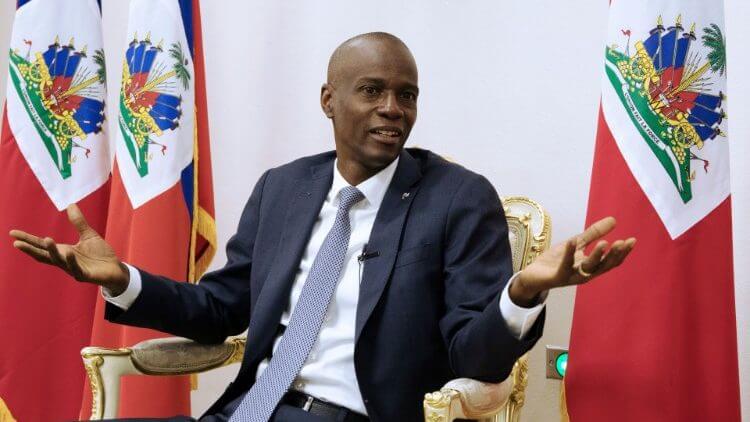
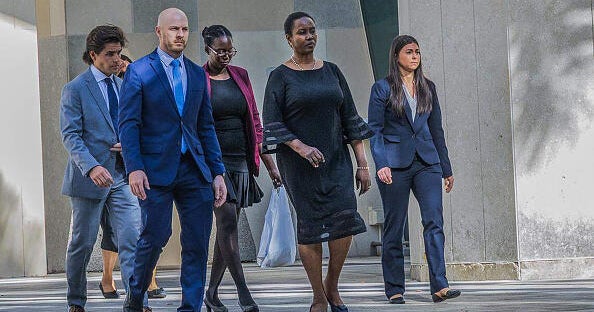
Nearly five years after Haitian President Jovenel Moïse’s assassination, his widow testified in a Miami federal courtroom, delivering pointed and emotional testimony that accused prominent Haitian political and business figures of involvement.
Martine Moïse, the former first lady of Haiti, was the prosecution’s first witness in the U.S. federal trial of four South Florida men accused of conspiring to kidnap or kill President Moïse. The four defendants — Arcangel Pretel Ortiz, Antonio Intriago, Walter Veintemilla, and James Solages — have pleaded not guilty. The trial, presided over by U.S. District Judge Jacqueline Becerra, is expected to last more than two months.
Testifying through a Haitian Creole interpreter, Martine Moïse directly accused former President Michel Martelly and former Prime Minister Ariel Henry of having connections to her husband’s death. She told the court she had filed a formal complaint accusing Henry of involvement in the case. She also accused members of Haiti’s powerful economic elite — influential businessmen who she says wanted Jovenel Moïse dead because he had terminated or renegotiated lucrative contracts they held with the Haitian state.
“They accuse me because the people who killed him are now in power in Haiti,” she told the court, in response to questions about why she herself had been placed under investigation by Haitian authorities in connection with the assassination.
“Honey, We Are Dead”
Martine Moïse recounted in harrowing detail the night of July 6 into July 7, 2021, when approximately two dozen foreign mercenaries — the majority of them former Colombian soldiers — stormed the couple’s private residence in the hills of Pétionville, outside Port-au-Prince.
She testified that she had gone to bed around 10 p.m. that night while her husband remained awake, working. Just after 1 a.m., she was jolted awake by gunfire. She turned to her husband beside her. “Honey, we are dead,” Jovenel Moïse told her, according to her testimony.
Martine Moïse said she dropped to her hands and knees and crawled to check on their two adult children. She found them together in a room and instructed them to hide in a windowless bathroom. She then crawled back to her husband’s side.
The couple used the bed as a shield as the shooting intensified. Men eventually burst into the bedroom, firing what sounded like an automatic weapon. Martine Moïse was struck multiple times. She said she heard the attackers speaking in Spanish before her husband was shot multiple times and killed. He suffered 12 gunshot wounds.
After the attack, she said she expected to find the bodies of the 30 to 50 security officers assigned to guard the residence, but found none. She later learned that some had been paid to abandon their posts before the assault began.
Moïse was taken to a nearby hospital for immediate treatment, then airlifted to Miami for emergency surgery. She told the court that her right arm remains permanently disabled from her wounds and that she continues to experience pain.
“Please forgive me,” she said at one point, addressing her late husband as she struggled to hold back tears. “I promised Jo I would never cry again.”
Accusations Against Martelly, Henry, and Haiti’s Economic Elite
Beyond the men on trial, Martine Moïse used her testimony to cast a wider net of responsibility, naming figures who have not been charged in the U.S. proceedings.
She told the court she believes former President Michel Martelly was connected to the assassination and leveled similar accusations against former Prime Minister Ariel Henry, who governed Haiti until 2024.
Martine Moïse also accused Haiti’s business elite, claiming Jovenel Moïse’s moves to cancel or renegotiate state contracts provided a direct financial motive for his killing.
This account echoes what Martine Moïse has said publicly before.
In the days following the assassination, she warned at her husband’s funeral in Cap-Haïtien that “raptors” — a term she used to describe corrupt oligarchs — were still at large in Haiti.
U.S. federal prosecutors allege that the four defendants conspired in South Florida to organize and finance the plot, motivated by what Assistant U.S. Attorney Sean McLaughlin described in his opening statement as “greed, arrogance and power.” According to prosecutors, the group sought to install a new president who would grant their associates access to lucrative government contracts in Haiti.
The conspirators initially backed Christian Sanon, a Florida-based pastor, as a potential replacement for Moïse. By June 2021, however, they concluded that Sanon lacked the constitutional qualifications and popular support to take power. They then turned to Wendelle Coq Thélot, a former Haitian Superior Court judge, who died in January 2025 while still a fugitive.
Defense attorneys have pushed back against the prosecution’s account. They argued that their clients were misled into believing they were supporting a lawful effort to arrest a president accused of corruption, and that they were working in coordination with FBI agents and U.S. Embassy officials.
The defense has pointed to Joseph Félix Badio — a former Haitian government official arrested in Haiti in 2023 — as the true mastermind behind the assassination plot.
Prosecutors also submitted a security camera video showing defendant James Solages telling co-defendants, “Jovenel is not leaving the country alive.”
A Landmark Trial with Wide Implications
The Miami trial is among the most significant legal proceedings in Haiti’s modern history, though it represents only one front in the sprawling investigation. Five other defendants previously pleaded guilty to conspiracy charges in U.S. federal court and have been sentenced to life in prison. A sixth person received a nine-year sentence for providing body armor to the conspirators. Christian Sanon’s trial has yet to be scheduled.
In Haiti itself, the investigation has been severely hampered by gang violence, death threats, and a crumbling judicial system. Seventeen Colombian soldiers and three Haitian officials face charges there, but proceedings have stalled.
For the Haitian diaspora and the Haitian public, the Miami proceedings represent the first real opportunity to hear a comprehensive account of what happened that night in Pétionville — and to begin to understand who, beyond the mercenaries, may have orchestrated the killing of Haiti’s last elected president.
Martine Moïse, closing her second day of testimony, said she remains driven by a single goal nearly five years after her husband’s death. “I am still seeking the same thing,” she told the court. “Truth and justice for Jovenel.”

https://ctninfo.com/?p=40581&preview=true
https://www.facebook.com/CaribbeanNewsMedia/
https://ctninfo.com/?p=40581&preview=true
https://www.facebook.com/CaribbeanNewsMedia/
Sources: Associated Press
CBS Miami
CBS Miami