

The State of Qatar announced Thursday, April 23, 2026, a $30 million contribution to Haiti’s Gang Suppression Force, strengthening international efforts to help the country regain control from powerful armed groups.
The contribution will be paid into a United Nations trust fund created to support the recently authorized force, Stéphane Dujarric, spokesperson for U.N. Secretary-General António Guterres, said, according to the Miami Herald.
With Qatar’s donation, the trust fund has now received a total of $203 million. Of the pledged contributions, including a donation made this week by Greece, $174.1 million has already been deposited.
The announcement comes as the Dominican Republic and other countries urge the international community to intensify support for both the Gang Suppression Force and the special trust fund that finances its operations.

Although deployment is underway, a significant gap remains between the number of personnel currently on the ground and the authorized ceiling of 5,500 troops. That shortfall represents “the main operational challenge at this stage,” Dominican Ambassador Wellington Bencosme said Thursday during a U.N. Security Council meeting on Haiti.
The Security Council, which authorized the U.S.-backed force in September 2024, received an updated briefing on its deployment. International support is now shifting from the Kenya-led Multinational Security Support Mission, known as the MSS, toward a broader coalition and a larger, more robust force.
Jack Christofides, the special representative overseeing the Gang Suppression Force, told the Council that the new multinational force would deploy in “phases” over the coming months.
“This new suppression force is taking shape in a structured and deliberate manner,” Christofides said.
“Pre-deployment training and integration are being prioritized to ensure that all incoming personnel are prepared to operate effectively in a complex and sensitive environment, and in full compliance with international standards,” he added.

Christofides declined to provide precise troop deployment figures but said a deployment plan had been developed, focused on priority areas and designed to leverage the specialized capabilities of contributing countries. At the same time, the deployment of civilian personnel is moving forward, and structures are being put in place to support planning, coordination, and intelligence-led mission control.
A finalized concept of operations now provides “a clear framework for how the mission will unfold in practice, particularly regarding integration with Haitian counterparts,” he said.
Christofides stressed that the mission is not starting from scratch.
“But we are approaching the situation differently,” he said. “The GSF is being established as a disciplined, accountable, and partnership-driven mission, designed to achieve targeted security objectives while respecting the highest standards of conduct and Haitian sovereignty.”
The Security Council met on Thursday as Haiti continues to confront both tentative electoral progress and persistent gang violence. Carlos Ruiz Massieu, the U.N. Secretary-General’s Special Representative, said Haiti is at a “pivotal moment.”
He welcomed the recent completion of political party registration — the first such process since 2016 — as well as updates to the electoral legal framework. However, he warned that crucial steps, including approval of the electoral budget, require immediate attention. Haitian stakeholders, he said, remain clear that elections are the only legitimate path toward restoring constitutional order.
On the security front, the situation remains “extremely concerning.” Massieu cited the recent Jean-Denis massacre on March 28 and 29, as well as attacks in Marigot on April 11. Today, more than 1.45 million people are displaced, mostly because of violence. Without tangible improvements in security, he warned, political progress could be erased.
Created on September 30 under Resolution 2793, the Gang Suppression Force is intended to help Haitian institutions regain control. Christofides said the force is not an end in itself, but a means to create the necessary space for the Haitian state to reassert its authority. Civilian protection and respect for human rights, he said, are central to the mission’s operations.
The United States, represented by Jennifer Locetta, welcomed the operationalization of the Gang Suppression Force while emphasizing that stability will not be achieved by force alone. Credible alternatives, she said, must be offered to the population.
Russia, through Ambassador Vassily Nebenzia, warned against foreign interference in Haiti’s electoral process and expressed concern about the circumstances surrounding the deployment, citing a bullet reportedly found on an aircraft carrying a Chadian contingent. He also called for avoiding a security vacuum during the withdrawal of the Kenyan contingent.
Kenya said it is imperative that the Gang Suppression Force become fully operational and receive adequate resources, as the transition from the MSS nears its conclusion.
The Dominican Republic urged the international community to redouble its efforts, stressing that political progress is just as essential as security gains for the country’s stability.
Haiti’s Prime Minister Issues Urgent Appeal
Haitian Prime Minister Alix Didier Fils-Aimé on Thursday called for the rapid deployment of the Gang Suppression Force.
“The urgency is absolute. The deployment of the GSF must take place without delay, while we also act over the medium term,” he said, urging the Security Council to provide “greater, rapid and concrete” support for the force’s deployment, particularly in logistical and financial terms.
Fils-Aimé said that, thanks to the Haitian Armed Forces, the Haitian National Police, and the Gang Suppression Force, several areas of the capital are gradually being retaken from gangs.
“Economic and social life is timidly but surely resuming there,” he said.
The Haitian head of government highlighted progress in strengthening the Haitian National Police and the Armed Forces of Haiti. His government, he said, has three priorities: restoring state authority, protecting the population, and preparing the return to constitutional order.
“Our conviction is clear: without security, no development is possible,” he said.
Strengthening Haiti’s Security Forces
In the immediate term, efforts are underway to reinforce the Haitian National Police. About 1,200 officers are already operational, and 887 others are on track to graduate. The goal is to reach a force of 2,500 to 3,000 officers by the end of 2026.
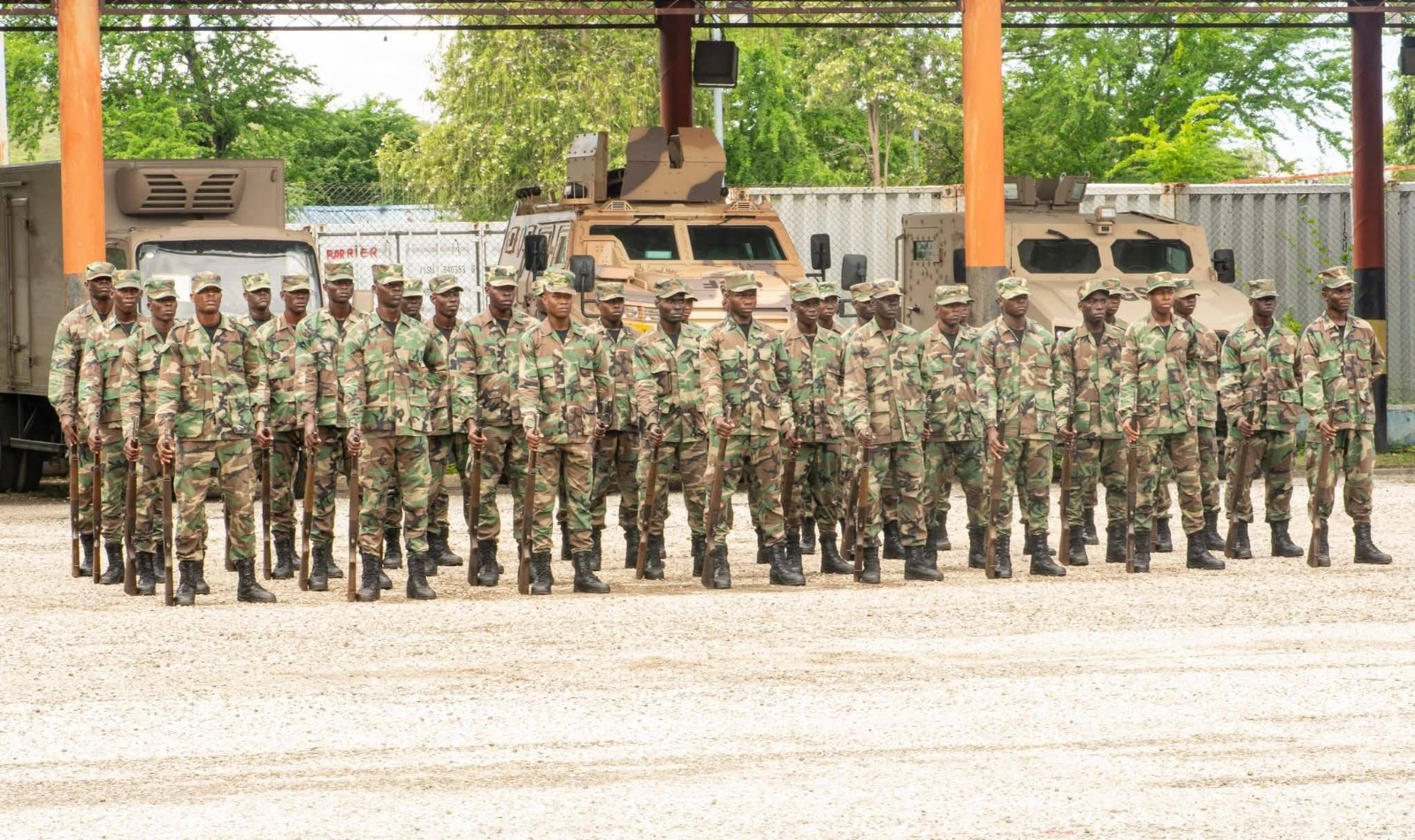
In addition, 338 new soldiers joined the ranks of the Haitian Armed Forces this week.
“To members of armed groups who continue to refuse to lay down their weapons, I reiterate — with the same firmness and urgency — that justice will be served, in full respect for human dignity and applicable laws,” Fils-Aimé said.
The prime minister also praised progress in the electoral process, reaffirming the goal of restoring citizens’ trust in democratic institutions.
“The Haitian people are not asking for charity, but for solidarity and the means to rebuild their future. Haiti resists, Haiti rises again, Haiti will live,” he concluded.
https://ctninfo.com/?p=42400&preview=true
https://www.facebook.com/CaribbeanNewsMedia