

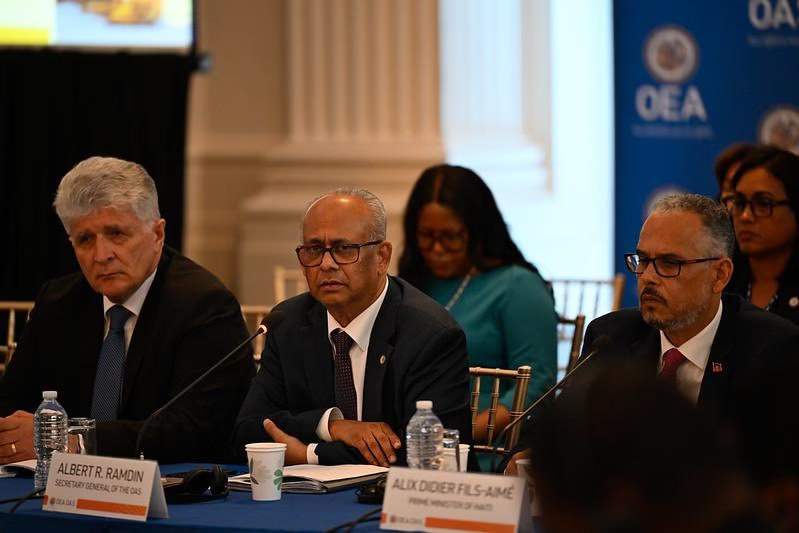
The Haitian crisis took center stage in Washington on Wednesday, August 27, 2025, during a meeting of the “Friends of Haiti” Group, convened by the Organization of American States (OAS). Around the table were permanent representatives from the OAS, United Nations, CARICOM, and the Group of Eminent Personalities (GEP). Prime Minister Alix Didier Fils-Aimé, accompanied by members of his government, “defended the priorities of Haiti’s transition.”
From the outset, the head of government expressed his gratitude to OAS Secretary General Albert Ramdin, welcoming the presentation of a new roadmap for Haiti. “This document, realistic and grounded in the realities of the field, provides a constructive foundation for guiding our country toward stability and peace,” he stated.
Security as Absolute Priority
In his address, Fils-Aimé emphasized the severity of the security crisis. Armed gangs still control more than 60% of Port-au-Prince and several strategic road networks, paralyzing the economy and isolating entire regions.
The Prime Minister announced a series of measures to “restore state authority”: regaining control of the capital’s administrative center, securing national roads, strengthening the Haitian National Police (HNP), and remobilizing the Armed Forces of Haiti (FAH).

He also advocated for a targeted lifting of the arms embargo to allow Haitian forces to equip themselves against heavily armed gangs. Finally, he called for strengthening the Multinational Security Mission, which is still considered too limited.
Elections and Governance
The Prime Minister reaffirmed the government’s commitment to organizing free and inclusive elections. According to him, significant progress has been made: 85% of voting centers have been identified, 70% of electoral staff has been mobilized, and $65 million has already been secured to finance the operation.
The government also aims to strengthen the National Identification Office (ONI) and ensure broader participation, including women, youth, and marginalized individuals.
On the institutional front, Fils-Aimé emphasized the need for profound reforms: combating impunity, judicial reform, and good governance. “We must end corruption and restore the rule of law,” he stressed.
A Worsening Humanitarian and Economic Crisis
Beyond security and elections, the Prime Minister painted a grim picture of the humanitarian situation in Haiti. More than 600,000 internally displaced people live in precarious conditions, with limited access to water, education, and healthcare. Less than 50% of the capital’s hospitals are functioning normally.

Economically, Haiti is experiencing its seventh consecutive year of recession. Inflation exceeds 40%, supply chains are disrupted, and the private sector is collapsing. “Our priority is to revitalize the economy from the bottom up, by supporting small and medium enterprises and developing two major regional hubs in the North and South,” emphasized Fils-Aimé, highlighting strategic sectors such as agro-industry, textiles, and renewable energy.
The OAS Roadmap: A $2.6 Billion Plan
The meeting primarily served as a platform for the OAS to present its new 2025-2028 roadmap, valued at $2.6 billion. This plan, which doubles initial projections, allocates $1.3 billion solely to security measures to combat gang violence.
Structured around five pillars: security, governance, elections, humanitarian aid, and economic recovery, the roadmap outlines a 36-month implementation period, with emergency actions planned for the first 30 days. The United Nations has expressed support for this comprehensive approach to Haiti’s recovery.
While the plan has been hailed as a strong signal of regional solidarity, questions remain: The United States has deemed that the security package might still be insufficient, while Argentina has expressed doubts about the clarity of funding and the OAS’s coordination capacity.
A Step, but Not an Immediate Solution
In conclusion, Prime Minister Fils-Aimé emphasized that the roadmap must become “a realistic and effective instrument, aligned with Haiti’s priorities.” He proposed establishing a joint monitoring committee between the OAS and the government to ensure concrete implementation.
Haiti’s crisis remains multidimensional: security, political, humanitarian, and economic. However, for the first time in several months, a clear framework with dedicated funding and international community support, including the United Nations, is taking shape.
The OAS roadmap does not represent a miracle solution, but it stands as a collective endeavor to prevent Haiti’s total collapse and chart the first steps toward restoring stability.