



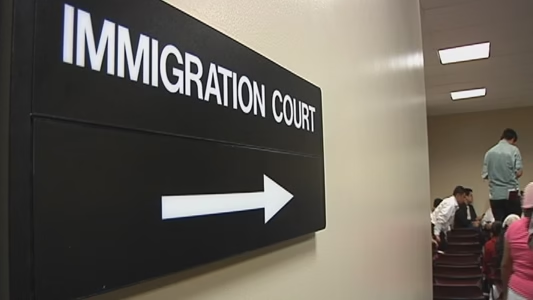
Ninety-four percent of asylum cases decided by U.S. immigration judges in June ended in denial, the highest rejection rate on record, according to an analysis by the Transactional Records Access Clearinghouse, the nonpartisan research center at Syracuse University known as TRAC, as reported by The Latin Times.
For Haitian immigrants, the timing could hardly be worse: asylum has become the main remaining option for hundreds of thousands who lost Temporary Protected Status this summer, and the data shows that option is now closing fast.
Just 771 people were granted asylum nationwide that month — a grant rate of about 5.5 percent, the lowest TRAC has ever measured, according to figures reported by the Latin Times and the Washington Examiner.
That is a collapse from recent years: as recently as June 2024 the denial rate was around 50 percent, and three years ago roughly 43 percent of applicants were approved.
More than 14,000 asylum cases were decided in June alone, one of the highest monthly totals TRAC has recorded, as courts race through a backlog that now exceeds three million cases.
The stakes are especially acute for the Haitian community. When the Supreme Court cleared the way in June for the administration to end Haiti’s TPS, and the designation formally lapsed in late July, roughly 350,000 Haitians lost both their work authorization and their protection from deportation. For many, an asylum claim is now the only legal avenue to remain in the country lawfully — the fallback when TPS disappears.
That avenue has never been easy for Haitians.
In TRAC’s nationality breakdowns from earlier periods, Haitian applicants faced denial rates of roughly 80 percent, among the higher rates for any nationality. CTN could not verify a current, Haiti-specific figure for 2026 in TRAC’s latest release, which reports the 94 percent denial rate across all nationalities combined. But with the overall rate now far above where Haitian denials historically sat, the direction is unmistakable, and it points toward a system in which a Haitian asylum seeker’s odds are lower than ever.
The steep drop coincides with a sweeping turnover on the immigration court bench. TRAC found that 279 immigration judges were fired or resigned during fiscal years 2025 and 2026 — about 38 percent of the 735 judges employed at the end of fiscal 2024. The administration has since hired 192 new judges this year and added 53 temporary ones, so that of the 743 judges who decided asylum cases in fiscal 2026, only 43 percent had been on the bench before President Trump returned to office, according to The Latin Times.
The shift is not limited to new appointees.
Among 130 judges who decided asylum cases continuously from 2021 through 2026, TRAC found that three-quarters denied a larger share of cases this year than in 2021, with denial rates rising by an average of 33 percentage points. TRAC itself cautioned that the makeup of the bench is only one factor, noting that legal representation, nationality, detention status, and the types of cases assigned all shape outcomes for each judge.
Not everyone reads the numbers the same way. Matt O’Brien, deputy executive director of the Federation for American Immigration Reform, which favors stricter limits, told the Arizona television station AZFamily that the figures could be misleading and that the courts are simply working through cases “as per usual,” arguing that some removed judges had not been doing their jobs.
If there is a lever within reach for asylum seekers, researchers say it is legal representation, and it is one many Haitians lack.
TRAC’s long-running research has found that immigrants with lawyers are roughly ten times more likely to win asylum than those who go it alone, yet a large share of applicants have no attorney at all. In a system that now denies the overwhelming majority of claims, the gap between represented and unrepresented applicants can mean the difference between staying and being ordered removed.

Where a case is heard matters too. TRAC has repeatedly documented enormous variation from judge to judge, even within the same courthouse — grant rates ranging from single digits to well over 80 percent depending on the judge assigned. The Boston Immigration Court, which serves much of New England’s Haitian population, has ranked among the courts with the widest spread between its most and least generous judges, meaning two Haitians with similar cases can meet very different fates depending on whose courtroom they enter.
The erosion did not begin this year.
TRAC found that asylum grant rates started falling during the Biden administration, sliding from above 50 percent earlier in his term to about 32 percent by its end, before the decline sharply accelerated. And the pressure on asylum seekers is set to intensify: the administration is preparing to revoke the business and tourist visas of up to 200,000 people who have applied for asylum, according to State Department documents and officials cited by the Associated Press, a move that, while it would not automatically trigger deportation for those with pending cases, adds another layer of jeopardy.
For a Haitian family that has already lost TPS, the data describes the path most of them have left: it now ends in denial in about 94 percent of cases, outcomes vary widely by judge, and the odds improve sharply only with a lawyer or a DOJ-accredited legal representative, which many applicants often do not have.
https://ctninfo.com/94-of-asylum-cas…ast-door-closing/
Source: The Latin Times
This article was originally written in English. Other language versions are produced using AI translation software, and errors are possible — the English version is authoritative. CTN also uses AI to convert text into audio.