

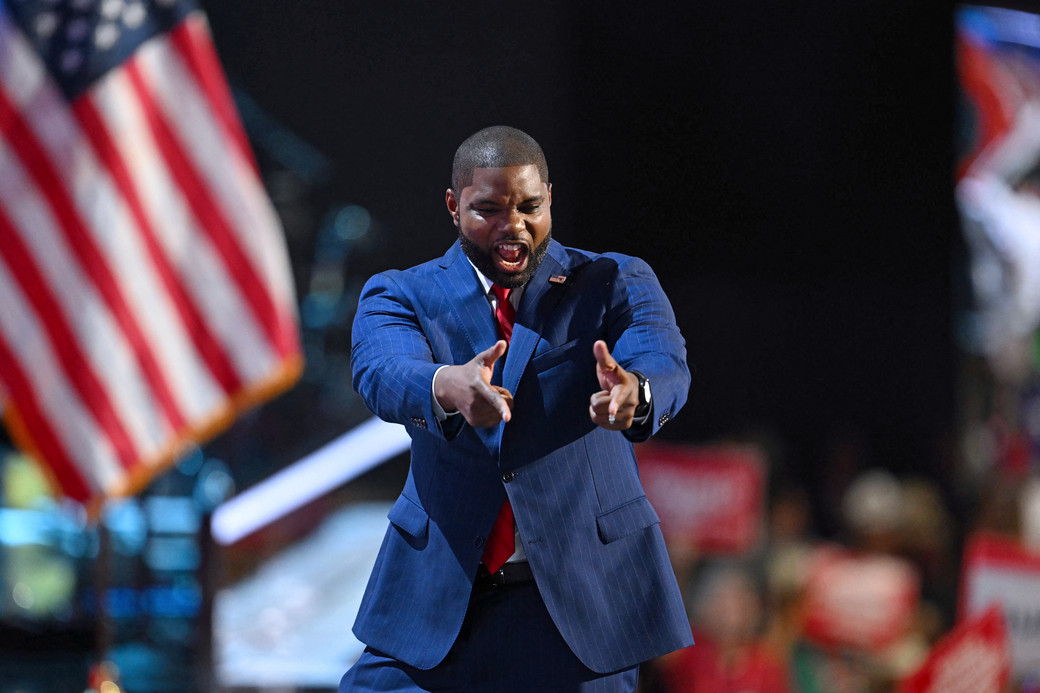
Rep. Byron Donalds, the Republican nominee for Florida governor, said this weekend that he is “working” with Haiti’s transitional government to help stabilize the country, using the argument to defend ending Temporary Protected Status for more than 300,000 Haitians in the United States. But the central factual claim behind his case, that Haitian authorities have clawed back a large share of the country from armed gangs, is contradicted by the assessments of the United Nations and independent monitors, who describe a security collapse that has only deepened.
Donalds, a Florida congressman who won the state’s Republican gubernatorial primary last week, made the comments Sunday on CBS News’s “Face the Nation.” Pressed by host Margaret Brennan on whether it was safe to send Haitians back, he pointed to his own contacts with officials in Port-au-Prince. “I’ve actually had meetings with the transitional government and the ambassador for the transitional government,” he said, adding that Haitian security forces “are working right now as we speak to begin to stabilize Haiti.”
Then came the claim at the heart of his argument: that the government has “gotten about a quarter to half of the country under control from the gangs that basically took over Haiti.”
That characterization runs sharply against the documented reality.
Armed gangs control roughly 90 percent of the capital, Port-au-Prince, according to the UN Office on Drugs and Crime and multiple independent analyses, and as of mid-2026 their reach had expanded beyond the capital into at least five of Haiti’s ten departments, the Global Center for the Responsibility to Protect reported. Since January 2022, more than 16,000 people have been killed and roughly 1.4 million displaced, and more than half the population does not have enough to eat.

The international response Donalds alluded to has struggled to gain traction. A Kenya-led Multinational Security Support mission that began deploying in 2024 never reached the strength needed to confront the gangs and remained underfunded and understaffed. In September 2025, the UN Security Council authorized its transition into a larger “Gang Suppression Force” of roughly 5,550 personnel with a more aggressive mandate, but that force was not expected to be fully deployed until late 2026. Analysts who track the crisis describe the gains by Haitian police and their international partners as real but fragile — symbolic victories against a criminal order that, in large stretches of the country, has effectively replaced the state.
The government Donalds referenced has also changed shape. The Transitional Presidential Council, which took office in 2024, saw its term end in February 2026 without fulfilling its mandate to restore security, giving way to an interim government led by Prime Minister Alix Didier Fils-Aimé.
Brennan put the contradiction to Donalds directly.
The U.S. State Department, she noted, tells Americans not to travel to Haiti for any reason, citing crime, kidnapping, terrorism, civil unrest, and the collapse of health care, and asked whether those very conditions were not the reason protection existed in the first place. That advisory, at the department’s highest “Do Not Travel” level, remains in effect.
Donalds did not dispute the dangers, but argued that a temporary program cannot be open-ended. TPS, he said, was never meant to run “into perpetuity with no end,” a structure he said creates “the wrong incentives” for people to return home and rebuild. He maintained that the Trump administration was right to treat the designation as temporary while, in his telling, Washington works with Haitian authorities to restore stability over time.
The stakes are especially high in the state Donalds hopes to lead.
As of January, roughly 158,000 Haitian TPS holders lived in Florida, according to the immigration advocacy group Fwd.us. The group estimates that Haitian TPS holders contribute about $2.6 billion each year to the state’s economy, with some 93,000 working in industries including agriculture, security, and nursing. Asked about the loss of those workers, Donalds suggested the gaps could eventually be filled by training younger residents to take their place.

The protection now being wound down dates to 2010, when the Obama administration first granted Haitians TPS after a catastrophic earthquake. The designation was renewed repeatedly over the following years as conditions in the country deteriorated rather than improved.
The U.S. Supreme Court cleared the end of Haiti’s TPS earlier this summer.
In a 6-3 decision split along ideological lines, the justices allowed the Trump administration to revoke the designation, ruling that federal judges lacked authority to review the challenge Haitian TPS holders brought. That reversed a February decision by U.S. District Judge Ana Reyes, who had paused the revocation. With the legal barriers cleared, the protections lapsed in late July, and the first deportation flights to Haiti have already begun.
For the hundreds of thousands of Haitians affected — and for the Florida communities where many of them live and work — Donalds’s message frames the end of TPS as a step toward a Haiti on the mend. The evidence assembled by the UN, humanitarian organizations, and Washington’s own travel warnings describes a country still gripped by the violence that made the protection necessary, with the force meant to reverse it not yet fully in place.
https://ctninfo.com/the-republican-n…ountry-after-tps/
Source: The Hill
This article was originally written in English. Other language versions are produced using AI translation software, and errors are possible — the English version is authoritative. CTN also uses AI to convert text into audio.