


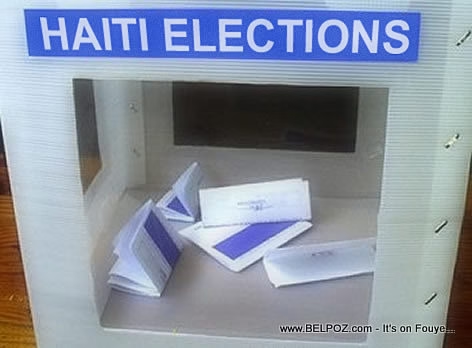
Port-au-Prince, Haiti- As the period for filing candidacies for the upcoming elections opened this Sunday, September 13, and runs through September 22, the Provisional Electoral Council (CEP) is undergoing a leadership change. Pastor Peterson Pierre-Louis is preparing to succeed Jacques Desrosiers as president of the institution, a transition that comes at a pivotal moment in the electoral calendar.
According to information confirmed by several sources, the nine councilors unanimously approved the new composition of the CEP’s executive bureau. Peterson Pierre-Louis, who until now held the position of secretary general, takes over the presidency. Jaccéus Joseph retains the vice-presidency, Nemrod Sanon moves from treasurer to secretary general, and Schnaïda Adély becomes treasurer.
An electoral process already well underway
This reshuffle comes as several key stages of the process have already been completed. The electoral calendar, published on July 27, sets the first round of the presidential and legislative elections for December 13, 2026, with a second round planned for February 21, 2027, and final results to be published on March 7, 2027.
The registration of parties and political groupings was the first major phase. As of August 5, seventeen political groupings bringing together 227 of the 316 approved parties had already been registered, and the registration period for groupings ran from August 10 to 14. On July 31, the DELIVRANS Platform, which brings together ten parties, officially confirmed its registration with the CEP.

Voter registration began on July 20 in departmental capitals and in the West, then progressively expanded to other areas of the country.
Initially scheduled from August 20 to October 2, the candidate registration period was extended until October 14 at the request of several parties and political groupings. This extension led to a readjustment of all activities: online registration continues until September 20, file review will run from September 13 to 28, and the preliminary list of candidates will be published on September 29.
Filing procedures adapted to conditions on the ground
For the document filing period now open, the CEP has established differentiated procedures by constituency. Senate candidates must file with the Departmental Electoral Bureau (BED) of their department, while candidates for the Chamber of Deputies and territorial collectivities must, in principle, file with the competent Communal Electoral Bureaus (BEC).
In the West, candidates for the presidency and the Senate will file their documents at BED Ouest I, located at the CEP annex on Route de Frères. Special provisions concern several constituencies, including Carrefour, Gressier, Kenscoff, Cabaret, Cornillon/Grand-Bois, Croix-des-Bouquets, Fonds-Verrettes, Ganthier, Thomazeau, and Port-au-Prince III. In the Artibonite, candidates from Grande-Saline, La Chapelle, Liancourt, Marchand-Dessalines, Montrouis, Petite-Rivière de l’Artibonite, and Verrettes must go to the Artibonite BED, while those from Mirebalais and Saut-d’Eau will fall under the Center BED.
Security: the central equation of a calendar under tension
Despite these procedural advances, the shadow of the security crisis hangs over the entire process. The CEP itself has conditioned compliance with the deadlines on “the establishment of an acceptable security climate” and “the financial resources necessary to continue electoral operations.”

This warning is not rhetorical. According to an analysis by the Table de la Relève Nationale (TRN) published in August, nearly 30% of the potential national electorate – approximately 2.17 million adults – resides in communes where access to voting centers could be severely disrupted by insecurity. The identified perimeter notably includes Port-au-Prince, Carrefour, Delmas, Cité Soleil, Croix-des-Bouquets, Saint-Marc, Dessalines, Petite-Rivière de l’Artibonite, and Verrettes.
The TRN emphasizes an essential distinction: “Abstention and exclusion are not equivalent.” A citizen who chooses not to vote is not in the same situation as a person prevented from registering or moving about because of violence. In the hypothetical scenario of total inaccessibility of the studied perimeter, the organization estimates at approximately 363,600 the number of potentially uncast ballots – a figure comparable to the margins that separated the main candidates in the 2011 and 2016 presidential elections.
Specialists consulted on the electoral process agree: holding credible elections will depend on the State’s ability to guarantee secure access to voting centers and protect voters and electoral personnel.
A race against the clock
Three months before the first round, the CEP must therefore juggle several challenges simultaneously: finalizing candidate registration, publishing the final lists, organizing the logistics of the vote, and, above all, creating the minimum conditions that allow citizens to vote in a secure environment.
Several political groups have already expressed reservations about the calendar, estimating that “current conditions could affect the security of voters, candidates, and electoral agents.” They are calling for a clear security plan and denounce the absence of provisions allowing participation by the diaspora.
The new CEP bureau thus inherits a complex dossier, in which the technical advances of the process collide with the brutal realities of a country where armed groups control vast portions of the territory. The success of the December vote will depend less on the political will of the actors than on their ability to meet this security challenge.
https://ctninfo.com/the-haitian-elec…-security-crisis/
https://www.facebook.com/CaribbeanNewsMedia