

Port-au-Prince, Friday, April 17, 2026 — By launching the pilot project “Return to the Neighborhoods,” the Haitian government has embarked on an ambitious operation aimed at “restoring the dignity of displaced populations, revitalizing the local economy, and sustainably re-establishing the presence of the State” in the hardest-hit areas of the capital.
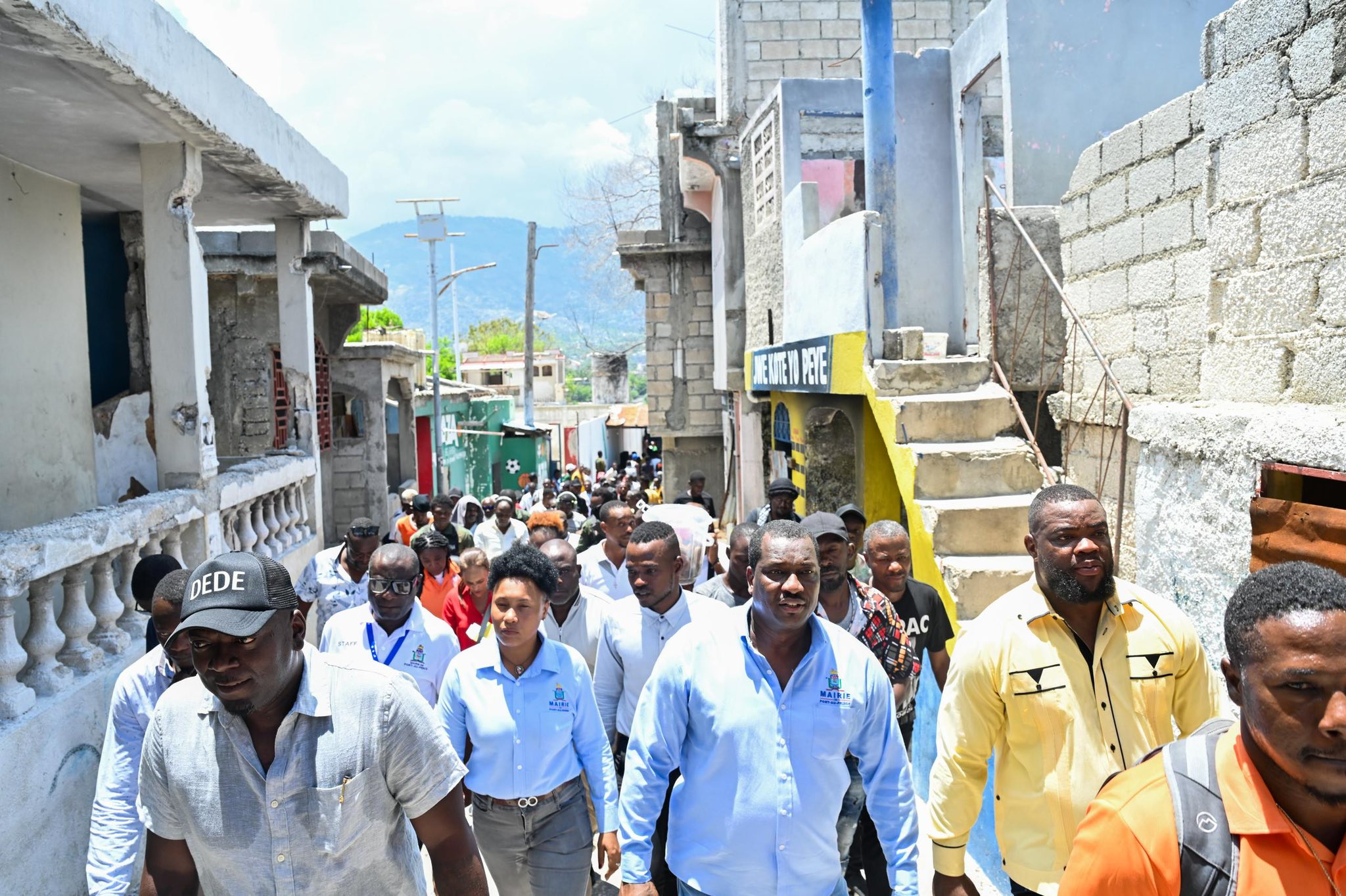
Carried out on the instructions of Prime Minister Alix Didier Fils-Aimé, this initiative has entered a concrete phase with an official visit to Solino this Friday by a high-level government delegation, according to a statement from the Prime Minister’s Office. The objective: to assess the damage, listen to residents, and accelerate the implementation of a structured reconstruction plan.
Led by the Prime Minister’s Office, several institutions are mobilized, including the ULCBP, the Port-au-Prince City Hall, DINEPA, Civil Protection, and various relevant ministries. For the executive branch, the focus is now on coordinated action.
The delegation included the Minister of Youth, Sports, and Civic Action, Pythagore Dumas; the Principal Mayor of Port-au-Prince, Yves Andrel Salomon; the project coordinator, Pascale Oriolle; as well as representatives from the Ministry of Public Health and DINEPA.

Speaking on behalf of the Prime Minister, Minister Dumas announced urgent measures to support affected residents. He also unveiled a large-scale national training program for 5,000 young people, focused on promising trades such as welding, motorcycle repair, and solar energy.
Beyond the immediate emergency, the executive branch is demonstrating a deep-rooted strategy: to offer young people prospects in order to curb exclusion and rebuild the social fabric.
According to Pascale Oriolle, this field mission marks the launch of a long-term rebirth project for Solino. Municipal authorities struck a similar tone, promising sustainable support for the families involved.
Enhanced security, social assistance, psychosocial support, public space sanitation, and the restart of economic activities are among the initial priorities identified.
Former President-Councillors Leslie Voltaire and Edgar Leblanc Fils, along with Prime Minister Alix Didier Fils-Aimé, had visited Solino on Saturday, December 20. The neighborhood in Port-au-Prince had returned to calm after more than a year of gang terror.

Presented by authorities as a “strong political act” marking the “concrete return of the State,” this outing under the “Return to the Neighborhood” program had sparked both hope and skepticism among the displaced, who are waiting for concrete action and lasting security.
For the first time in over a year, senior state officials were able to enter the Solino neighborhood.
Solino, like many neighborhoods in the metropolitan area, had been under the yoke of the “Viv Ansanm” criminal coalition for more than a year. Gangs sowed terror, forcing thousands of residents to flee. Businesses and homes were systematically looted and then set on fire, leaving behind a landscape of ruins.
In August 2025, the leader of “Viv Ansanm,” Jimmy Chérizier, alias “Barbecue,” paradoxically called for calm, inviting the displaced to return.
No large-scale law enforcement operation was carried out in Solino to retake the neighborhood from the gangs. The armed groups themselves made the decision to withdraw.