

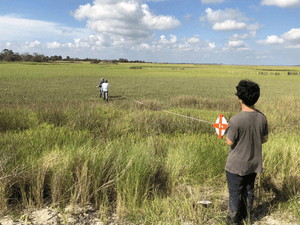

Credit: Joel Kostka Lab
Salt marshes cover much of the state of Georgia’s coast and perform key “ecosystem services” for people. They clean the water, protect coastlines against storm surges, and provide a habitat for fish and shellfish. A new study from a team of Georgia Tech School of Biological Sciences researchers finds that a species of grass that dominates those marshes has bacteria in its roots and surrounding soil that affects productivity by providing nutrients, highlighting the importance of soil microorganisms in the entire ecosystem.
The study, “The core root microbiome of Spartina alterniflora is predominated by sulfur-oxidizing and sulfate-reducing bacteria in Georgia saltmarshes, USA” is published in Microbiome. The research team includes Georgia Tech Ph.D. students Jose Rolando (the study’s lead author) and Tianze Song; Max Kolton, a former postdoctoral researcher, now senior lecturer and principal investigator with Ben-Gurion University of the Negev in Beer Sheva, Israel; and corresponding author Joel Kostka, professor and associate chair for Research in the School of Biological Sciences with a joint appointment in the School of Earth and Atmospheric Sciences, who is also a member of Georgia Tech’s Center for Microbial Dynamics and Infection.
The study shows that diverse and abundant microbes associated with spartina cordgrass help mineralize sediment organic matter and release bioavailable nutrients to the plant, suggesting that the microbes help support plant productivity.
The work could…