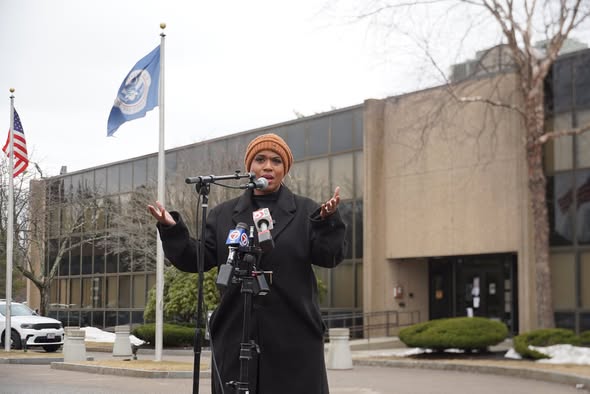
Congresswoman Ayanna Pressley provides details on the TPS discharge petition.
In a recent WCVB interview, the Massachusetts 7th District representative said the House will soon hold a full floor vote on her discharge petition to extend Temporary Protected Status for Haitian nationals. Pressley noted that she has secured 218 signatures and is confident these will translate into the votes needed to pass the bill, outlining these as the immediate next steps once Congress reconvenes.
“When I return to Washington, and we are back in session, that discharge petition has seven days to ripen — two days to call the question, to call the vote,” Pressley told WCVB. “I have every reason to believe those signatures will hold, translate to votes, and pass the House. Then we take this right to the Senate.”
The House is on its Easter/Passover recess from March 27 to April 13. Congress returns the week of April 14, when the seven-day period Pressley referenced will begin.
A Historic Legislative Maneuver
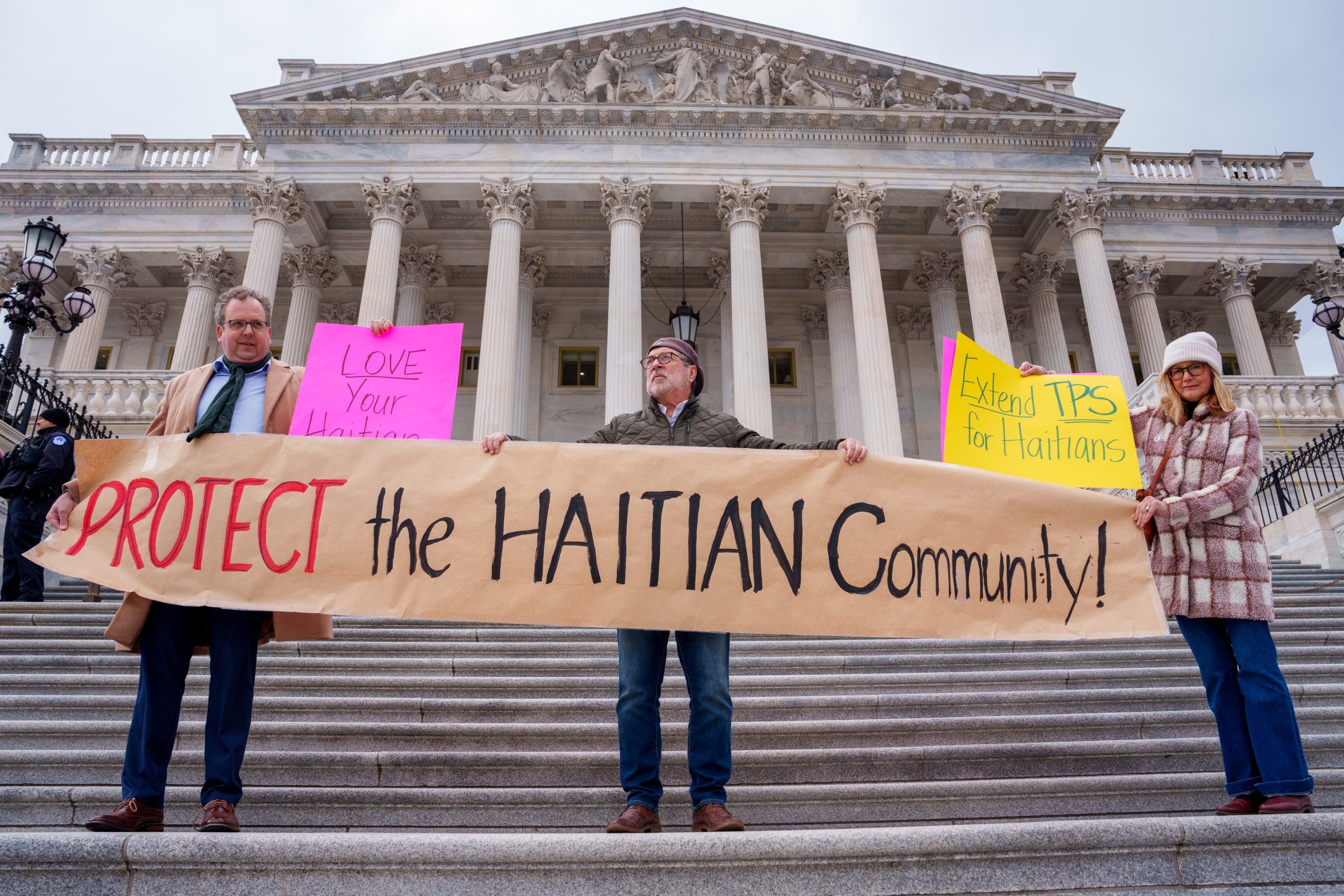
Discharge Petition No. 119-15 reached 218 signatures with bipartisan support on March 28. It seeks to bypass the House Rules Committee and bring H.Res. 965 to a floor vote, allowing immediate consideration of H.R. 1689. This bill requires the Department of Homeland Security to extend TPS for Haiti for an additional 3 years.
Pressley placed the achievement in historical context during the interview, noting the rarity of what her office accomplished.
“Due to Congressional dysfunction, we’ve had to use a discharge petition to force votes on major issues, such as the Epstein files and the Affordable Care Act,” she said. “In 40 years, only 15 discharge petitions have reached the 218-signature threshold—mine is one of them.”
The congresswoman credited her office’s strategy, effective whip operation, and a broad national coalition for this achievement. The petition garnered the support of every House Democrat and four Republicans: Maria Elvira Salazar, Brian Fitzpatrick, Mike Lawler, and Don Bacon. Marie Gluesenkamp Perez was the 218th signatory.
“This Is a Matter of Keeping Families Together”
Pressley emphasized the stakes of the TPS fight, framing it in humanitarian and economic terms.
“There are 350,000 Haitian nationals in this country. I represent the third-largest Haitian diaspora in the country. I co-chair the House Haiti Caucus,” she said. “And for me, this is a matter of keeping families together.”
Pressley described the prospect of deporting Haitian TPS holders as tantamount to condemning them to grave danger.
“Deporting those Haitian nationals back to a politically destabilized Haiti—ravaged by natural disasters, presidential assassination, and rampant gang violence—is a death sentence,” she said.
She cited the economic risks of ending TPS, spotlighting industries where Haitian nationals are essential. “Threatening families and industries—health care, construction, hospitality—is why I’m leading this fight,” Pressley said.
According to data cited by advocates at a January 2026 press conference organized by Pressley, immigrants make up one in four long-term care workers and over 30 percent of nursing home support roles nationwide; over 20 percent of Haitians nationwide work in health care.
The Road Ahead: Floor Vote, Then the Senate
Once a discharge petition reaches 218 signatures, House rules set a seven-legislative-day waiting period, then a vote within two more legislative days. With Congress in recess, the clock has not started. When lawmakers return on April 14, the ripening period starts, and a vote could occur by late April.
Pressley expressed confidence that the vote would succeed. “I have every reason to believe that those signatures will hold, translate to votes,” she said. “It will pass the House. And then we take this right to the Senate.”
If the bill passes the House, it goes to the Senate, where prospects are uncertain. It needs 60 votes to beat a filibuster. The Trump administration opposes extending TPS for Haitian nationals.
The Legal and Political Backdrop
The legislative push coincides with active legal battles over Haitian TPS. In February 2025, the Trump administration moved to end TPS for Haiti, which was set to expire on February 3, 2026. A federal district court in Washington, D.C., issued a temporary restraining order before the deadline. The D.C. Circuit upheld that ruling in March 2026. The administration has appealed to the Supreme Court, which is expected to hear arguments on TPS cases this spring. Current TPS protections and work authorizations for Haitian beneficiaries remain in effect under the court order.
The discharge petition offers a legislative approach alongside the ongoing litigation. Even if courts permit terminating TPS, passing H.R. 1689 would create a separate legal basis for extending Haiti’s TPS designation three more years.
In January 2026, Pressley and Senator Ed Markey (D-MA) held a Massachusetts field hearing on extending TPS for Haiti, with testimony later entered into the Congressional Record. That month, Pressley also led a Washington press conference to highlight the impact of TPS termination on seniors and the U.S. care economy.
Haiti received TPS in 2010 after an earthquake killed an estimated 220,000 people and displaced over a million. The designation has been extended several times due to ongoing instability, including the assassination of President Jovenel Moïse in 2021 and ongoing gang violence, displacing hundreds of thousands and leaving much of Port-au-Prince under the control of armed groups.
Greater Boston has one of the largest Haitian communities in the U.S., with about 80,000 residents—many in Pressley’s 7th Congressional District.