



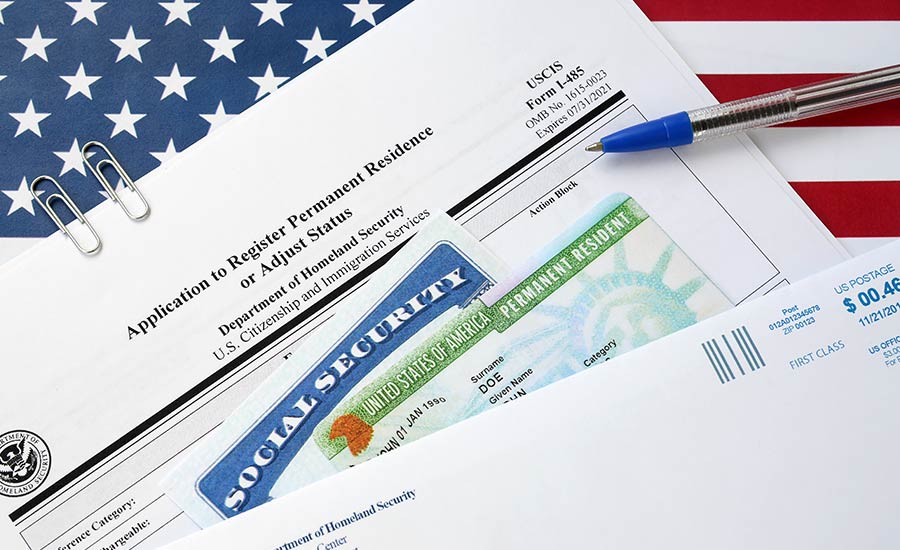
U.S. Citizenship and Immigration Services will require a new edition of Form I-485, the application to register permanent residence or adjust status, beginning Sept. 18, 2026, and will reject older versions filed on or after that date.
The agency announced the change in a notice to stakeholders, emphasizing that there is no grace period.
Form I-485 is the application most people already in the United States use to apply for a green card, or lawful permanent residence. The revised edition, dated 09/18/26, replaces the 01/20/25 version.
USCIS said it will accept the older 01/20/25 edition only if the application is postmarked or submitted electronically before Sept. 18; on or after that date, it will accept only the new edition and reject the old one.

The agency has posted a preview of the new form and instructions but told applicants not to file the new edition before Sept. 18.
The form is being updated to match a new federal rule on the “public charge” ground of inadmissibility, a long-standing part of immigration law that can bar people considered likely to depend on government assistance.
The Department of Homeland Security published the rule in the Federal Register on July 20, and it takes effect the same day as the new form, Sept. 18. USCIS issued detailed guidance for its officers in August.
The rule rescinds a 2022 regulation and changes how officers judge whether a green-card applicant is likely to become a public charge. Under the 2022 standard, officers could weigh only a narrow set of benefits, chiefly cash aid for income support and long-term institutional care, and applied a test of whether a person would be “primarily dependent” on the government.
The new rule removes that bright-line test and restores broad, case-by-case discretion, allowing officers to consider a wider range of means-tested public benefits, including non-cash assistance for needs such as food, housing and health care. DHS has said the change reflects the principle that immigrants should be self-sufficient and not rely on taxpayer-funded benefits.
Immigrant-advocacy organizations have criticized the shift, warning that wider discretion and the consideration of more benefits could make outcomes less predictable and discourage eligible families from using assistance they qualify for.
The public charge ground applies to most people seeking green cards through family, employment, or the diversity visa, whether they adjust status inside the United States or apply for an immigrant visa abroad. It can also affect green-card holders who spend more than 180 days outside the country and are treated as seeking admission when they return.

A number of categories remain exempt by law, and USCIS guidance confirms those exemptions stand.
Refugees, people granted asylum, VAWA self-petitioners, applicants for T and U visas, Special Immigrant Juveniles and Cuban Adjustment Act applicants, among other humanitarian categories, are not subject to the public charge test. Current green-card holders renewing their status are not affected, and the public charge test does not apply to naturalization.
The guidance also revives the use of “public charge bonds.”
If an applicant is found inadmissible only on public charge grounds, an officer may, at their discretion, allow the person to post a bond, using Form I-945, as a financial guarantee. The minimum bond is $1,000, set case by case, and can run much higher; USCIS materials include benefit projections of up to roughly $53,430 over five years for certain adults without children and about $42,000 for certain adults with children.
For applicants near the deadline, timing carries weight.
Filing a complete application before Sept. 18 keeps a case under the current form and the current rules; filing on or after that date means the new form and the new standard.
Immigration attorneys have cautioned that a rejection over an outdated form edition can be costly for anyone facing a visa availability window, an expiring status, or an age-out deadline, and they advise confirming the correct form edition on uscis.gov on the day of filing.
What applicants should know
- Deadline: The 01/20/25 edition is accepted only if postmarked or e-filed before Sept. 18, 2026. The 09/18/26 edition is required on or after that date.
- No grace period: There is no overlap window. USCIS will reject the wrong edition filed on or after Sept. 18.
- Do not file early: USCIS will not accept the new edition before Sept. 18.
- Check the edition date: Confirm the current form version on uscis.gov the day you file.
- What public charge is not: It applies when someone is seeking a green card or admission. It is not a reason to take away a green card someone already holds, and it does not apply to naturalization.
- Exempt categories: Refugees, asylees, VAWA self-petitioners, T and U visa applicants, Special Immigrant Juveniles, and Cuban Adjustment Act applicants remain exempt.
This article is general information, not legal advice. Public charge determinations are made case by case, and consular cases, benefit histories, and bond questions can be complex. Anyone with a pending or upcoming green-card application should verify details on uscis.gov and consult a licensed immigration attorney or an accredited representative about their specific situation.
This article was originally written in English. Other language versions are produced using AI translation software, and errors are possible — the English version is authoritative. CTN also uses AI to convert text into audio.
https://ctninfo.com/?p=44244&preview=true
https://www.facebook.com/CaribbeanNewsMedia