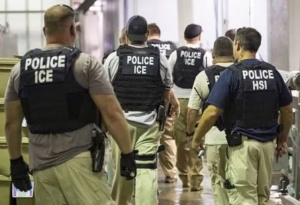


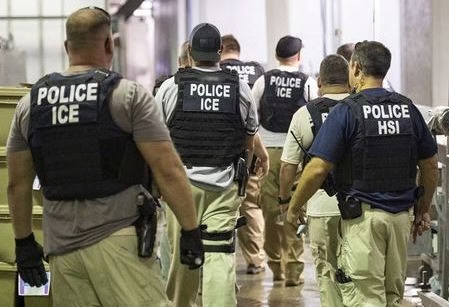
Louisiana Republican leaders are at odds over federal immigration enforcement efforts in the Bayou State, as Border Patrol agents seek to arrest 5,000 people, The Hill reports.
Lt. Gov. Billy Nungesser, a Republican, said local residents who are living legally in the state have expressed concerns.
“I think the president needs to take a step back and look at what’s going on and try to relieve some of the fear in these communities for the people that are here legally,” he said in an interview, according to local outlet 4WWL.
The Trump administration has launched several targeted immigration enforcement operations in various states in recent weeks with the goal of removing immigrants in the country illegally.
In addition to Louisiana, North Carolina, Illinois, California, New York, and Florida have been subject to heightened detention and removal efforts.
Agents have reportedly apprehended people at places of worship, schools, and businesses.
“It’s home builders, it’s restaurants, it’s hotels — people aren’t showing up for work,” said Nungesser, who is in charge of Louisiana’s tourism efforts, in an interview.
“How long is it going to continue?” he asked. “Did they say we’re gonna be here for two weeks, for two months, or we’re gonna be here until 12 million people are detained? What is that going to cost the economy?”
These questions underscore growing economic concerns about large-scale immigration operations, particularly in a state where tourism and hospitality are major economic sectors.
Governor’s Firm Stance
However, the office of Gov. Jeff Landry, also a Republican, has adopted a diametrically opposed position, stating that undocumented immigrants should be swiftly removed.
“It is disappointing that he would seek to give individuals who enter our country illegally and then commit crimes greater rights than American citizens,” said Kate Kelly, Landry’s spokesperson, when asked to comment on the lieutenant governor’s statements, according to The New Orleans Advocate.
“When an American citizen commits a crime, they are held accountable under the law and face jail time — the same standard should apply to everyone,” she added.
This public disagreement between two senior Louisiana Republican officials reveals growing tensions within the party over how to implement the strict immigration policies promised by President Trump.
On the one hand, Lt. Gov. Nungesser expresses the practical concerns of communities and economic sectors affected by the operations, highlighting their impact on the workforce and local economy. His position reflects the concerns of legal residents who fear being caught in the net of immigration operations or who see their communities disrupted.
On the other hand, Gov. Landry maintains a hard line, favoring strict law enforcement without consideration for short-term economic or social consequences.
This division within Louisiana’s Republican leadership illustrates a broader dilemma facing conservative elected officials: how to reconcile support for President Trump’s immigration agenda with the economic and social realities of their states.
Operation “Catahoula Crunch”
The ongoing operation in New Orleans, named “Catahoula Crunch,” has already led to more than 250 arrests. The stated goal of 5,000 arrests represents an unprecedented scale for an immigration operation in a single state.
Apprehensions at sensitive locations such as places of worship and schools have particularly fueled criticism, including from some Republican officials like Nungesser, who are concerned about the impact on local communities.
This controversy comes as the Trump administration intensifies its immigration enforcement efforts across the country, seeking to fulfill its campaign promise to conduct the largest deportation operation in American history.
The debate in Louisiana could foreshadow similar tensions in other states where large-scale immigration operations are underway or planned, pitting national political imperatives against local economic and social realities.