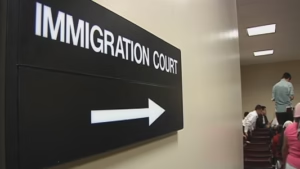
Immigrants who appear before immigration judges will no longer face arrest under the Trump administration’s 2025 courthouse-enforcement policy, after a federal judge ordered the practice halted nationwide.
The ruling, issued Tuesday by U.S. District Judge P. Casey Pitts in California, invalidates policies that opened the door for Immigration and Customs Enforcement officers to make civil arrests at immigration courts. The decision is a major rebuke of the administration’s efforts to use court appearances as opportunities for immigration enforcement, according to CNN.
For months, immigration lawyers and community organizations have warned that courthouse arrests were discouraging people from attending hearings that are often required to pursue asylum, challenge deportation, or request other forms of immigration relief. In some cases, immigrants were reportedly detained after leaving a hearing or while inside courthouse buildings.
Judge Pitts concluded that the administration did not adequately explain why it abandoned prior limits on immigration arrests in or around courthouses.

In his ruling, Pitts said the policy failed to confront the “chilling effect” that courthouse arrests could have on people required to attend proceedings.
He found that the government had not sufficiently addressed the consequences of making immigrants fear that complying with a judge’s order to appear could place them at risk of detention.
The court determined that the administration’s approach was “arbitrary and capricious,” a legal finding that means an agency acted without the reasoned explanation required under federal administrative law.
The case focused on policies adopted in 2025 after the Trump administration withdrew earlier guidance that had treated courthouses as sensitive locations for immigration enforcement. The previous restrictions did not prohibit all arrests, but they generally limited enforcement in court settings to exceptional cases.
Trump administration officials argued that those limits made it harder for ICE to take custody of people with removal orders or individuals considered threats to public safety.
The judge rejected the government’s explanation as insufficient, particularly because the policy did not account for the impact on immigrants who must attend court to defend themselves in removal proceedings.

Jordan Wells, a senior staff attorney with the Lawyers’ Committee for Civil Rights of the San Francisco Bay Area, welcomed the decision in comments to CNN.
“The courthouse is meant to be a refuge for the pursuit of justice, not a hunting ground for ICE,” Wells said.
Wells added that immigrants should not have to choose between protecting their liberty and appearing in court.
The ruling applies nationwide, meaning ICE cannot continue relying on the 2025 policy to make civil immigration arrests at immigration courthouses while the order remains in effect.
DHS General Counsel James Percival sharply criticized the decision in a post on X. He argued that people ordered removed by immigration judges should be taken into custody and described the ruling as judicial overreach.
The administration may seek to challenge the order on appeal. But the decision immediately changes the legal landscape for immigration courts across the country, including those in Boston, New York, Miami, Chicago, and San Francisco.
For immigrants with pending cases, the ruling restores an important safeguard: appearing in court to comply with a judge’s instructions should not, by itself, expose someone to arrest under the policy struck down by the court.
Source note: This article was independently written by Caribbean Television Network. It is based on reporting first published by CNN journalist Priscilla Alvarez, as well as reporting by Reuters and the Associated Press on Judge P. Casey Pitts’ nationwide ruling.