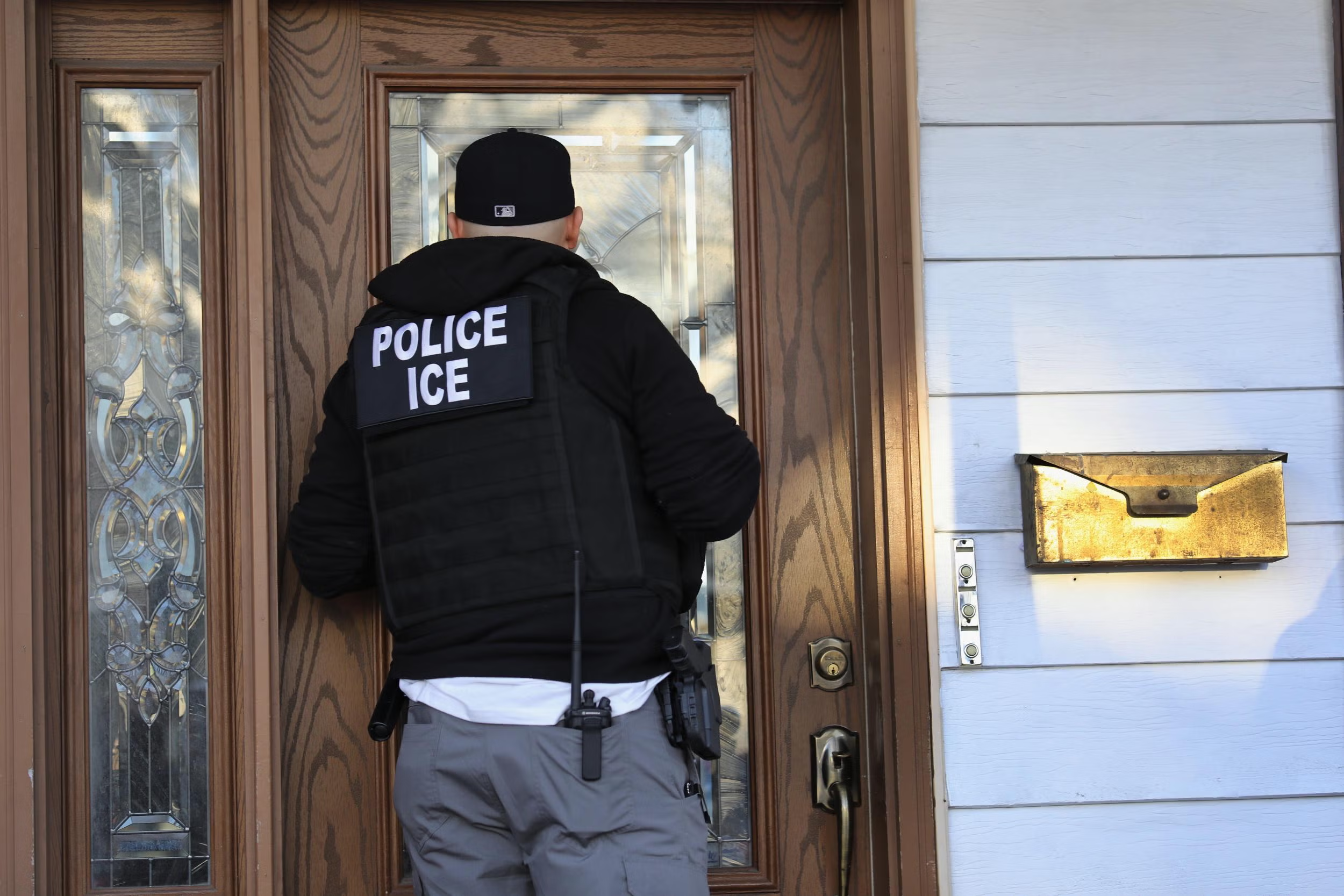



The BPS has ordered that no ICE agent may enter any Boston public school without a federal judicial warrant.
In a letter sent to all parents on Tuesday, March 3, 2026, the district confirmed that concrete measures are in place to prevent Immigration and Customs Enforcement agents from accessing school buildings without judicial authorization.
In the letter, Superintendent Mary Skipper stated that the district’s visitor policy prohibits any unauthorized adult — including federal immigration agents — from entering a school building during school hours unless they present a court-issued warrant or a legally issued subpoena.
The decision comes as reports circulate that ICE agents have been operating in plainclothes across several Boston neighborhoods, heightening fear among immigrant families throughout the city. The communication also follows the Trump administration’s January 2025 decision to abolish the “sensitive locations” policy that had shielded schools, hospitals, and houses of worship from ICE arrest operations since 2011.
More than 46,000 children are enrolled in Boston public schools. A significant number of them are the children of immigrants. Haitians represent the third-largest immigrant community in the city.
The district has established a rapid notification protocol to immediately alert the superintendent’s leadership team whenever immigration enforcement activity is reported near a school. The district’s legal counsel is available at all times to review any document presented by federal agents at the entrance of a school building.
The district also underscores a critical legal distinction: an administrative warrant issued by ICE itself does not grant agents the right to enter a public building without consent. Only a judicial warrant signed by a federal judge constitutes lawful authorization to enter.
BPS further clarifies that it does not collect or share information regarding students’ or their parents’ immigration status during enrollment. Under the Family Educational Rights and Privacy Act (FERPA), student records are protected and cannot be disclosed to federal agencies without a court order.
A Climate of Fear in the Classroom
The impact of immigration enforcement activity is already measurable. In Framingham, located west of Boston and home to one of the largest Brazilian communities in the United States, reports of ICE presence near schools caused more than 2,500 out of approximately 9,000 students to stay home. Superintendent Bob Tremblay described the situation as deeply concerning, warning that fear-driven absenteeism directly harms the children it is meant to protect.
In Boston, teachers report persistent anxiety among students from immigrant families. Children have been asking their teachers what would happen if their parents “did not come home.” Several Massachusetts school districts have urged parents to update emergency contact lists and ensure that authorized pickup persons are clearly designated.
The BPS letter also references an executive order recently signed by Mayor Michelle Wu reaffirming Boston’s sanctuary city status. The order prohibits municipal employees from cooperating with federal immigration enforcement operations and applies to all city-owned buildings and schools.
However, sanctuary city status does not provide absolute protection. Federal agents retain their legal authority within city limits. What sanctuary policies restrict is the active cooperation of local authorities with ICE — they do not remove the city from federal jurisdiction. Governor Maura Healey made this distinction explicit, publicly stating that she does not intend to obstruct the enforcement of federal immigration law in Massachusetts.
The district’s current stance must be assessed against a documented precedent. Between 2014 and 2017, at least 135 school incident reports generated by BPS were made accessible to ICE through the Boston Regional Intelligence Center (BRIC), an information-sharing network linking local, state, and federal law enforcement agencies funded by the Department of Homeland Security. A student from an East Boston high school was deported, in part, on the basis of a routine disciplinary report. The case, brought to light through litigation filed by civil rights organizations, led Lawyers for Civil Rights to denounce what it described as a “school-to-deportation pipeline.”
BPS maintains that these practices belong to the past. The letter to families is part of an effort to rebuild trust with the communities the district serves.
The Haitian Community Faces Compounding Risks
For Boston’s Haitian diaspora — the city’s third-largest immigrant community, concentrated in Dorchester, Mattapan, and Hyde Park — the measures announced by BPS carry particular weight. Tens of thousands of Haitian nationals live under Temporary Protected Status (TPS), whose legal future is currently being examined by federal courts. The potential termination of TPS, combined with intensified ICE operations and reports of plainclothes agents circulating in Boston neighborhoods, directly threatens families whose children are enrolled in Boston public schools. Most of those children are American citizens by birth. Their parents may not have the same legal protections.
BPS encourages families with questions to contact its helpline:
BPS Helpline — Monday through Friday, 8:30 a.m. to 5:00 p.m. 📞 617-635-8873 📧 helpline@bostonpublicschools.org
The district regularly updates its website with resources available in nine languages, including Haitian Creole.