



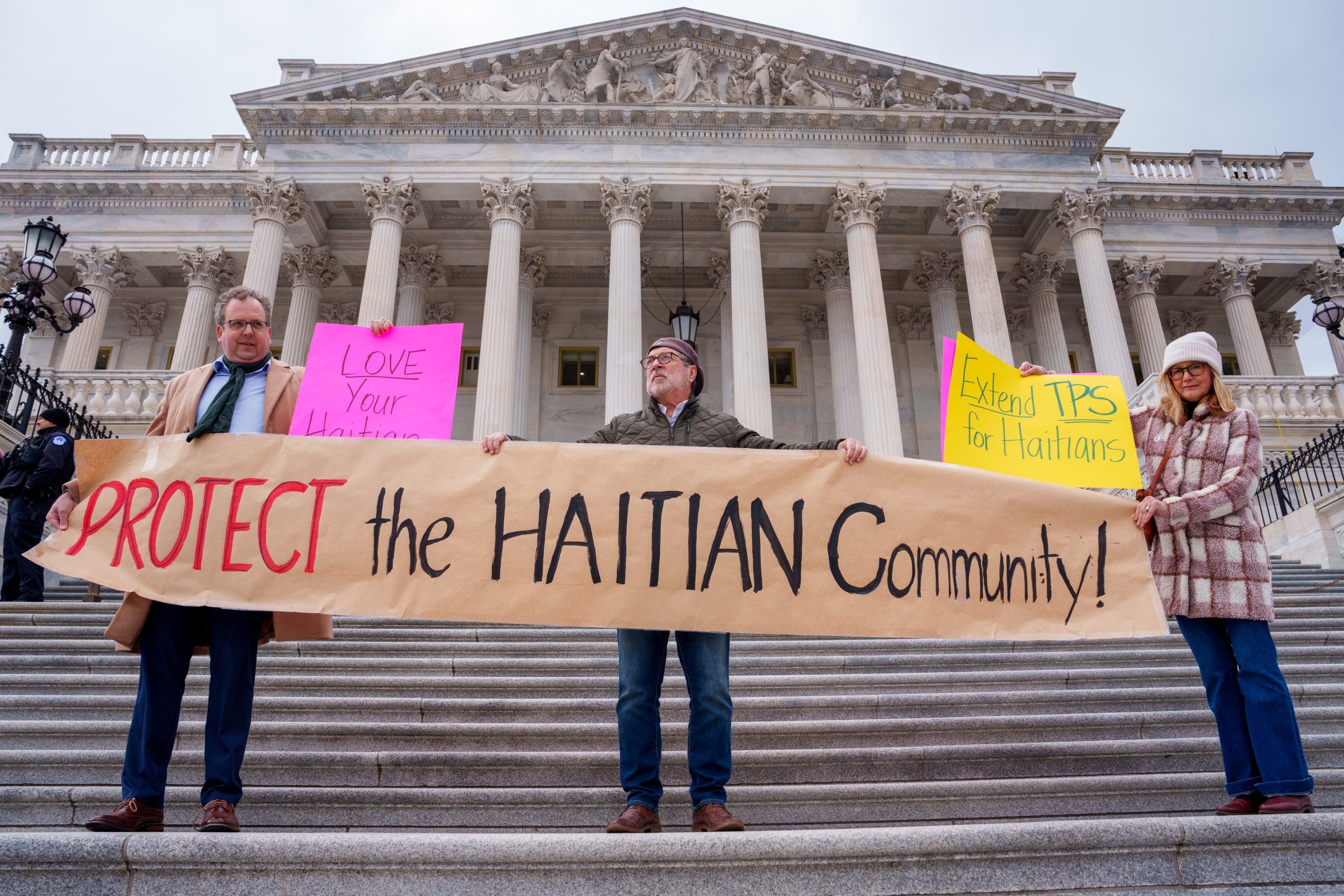
House Democratic Leader Hakeem Jeffries and U.S. Rep. Laura Gillen brought their push to extend Temporary Protected Status for Haitian nationals directly to Nassau County on Monday, meeting with Haitian American community leaders at Le Spot Cafe in Elmont as a pivotal House floor vote approaches later this week.
The roundtable event, first reported by the Herald’s Hailey Fulmer, came as the House prepares to act on legislation that would extend TPS protections for an estimated 350,000 Haitian nationals living in the United States.
The discharge petition, led by Rep. Ayanna Pressley of Massachusetts, secured 218 signatures after four Republicans — Reps. Mike Lawler of New York, Maria Elvira Salazar of Florida, Don Bacon of Nebraska, and Brian Fitzpatrick of Pennsylvania joined all House Democrats.
If passed, the measure would extend Haiti’s TPS designation for three years.
According to the Herald’s account, Jeffries told attendees that the bipartisan threshold had been met and expressed confidence that the bill would reach the floor this week. Gillen urged community members to press beyond Democratic ranks, calling on advocates to contact congressional offices and build support among undecided lawmakers.
The legislative effort runs in parallel with ongoing legal battles.
The U.S. Supreme Court announced last month that it would hear oral arguments in the Haiti TPS case during the second week of its April session, declining the Trump administration’s request for an emergency ruling and leaving lower court protections in place.

The case, Miot v. Trump, challenges the administration’s 2025 termination of Haiti’s TPS designation as unlawful. A coalition of 19 state attorneys general has filed an amicus brief opposing the administration’s effort to overturn the lower court’s stay.
As of Monday, the NAACP Legal Defense Fund and the NAACP also filed an amicus brief urging the justices to uphold the block on the termination of TPS.
Gillen, one of the original Democratic co-sponsors of the bipartisan Dignity Act, acknowledged at the roundtable that temporary measures alone are insufficient, underscoring the need for broader immigration reform, as reported by the Herald.
That bill, introduced by Reps. María Elvira Salazar and Veronica Escobar have now attracted 35 cosponsors from both parties and would create legal pathways for individuals who have been residing in the country without legal status prior to 2021, provided they meet criteria including tax payments and background checks. The proposal has drawn fierce opposition from immigration restrictionists and the Trump White House.
Community leader Mimi Pierre-Johnson, Assemblywoman Michaelle C. Solages, and Nassau County Legislator Carrié Solages also participated in Monday’s discussion, according to the Herald’s report. Pierre-Johnson emphasized the importance of grassroots mobilization in sustaining political momentum.
Haiti was first designated for TPS after the catastrophic 2010 earthquake that killed more than 200,000 people. Ongoing armed conflict, humanitarian crisis, and a Level 4 “Do Not Travel” advisory from the U.S. State Department have kept the designation in place through successive administrations. Ending TPS for Haitians would leave more than 350,000 nationals at risk of deportation, many of whom have lived and worked in the United States for more than a decade.
The anticipated House vote is expected to be one of the most significant bipartisan tests on immigration policy in the current Congress.
Although the bill is very likely to pass the House, given the 218 signatures already secured, it faces a far more difficult path ahead. In the Senate, 60 votes would be needed to overcome a filibuster — a threshold that would require significant Republican support in a chamber where the party holds a majority. Even if the bill were to clear both chambers, it would still land on President Trump’s desk, who has the power to veto it. Overriding a presidential veto would require a two-thirds supermajority in both the House and the Senate — an exceedingly high bar.
Trump has been one of the most vocal critics of Haitian immigration to the United States, and his administration moved to terminate Haiti’s TPS designation in 2025, making a presidential signature on this legislation highly unlikely without extraordinary political pressure.


https://ctninfo.com/house-minority-l…ension-this-week/
Original reporting by Hailey Fulmer, Herald Community Newspapers.