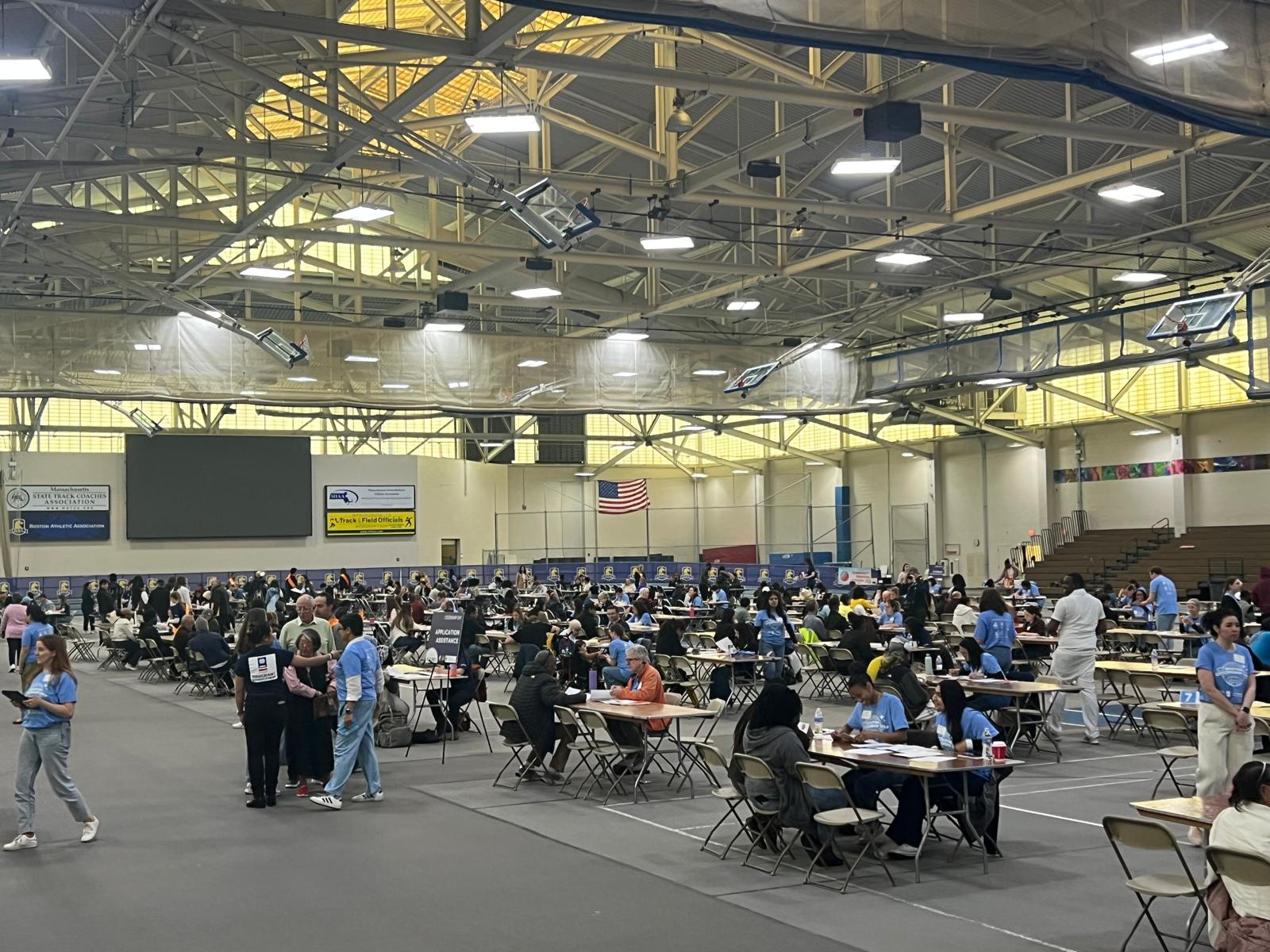
ROXBURY, Mass. — Fewer than 200 green card holders walked into the Reggie Lewis State Track Athletic Center on Saturday, May 2, for Boston’s 12th annual Citizenship Day — a sharp drop from the more than 300 applicants the event has typically served and the lowest turnout in its history, organizers said.
The free legal clinic, run by the Mayor’s Office for Immigrant Advancement (MOIA) and the nonprofit Project Citizenship, has helped lawful permanent residents prepare U.S. naturalization applications every year since 2014. This year, organizers attributed the falling numbers directly to the climate of fear created by federal immigration policy under the Trump administration’s second term.
“Usually, over 300 are registered, and we have a wait list,” said Monique Tú Nguyen, Executive Director of MOIA. “But this year, we only had 200 registered — 200.”
Nguyen said the drop reflects a community in retreat. “People are just scared about putting themselves at risk,” she said. “They are scared about coming here and being targeted, and also wondering, ‘What’s the point anymore,’ if they are hearing that the federal administration is deporting citizens.”
A federal squeeze on naturalization
Gail Breslow, Executive Director of Project Citizenship, said federal policy changes have made every step of the citizenship process more difficult than a year ago.
“A lot of the efforts that the federal administration is taking to discourage people from becoming citizens are having an effect,” Breslow said. “They made the civics exam longer and more difficult. They reduced the ways people can pay their application fee.”
A new screening framework also requires applicants to demonstrate “good moral character” through outside testimony. “Now we are asking each of our applicants to get a letter from a landlord, an employer, or a religious leader that can attest to the contributions they make to society,” Breslow said.
The slowdown is visible in federal data. According to figures from U.S. Citizenship and Immigration Services analyzed by NPR in April, monthly naturalization approvals collapsed from a peak of 88,488 in April 2025 to 32,862 in January 2026 — the lowest monthly figure since USCIS began publishing month-by-month data in 2022.
“In April of last year, USCIS approved 88,000 applications for naturalization. In January of this year, it was down to 33,000,” Breslow said. “It just shows all of the efforts they are making to discourage people from making the United States their home.”
The federal agency also paused processing of immigration benefits — including naturalization — for nationals of 39 countries, and announced a longer civics test, more rigorous “good moral character” reviews, and the revival of neighborhood checks, a 1991-era practice in which officers visit applicants’ homes.
A clinic 12 years in the making
Citizenship Day began in 2014 as a partnership between the City of Boston and Project Citizenship. It is the largest one-day citizenship clinic in New England and, before this year, had served almost 3,000 people from 115 countries, according to MOIA.
Project Citizenship has expanded its reach well beyond the single-day event. “Project Citizenship was founded in 2014, and since that time, we have helped over 14,000 people naturalize, or become U.S. citizens,” Breslow said.
The clinic operates as a full assembly line. Applicants are paired with volunteers who walk them through Form N-400, the 14-part Application for Naturalization. Pro bono attorneys review every form for accuracy. Eligible applicants are screened for a USCIS fee waiver. Project Citizenship then becomes the attorney of record and follows the case through to the oath ceremony.
“They follow through, making sure they get to the finish line of getting the application and getting their citizenship,” Nguyen said.
The cost of running it is not modest. “Between the facility we rent and all of the staff time and support, it is well over $100,000,” Breslow said. “It is definitely up there in the six-digit territory.”
A diverse turnout, even at lower numbers
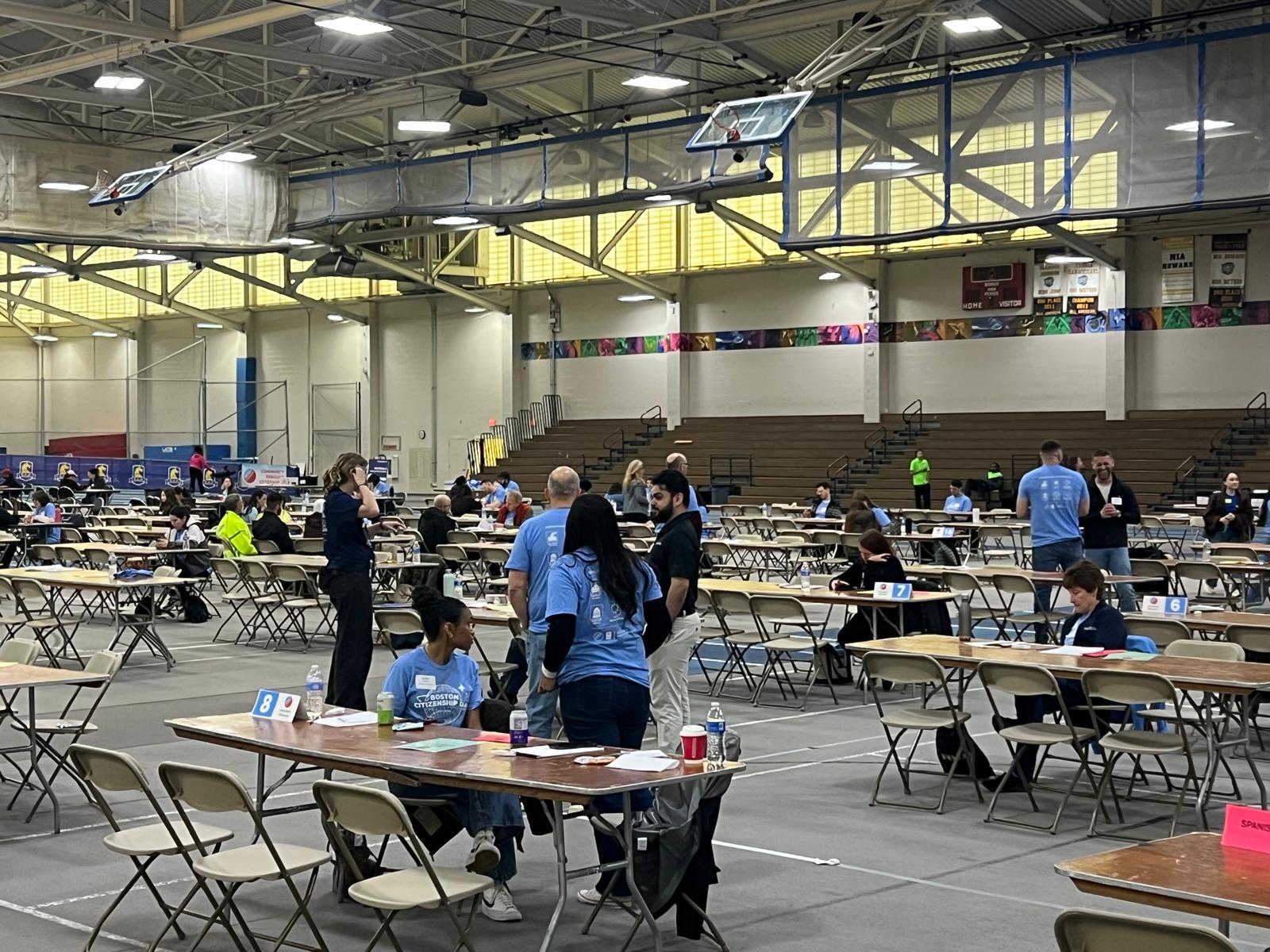
Despite the fall in registrations, the room on Saturday remained linguistically and culturally varied. In past years, Citizenship Day has drawn applicants from more than 50 countries. Haitians were among the largest immigrant groups served during the 12th-year citizenship day.
“It is so inspiring to see so many people — volunteers, staff both from my organization, Project Citizenship, as well as the Mayor’s Office for Immigrant Advancement — come together to help people,” Breslow said. “We have over 200 volunteers here today.”
Application assistants were on hand in multiple languages. “We have application assistants in Haitian Creole, Spanish, and Russian sometimes,” Nguyen said. “So it is really diverse.”
For Breslow, that diversity is the point. “It really points to the way in which the United States is a country that is, frankly, made of immigrants,” she said. “Most of us came here from somewhere else, and you see that represented in today.”
“First of all, the deportation of citizens is illegal”
Both directors said the most common question they hear now is whether citizenship still offers meaningful protection. Their answers were measured but firm.
“First of all, the deportation of citizens is illegal,” Nguyen said. “So I remind them that even though it is happening, it is not right. You are even more protected as a citizen from deportation than as a green card holder.”
Breslow said the decision to apply is personal, and that her organization sometimes counsels people to wait. “We advise people: ‘You know what — this might not be the right time for you to apply,'” she said. Common reasons include unresolved criminal records or unpaid back taxes that need a payment plan first.
“We are happy to have those conversations with people, and it is completely free of charge with no obligation,” she added. “You can at any point along the way decide, ‘You know what — this isn’t for me.'”
Cost remains a major barrier
The application itself is expensive. USCIS currently charges $760 to file Form N-400 by paper or $710 online. Project Citizenship reports that since 2014, more than 1,800 fee waivers have been submitted on behalf of qualifying applicants at the annual clinic.
Breslow said many applicants do not realize they qualify for a waiver. “We help people who might not know, for example, that they are eligible for a fee waiver if they are on MassHealth or food stamps,” she said.
Citizenship, Breslow said, also brings benefits beyond protection from deportation: “the right to vote, the right to travel freely, and the right to petition for other family members to join you here in this country.”
Both organizers stressed that immigrants who missed Saturday’s event should not wait another year.
“I would encourage them to call Project Citizenship,” Breslow said. “Our phone number is 617-694-5949, or go to our website, www.projectcitizenship.org. We have smaller events like this all throughout the year. So it is not the case that if you miss today, you have to wait another year. We are serving clients all year round.”
Project Citizenship limits its scope to naturalization. Green card renewals, asylum, and other immigration matters are referred to partner organizations across the region.
A unique model under pressure
Breslow described Project Citizenship as the largest provider of free citizenship services in New England, distinguished by its single-issue focus. “We are singularly focused on citizenship services,” she said. “We are truly experts at it.”
Nguyen said the group format itself is part of what makes the day work. “Typically, this process for becoming a citizen is very isolating, very solitary,” she said. “You do it by yourself with your lawyer. But doing it this way really creates a sense that many people share a desire to become citizens. So it makes it more heartwarming and more exciting.”
The federal climate, however, has narrowed Project Citizenship’s own resources. The organization lost a $150,000 federal grant earlier this year, roughly five percent of its annual budget, Breslow told the Boston Globe in April 2025. Last week, the group also joined a federal lawsuit on behalf of 14 of its clients — 11 from Haiti, 2 from Venezuela, and 1 from Côte d’Ivoire — who allege that the Trump administration unlawfully paused their citizenship applications based on their countries of origin.
“It is a mark of courage but also frustration and disappointment to be treated like this by the country they love and call home,” Breslow said in a statement to the Globe.
What organizers want immigrants to know
For Breslow, the message at this year’s smaller, quieter event was the same as in past years, but more urgent.
“Citizenship provides protections that people don’t have without citizenship,” she said. “It is obviously a very personal decision to make. And it also affords benefits.”
She invited those who came on Saturday to take in the moment. “I would invite you to look around and drink it in, because it really is a very special day.”
For Nguyen, the answer to fear is information. “If you know people who are eligible, please encourage them to work with us to get their citizenship,” she said.
The next Boston Citizenship Day is expected in spring 2027. Until then, Project Citizenship continues to take applications, conduct eligibility screenings, and refer cases week by week — quietly, and one applicant at a time.
https://ctninfo.com/?p=42507&preview=true