


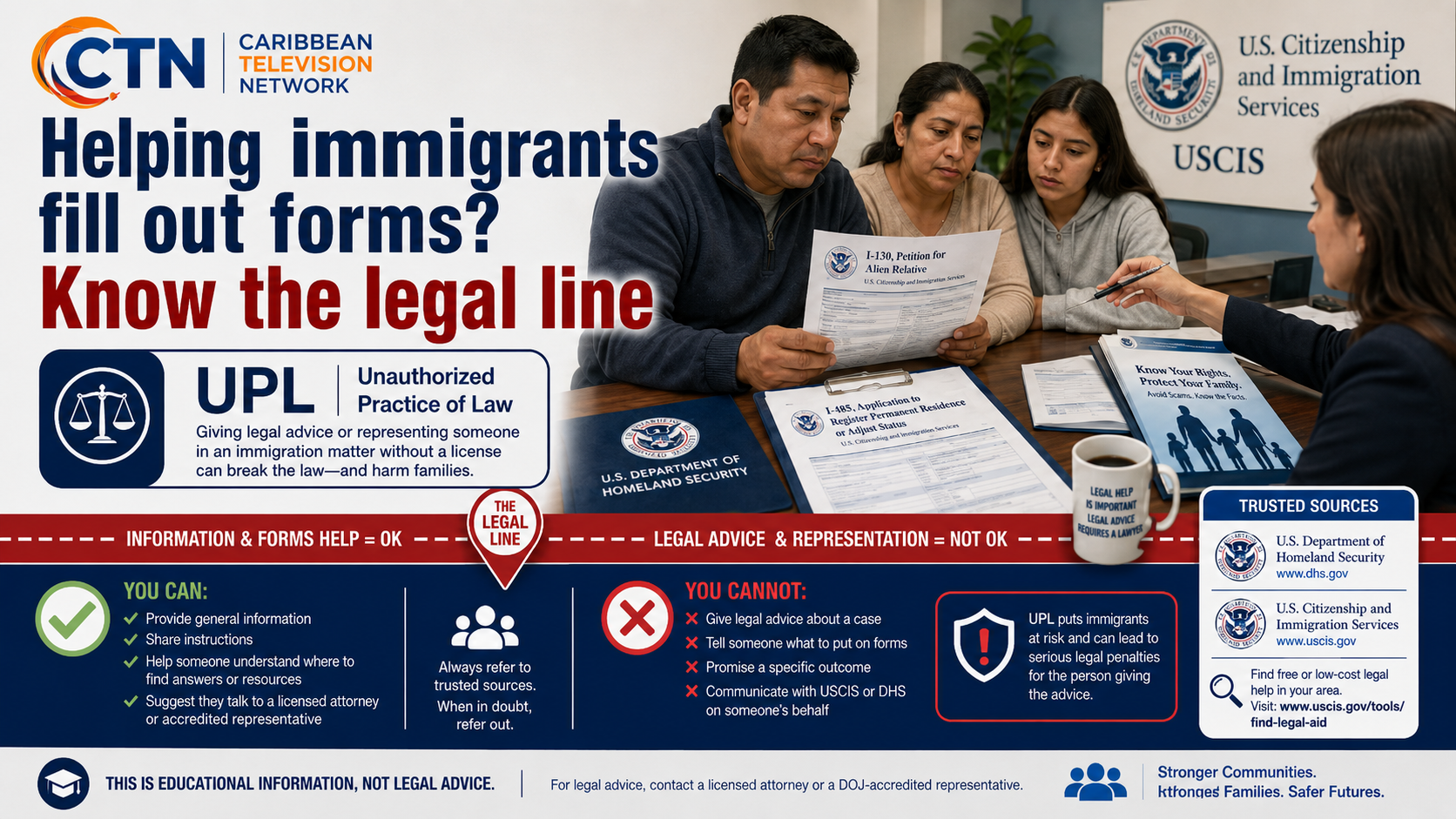
If you help immigrants fill out forms, or if you rely on someone who is not a lawyer for help with an asylum application or any other immigration filing, you need to understand a legal boundary that the federal government is now enforcing with new urgency: the line between clerical assistance and legal advice.
That line has always existed. But under the Trump administration’s intensifying immigration crackdown, the consequences of crossing it are growing sharper, for attorneys and non-attorneys alike.
The issue is called the Unauthorized Practice of Law (UPL). It applies to anyone who gives legal counsel or makes legal recommendations without being licensed to do so.
In the immigration context, where community members, tax preparers, notaries, and document service providers routinely help people navigate government paperwork, the risk is real, immediate, and widely misunderstood.
The distinction is straightforward in principle and treacherous in practice.
According to the Catholic Legal Immigration Network (CLINIC), immigration consultants and immigration assistance service providers cannot give legal advice or provide legal services unless they are attorneys or accredited representatives. What they can do is limited to clerical and administrative tasks: help clients get documents, fill out forms that the client selects with information the client provides, translate information into English, refer clients to an attorney (without charging a fee for the referral), secure supporting documents, and prepare or arrange for photographs, fingerprints, and medical tests
What they cannot do is tell a client which form to file, which immigration benefit to pursue, or what legal strategy is best for their situation. Notarios, document preparers, immigration consultants, and travel agents are not allowed to give any legal advice, according to the U.S. Department of Justice’s self-help guide on immigration representation
USCIS itself warns on its website: “‘Notarios,’ notary publics, immigration consultants, and businesses cannot give you immigration legal advice unless they are authorized legal service providers.” The agency notes that in many other countries, the word “notario” signifies someone with legal authority, but that is not the case in the United States.
On May 26, 2026, the Department of Homeland Security released a new directive instructing ICE to take additional steps to crack down on fraudulent asylum claims, including developing anti-fraud policies to further enforce 8 U.S.C. § 1324c(d), a federal law that establishes penalties for violations of document fraud.
The directive is aimed at attorneys, but its logic extends to anyone involved in preparing immigration filings. DHS said that as a result of the directive, ICE attorneys have greater authority to enforce the law, including through enforcement actions against immigration attorneys who file false asylum claims in immigration court.

DHS General Counsel James Percival framed the issue in sweeping terms. The directive instructs ICE attorneys in the Office of the Principal Legal Advisor to develop formal anti-fraud policies to support the robust enforcement of existing federal statutes. The policy builds on a March 2025 presidential memorandum. President Trump wrote at the time that “the immigration bar, and powerful Big Law pro bono practices, frequently coach clients to conceal their past or lie about their circumstances when asserting their asylum claims, all in an attempt to circumvent immigration policies enacted to protect our national security and deceive the immigration authorities and courts into granting them undeserved relief”.
If the federal government is now pursuing licensed attorneys for their role in asylum filings, the exposure for unlicensed individuals who offer the same or similar guidance, without even the basic protections of a law license, is far greater.
Reports from the interview room
What makes this environment especially dangerous for non-attorney service providers is what reportedly happens during USCIS interviews. There are reports from people who have attended asylum interviews that USCIS officers are asking applicants directly whether they decided to file for asylum on the advice of an attorney or of someone who is not a lawyer.
This is a critical question. If an applicant tells a USCIS officer that a non-attorney told them to file for asylum, that statement can trigger consequences in two directions: for the applicant, whose case may be questioned, and for the non-attorney, who may face an accusation of unauthorized practice of law.
USCIS has also tightened the conditions for asylum interviews. Effective May 18, 2026, the agency will no longer permit attorneys and accredited representatives to participate remotely in asylum interviews at field offices, except in limited circumstances. All legal representatives must now be physically present. That policy change signals a broader push toward scrutinizing who is advising applicants and how.
Unauthorized practice of law is not a theoretical risk. The penalties span both state and federal law.
According to CLINIC, the majority of states have enacted laws targeting unauthorized practice of immigration law or have applied existing unauthorized practice of law statutes to immigration cases, imposing fines, civil penalties, and misdemeanor charges.
At the federal level, the consequences can be far more severe. Under 8 U.S. Code § 1546, individuals convicted of immigration document fraud can be fined or imprisoned for up to 25 years, with penalties varying based on the intent behind the offense.
In Massachusetts specifically, there is precedent. In 2016, a Waltham man, Gerson Barahona, and his company were ordered to pay more than $155,760 in restitution to victims, civil penalties, and attorneys’ fees after he posed as an immigration attorney and unlawfully charged Massachusetts residents hundreds or thousands of dollars for legal advice and services. Then-Attorney General Maura Healey said at the time that Barahona “deceived vulnerable people who trusted him to help them with sensitive immigration matters, resulting in significant personal and financial harm”.
The Massachusetts Attorney General’s office has maintained a multilingual education campaign warning immigrant communities about fraudulent practices in immigration law. The office has issued an advisory stating that the unauthorized practice of immigration law is a widespread problem and that dishonest individuals frequently hold themselves out as attorneys, charging hundreds or thousands of dollars for preparing forms or providing advice and services they are not qualified or authorized to perform.
In California, the State Bar seized the offices of Salve Esperanza of Los Angeles in 2024 for the unauthorized practice of law after she falsely represented herself as an attorney and charged Filipino immigrants significant sums while directing them to enroll at a university and take jobs with a specific employer with whom she collaborated. The State Bar’s chief trial counsel called the case “a stark reminder of the risks posed by unauthorized practitioners”.
The consequences for the people you are trying to help
The harm does not stop with the service provider. According to legal analysts, the consequences of unauthorized practice can be devastating for the immigrants who receive the flawed assistance; they face loss of money, missed filing deadlines, and severe immigration ramifications, including deportation. In one documented case cited by the California State Bar, two former clients of a non-attorney face a substantial risk of removal and deportation due to the false and incorrect information the practitioner provided on their asylum applications.
The American Bar Association has warned that the problem extends beyond obvious fraud. While most people can readily identify the “notario” scenario as the unauthorized practice of law, seemingly innocent assistance by community members can also cross the line.
For anyone who assists immigrants with paperwork and is not a licensed attorney or an accredited representative recognized by the Department of Justice, the following protections are not optional; they are essential:
You must not advise a client on which immigration benefit to pursue. The decision to file for asylum, a green card, a work permit, or any other benefit must come from the client alone or from a licensed attorney.
You must make the client sign a written acknowledgment stating clearly that you did not provide any legal advice, that the decision to pursue the particular filing was the client’s own, and that you informed the client of the availability of free or low-cost legal services.
You should provide a list of pro bono legal organizations and accredited representatives in your area. In Massachusetts, legal aid can be obtained through organizations such as the International Institute of New England, Greater Boston Legal Services, or the Political Asylum/Immigration Representation Project. The Department of Justice maintains a national list of free legal service providers at justice.gov/eoir/list-pro-bono-legal-service-providers.
Where to find authorized help
USCIS directs immigrants to the American Bar Association for help finding an attorney in their state and to the Department of Justice’s list of accredited representatives and recognized organizations (https://www.uscis.gov/scams-fraud-and-misconduct/avoid-scams/find-legal-services). The DOJ also provides a list of attorneys who offer immigration services at no cost or at reduced cost.
Before hiring anyone to provide legal advice or representation in connection with immigration or other matters, the Massachusetts Attorney General’s office urges residents to verify that the individual is a licensed attorney in good standing by checking the Massachusetts Board of Bar Overseers.
The federal government’s enforcement posture has changed. Under a DHS that is actively directing ICE to pursue fraud in asylum cases, and under interview conditions where USCIS officers are reportedly asking applicants who told them to file, the margin for error has collapsed. Anyone providing immigration-related services without a law license must understand that the boundary between helping someone fill out a form and telling them what form to fill out is the boundary between lawful assistance and a criminal offense.
This is not legal advice. This article is for informational purposes only.
Sources: U.S. Department of Homeland Security (dhs.gov); U.S. Citizenship and Immigration Services (uscis.gov); U.S. Department of Justice (justice.gov); Catholic Legal Immigration Network, Inc. (cliniclegal.org); American Bar Association (americanbar.org); Massachusetts Attorney General’s Office (mass.gov); California State Bar (calbar.ca.gov); Nolo (nolo.com); STL News; Ramapo Journal of Law & Society.
This article was originally written in English. The French and Haitian Creole versions were produced using AI translation software; errors may occur, and the English version is authoritative.
https://ctninfo.com/?p=43075&preview=true
https://www.facebook.com/CaribbeanNewsMedia