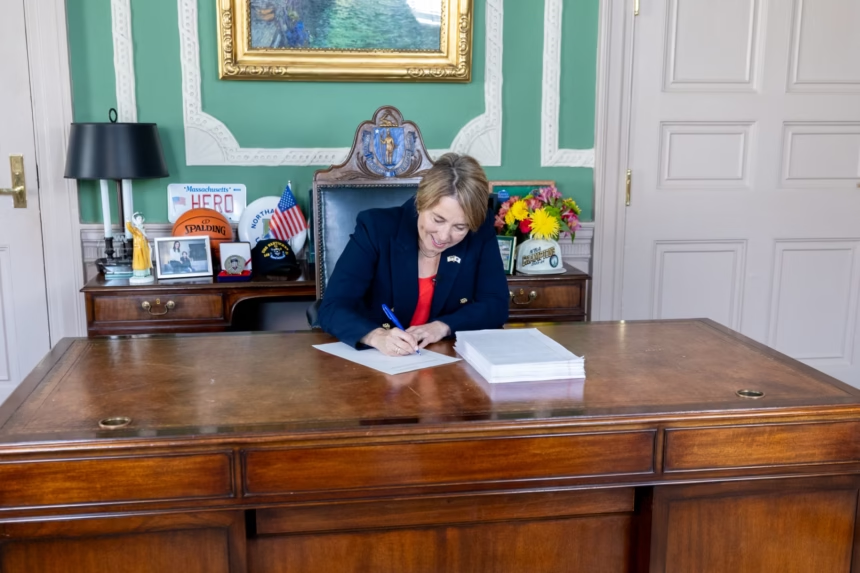
With home heating oil running more than 70 percent higher than a year ago, Governor Maura Healey on Monday declared a State of Energy Emergency and announced nearly $150 million in relief intended to help Massachusetts families get through the winter.
Through an executive order, the Healey-Driscoll administration is expanding who qualifies for heating help, raising benefits for those already eligible, and stripping some charges off electric bills. Together, the state says, the plan will lower energy costs for roughly 85 percent of ratepayers. Details are posted at mass.gov/heatinghelp.
“Families are seeing the impact of the war in Iran every time they fill up their gas tank, place an order for heating oil or open their electric bill,” Healey said in announcing the measures, which she attributed to volatile fuel prices. “I’m declaring a State of Energy Emergency because in Massachusetts, we are going to use every tool we have to get people relief.”
The centerpiece is a new benefit aimed at households that have long fallen between the cracks.
For the first time, Massachusetts is creating a home heating oil assistance benefit for middle-class families earning between 60 and 100 percent of the state median income — for a family of four, roughly $103,000 to $171,750 a year. About 50,000 oil-heat households are expected to qualify for a one-time payment of up to $680, available from December through the end of the heating season on April 30, 2027, or until the money runs out. The same local agencies that already handle energy assistance will administer it, according to a statement released by the governor’s office.

Low-income households get more, too. The administration is adding $15 million to the Home Energy Assistance Program (HEAP), which last winter helped more than 156,000 households — over 300,000 people.
Under the plan, families who heat with oil will see a 20 percent increase in aid, and those who heat with utilities a 15 percent increase, on top of current benefits ranging from about $525 to $1,200. HEAP runs from November 1 through April 30, and the state notes that renters can qualify, including those whose heat is included in their rent, and that households do not need to be on public assistance or behind on their bills to apply.
On the electric side, the state will spend $80 million to remove the Solar Massachusetts Renewable Target (SMART) charge from residential and commercial bills for three months, from January through March 2027, and will cut the Alternative Energy Portfolio Standard by half this winter for an estimated $20 million more in savings.
Healey also announced an Emergency Winter Warmth Fund, created with Citizens Energy Corporation, which is launching it with an initial $100,000 and will channel contributions through the same local agencies to both low-income and the new middle-class recipients. Former Congressman Joe Kennedy III, now president of Citizens Energy, leads the fund.
“For too many of our neighbors, an unexpected heating emergency can quickly become a crisis — forcing families to make impossible choices between keeping the heat on and putting food on the table,” Kennedy said.
The emergency declaration also activates state price-gouging protections for petroleum products, with Healey directing state agencies to monitor and enforce against excessive or misleading prices. And she sent a letter to congressional leaders urging an additional $3 billion in federal Low-Income Home Energy Assistance Program funding, which would bring the national program to $7 billion.
State officials framed the moves as much a health issue as a cost issue.
“No one should be afraid to turn on the heat when costs are high. This is a matter of public health,” said Energy and Environmental Affairs Secretary Rebecca Tepper. Housing and Livable Communities Secretary Juana Matias said the expanded HEAP benefits and access mean “more Massachusetts households can get the help they need to stay warm this winter.”

The relief responds to a sharp run-up in fuel costs. The average price of home heating oil in Massachusetts reached $6.08 a gallon as of September 28, up 73 percent from $3.52 a year earlier, according to the state — a burden that falls hardest on the roughly one in five households, often in older homes and rural areas, that heat with oil.
Monday’s announcement follows other recent steps by the administration to lower costs, including legislation filed last week to suspend the state’s 24-cent-a-gallon gas tax for two months. For Massachusetts families bracing for winter bills, the message from the state was that help is available now — and, for many, through agencies and an application process already in place in their own communities.
Applications are available at mass.gov/heatinghelp or through local agencies.
https://ctninfo.com/?p=44824&preview=true
https://www.facebook.com/CaribbeanNewsMedia
https://ctninfo.com/?p=44824&preview=true
https://www.facebook.com/CaribbeanNewsMedia
AI Use Policy: Some of CTN’s journalists are not native English speakers and draft their work in French or Haitian Creole. We then use AI-assisted translation software to produce the English versions, and traces of machine-generated phrasing may occasionally remain. Every article — in any language — is written, reviewed, and edited by CTN’s staff writers and editors, who remain responsible for its accuracy. CTN also uses AI to convert text into audio.