


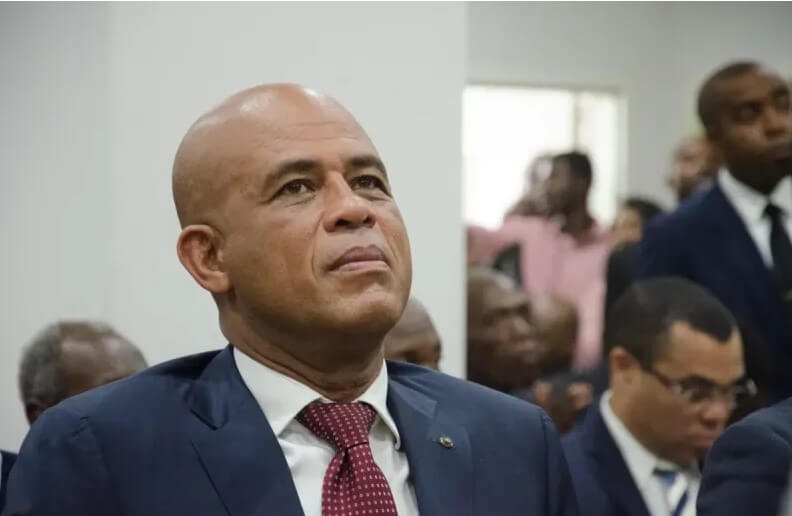
Pressure is mounting on the American administration in the Haitian file. In correspondence dated November 23, 2026, Senator Jeanne Shaheen and Representative Gregory W. Meeks, both Democrats, vigorously denounce the Trump administration’s shortcomings in implementing legislation targeting the political and economic ramifications of armed gangs in Haiti. The two parliamentarians explicitly name former head of state Michel Martelly, whom they accuse of ties to several criminal organizations. This accusation immediately provoked a reaction from the political party “DEBLOKE,” under whose banner Michel Martelly is running in the next Haitian presidential election.
A Bipartisan Law Ignored
Addressed to Secretaries of State Marco Rubio, Scott Bessent, and Pete Hegseth, the two congressmen’s letter expresses “concern” regarding “the Administration’s failure to fully implement the bipartisan Haiti Criminal Collusion Transparency Act.” This text, enacted as Section 8319 of the National Defense Authorization Act for Fiscal Year 2026 (NDAA FY26), came into force on December 18, 2025. “By failing to name and sanction the political and economic elite fueling Haiti’s insecurity, the Administration allows those responsible to evade accountability and signals that their actions carry no consequences,” write Jeanne Shaheen and Gregory Meeks. According to them, “the Administration’s inaction undermines U.S. efforts to advance security and democratic governance in Haiti and harms U.S. national security interests.”
The Haiti Criminal Collusion Transparency Act, which Marco Rubio himself had sponsored as a Republican when he was a senator, requires the State Department to work with the entire interagency to submit an annual report identifying Haitian political and economic elites with significant ties to criminal gangs. This report must describe their criminal collusion in detail. The text also requires the President to impose sanctions on these actors within 90 days of the report, including through asset blocking and visa restrictions. However, on June 30, 2026, Congress received the first required annual report. While it rightly notes that “collusion between politicians and the economic elite with terrorist gangs threatens the Haitian people and the viability of the Haitian State… fueling impunity, gang violence, and political instability,” and underscores how this collusion “directly harms the U.S. interest in stabilizing Haiti to prevent mass and illegal immigration to U.S. shores… [and] also threatens U.S. citizens and embassy security,” the rest of the document and the subsequent actions of the departments concerned “fail to show an intent to comply with the text or spirit of the law.”

The two parliamentarians notably point out that the June report listed only individuals who had already been sanctioned prior to the law’s passage. “Repackaging existing designations does not meet the Act’s requirement to identify those who finance and enable gang violence in Haiti,” they denounce. They also reproach the report for failing to provide any new insight into the current nature or magnitude of criminal collusion in Haiti, the leadership structure of gangs and their involvement in firearms trafficking and human smuggling, or the concrete actions the U.S. government will take to address these issues. Despite Secretary Rubio’s May 2025 declaration that “the age of impunity for those supporting violence in Haiti is over,” the Administration also did not comply with the Act’s mandatory requirement that the political and economic sponsors of gangs be sanctioned by September 28, 2026. “The Administration has not invoked the Act’s national security waiver nor provided any other rationale for its inaction,” emphasize Jeanne Shaheen and Gregory Meeks.
The two elected officials further reproach the Administration for systematically failing to adequately engage with the committees of jurisdiction on implementation of the law. In communications to Congress, State Department representatives have confirmed that there is no working list of sanctionable targets in Haiti. The State Department has also been unable to explain why a classified annex on criminal collusion in Haiti, though permitted by the legislation, was not included in the June 30 report or subsequently provided to Congress. To date, the Administration has failed to make leadership from the Bureau of Western Hemisphere Affairs, a representative from the U.S. Embassy in Port-au-Prince, or personnel from the Office of Foreign Assets Control available for briefings with the Senate Foreign Relations Committee and House Foreign Affairs Committee on the Act’s implementation.
Michel Martelly Explicitly Named
It is in this context that the two congressmen explicitly cite the former Haitian president. “At a time when the Haitian people are preparing to vote for the first time in over a decade, Congress, the American public and the Haitian people deserve transparency about the nature and scale of collusion between gangs and their political and economic support networks,” they write. “The consequences of the Administration’s silence on this issue are already evident, as at least one individual with ties to multiple gangs, Michel Martelly, is running as candidate for President despite the Organization of American States and other regional leaders calling for bans on gang-linked candidates.”
The two parliamentarians recall that “past failures to confront these criminal networks helped the current crisis in Haiti take hold” and that “repeating them would undermine the Administration’s own goals of credible elections and security gains through the Gang Suppression Force.” They finally demand that the Administration take “immediate and concrete steps to comply with the law,” provide “a bipartisan classified briefing on the Act’s implementation,” and prioritize “efforts to hold corrupt Haitian elites accountable.”

DEBLOKE Steps Up
The explicit mention of Michel Martelly in the two Democratic elected officials’ correspondence did not fail to provoke a reaction from his party. In a press release distributed Tuesday, DEBLOKE confirms it has taken note of the document dated November 23, in which Jeanne Shaheen and Gregory Meeks cite the former president among personalities likely to be linked to networks that finance, arm, and support gangs in Haiti. While declaring itself in favor of investigations aimed at identifying those responsible for financing armed groups, the political group denounces the vagueness surrounding the accusations brought against its leader. It notably points out that the two parliamentarians themselves acknowledge that the report transmitted to Congress in June 2026 contained no new information, without specifying the facts reproached to Michel Martelly or the period concerned.
Based on these observations, DEBLOKE announces its intention to send an official referral to Jeanne Shaheen and Gregory Meeks. The objective: to obtain clarifications as well as any element that may be communicated, in order to allow Michel Martelly to exercise his right of reply. The party also firmly recalls that the two congressmen’s correspondence cannot be likened to a court decision, a new sanction, or a declaration of ineligibility. For DEBLOKE, the evaluation of candidacies for the next elections falls exclusively within the competence of Haitian institutions, in accordance with the laws in force in the country.
This exchange of arms between the U.S. Congress and the Trump Administration, on the one hand, and between the Democratic parliamentarians and Michel Martelly’s party, on the other, illustrates the complexity of the Haitian file as the general elections scheduled for 2027 approach. As the country attempts to emerge from several years of security and political crisis, the question of the political and economic elite’s involvement in financing gangs remains at the heart of debates. The letter from Jeanne Shaheen and Gregory Meeks could well relaunch discussions on the need to sanction those responsible, but it could also fuel political tensions in an already explosive context. For now, the American administration has not publicly reacted to this correspondence.