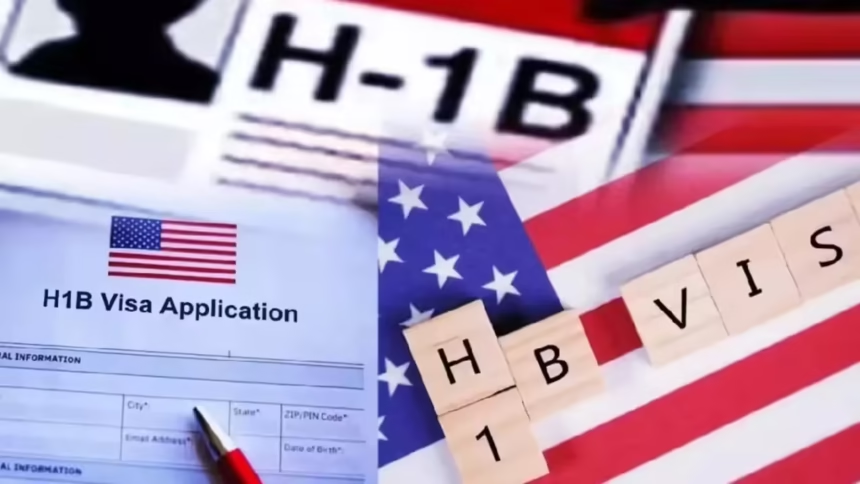
The Department of Homeland Security is proposing to charge employers a new fee of $103,265 for every H-1B petition subject to the annual visa cap, a surcharge so large it would rank as the single biggest fee ever imposed on a U.S. immigration filing. The proposal, released this week, would apply on top of every fee employers already pay and would sharply raise the cost of a program that technology firms, hospitals and other employers rely on to hire skilled foreign workers.
DHS posted the notice of proposed rulemaking for public inspection on Aug. 24, with formal publication in the Federal Register set for Aug. 25.
The rule is not in effect. DHS will take public comments for 30 days after publication, and the agency must review those comments, clear White House review, and issue a final rule before it can collect any fees. Analysts noted the charge would be more than one hundred times the current base filing fee for an H-1B petition and would be added to the U.S. Citizenship and Immigration Services fee schedule under a new provision.
The fee would apply to all cap-subject petitions, including the 20,000 slots reserved each year for workers with a master’s degree or higher from a U.S. institution, in addition to the 65,000 available under the regular cap. It would be due at the time of filing and added to the standard Form I-129 fee, the H-1B registration fee, the anti-fraud fee, the asylum program fee, the ACWIA training fee, and premium processing, where employers elect it. According to the proposal, it would apply whether a petition seeks a change of status inside the country or notification to a consulate abroad.
Not every H-1B employer would be affected.
DHS proposes to exempt cap-exempt petitions — those filed by universities, their affiliated nonprofits, and nonprofit or governmental research organizations — carrying over the same logic it used to spare those employers from the asylum program fee, according to the proposed rule. The charge also would not reach extensions, amendments or transfers for workers already counted against the cap.

DHS estimates the fee would raise roughly $8.8 billion a year, a figure it reached by dividing about $8.78 billion in projected annual costs by an estimated 85,000 cap-subject petitions. The agency frames the money as a way to recoup a share of what the federal government spends running the legal immigration system, well beyond the processing of H-1B cases themselves. Those costs, DHS said, span the adjudication of immigration benefits, fraud detection and national security vetting, systems modernization, records and fee-collection operations, immigration court operations, consular visa processing, labor-standards enforcement and coordination among agencies. “The proposed H-1B fee is intended to recover the costs incurred across the federal government to adjudicate, vet, and support lawful immigration programs that otherwise must be funded by taxpayers,” USCIS spokesperson Zach Kahler said in the agency’s announcement.
The approach marks a departure from how immigration fees have traditionally worked.
As reporting on the rule noted, USCIS fee schedules have historically been set to recover USCIS’s own costs; this proposal instead asks one group of employers — those filing cap-subject H-1B petitions — to help underwrite a much broader set of federal immigration expenses. DHS said it singled out those employers because it believes they can generally absorb the cost, pointing to a USCIS report showing median annual pay of about $133,000 for approved H-1B beneficiaries in fiscal 2025 and to the wage obligations employers already carry under the program.
The department acknowledged the change would hit some businesses hard. In its own analysis, DHS estimated that roughly 76% of small entities filing H-1B cap petitions would face a significant economic impact, according to firms that reviewed the rule. Immigration attorneys widely described the proposed amount as unprecedented and said legal challenges to any final rule are all but certain.
The proposal is the administration’s second attempt this year to attach a six-figure price to H-1B hiring.
In 2025, a presidential proclamation sought to require a $100,000 payment tied to certain H-1B workers entering from abroad, but federal court blocked that effort, as Newsweek and others reported.
The new rule is broader, reaching cap-subject petitions regardless of where the worker is located and covering both change-of-status and consular cases. Analysts also flagged a timing wrinkle: the 2025 proclamation is set to expire on Sept. 21, 2026, before the proposed fee could take effect, though if it were extended and both were in force, an employer could in theory owe both.

For now, nothing changes for employers mid-filing. Immigration lawyers cautioned petitioners not to add the new charge to current cases unless and until a final rule sets an effective date and transition rules. Comments on the proposal can be filed through the federal Regulations.gov portal during the 30-day window that opens with publication, under DHS Docket No. USCIS-2026-0298 (RIN 1615-AD20).
If the fee survives that process and the litigation likely to follow, it would represent one of the most consequential shifts in the cost of employment-based immigration in decades, potentially pricing smaller employers out of the H-1B program and reshaping which companies can afford to sponsor foreign professionals. Whether it takes effect, and in what form, now depends on the comment period, White House review, and the courts.
https://ctninfo.com/?p=44352&preview=true
https://www.facebook.com/CaribbeanNewsMedia
This article was originally written in English. Other language versions are produced using AI translation software, and errors are possible — the English version is authoritative. CTN also uses AI to convert text into audio.