


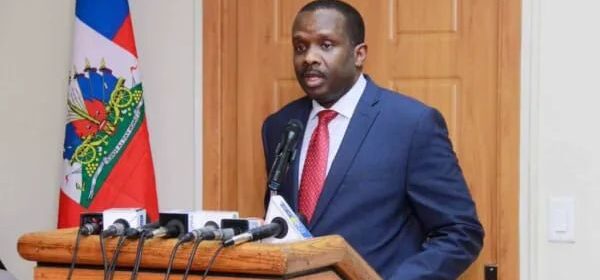
Port-au-Prince, June 4, 2026 – The Haitian political climate has just experienced another major shock. Just months before the upcoming electoral deadlines, the Provisional Electoral Council (CEP) and the Executive are now in open warfare. The most glaring evidence: the ban on access to CEP premises imposed on Uder Antoine, the institution’s Executive Director, who was appointed Director General by Prime Minister Alix Didier Fils-Aimé. This precautionary measure was taken on Wednesday, June 3, 2026, the day after the controversial adoption of the electoral decree by the Council of Ministers.
According to an internal note initialed by eight of the nine members of the electoral college, Uder Antoine is now persona non grata within the institution he was supposed to help lead. The document, a copy of which has been obtained, states that “Mr. Antoine has shown no signs of life for approximately 48 hours.” This prolonged absence, deemed suspicious by his peers, justifies an immediate precautionary measure: “Access to CEP facilities is prohibited until further notice.”
This nearly unanimous vote — eight out of nine votes — sends a strong signal. The CEP, led by Jacques Desrosiers, refuses to endure what it perceives as an attempt by the Executive to interfere in its internal affairs.
A Standoff Over the Electoral Decree
To understand this radical decision, we must go back to the day before. On Tuesday, June 2, 2026, the Council of Ministers adopted the long-awaited electoral decree. This text, which establishes the organizational rules for the upcoming elections (calendar, funding, candidacy criteria, composition of polling stations), has been crystallizing tensions between the National Palace and the CEP for weeks.

One of the most sensitive points concerns the appointment of senior officials within the electoral institution. In several government circles, Uder Antoine’s name had been insidiously circulating to fill the strategic position of Director General of the CEP. A position of great responsibility — financial management, supervision of electoral logistics, personnel management — that the Executive clearly wanted to entrust to a trusted person. A decree appointing Uder Antoine was even circulating Wednesday evening. CTN could not immediately confirm its authenticity.
The problem: for the CEP, this appointment was never officially ratified. Hired on April 14, 2026, as a simple Executive Director, Uder Antoine had, according to the institution, no legitimacy to aspire to the position of Director General. The public association of his name with this position, relayed by certain media outlets and government offices, was seen as a provocation.
This standoff comes in an already explosive context. The Haitian electoral process, faced with growing insecurity, a glaring lack of funding, and the chronic distrust of political parties, did not need this internal leadership crisis.
With an Executive Director banned from access and an open conflict between the CEP presidency and the Executive, the electoral administration risks total paralysis.
What Scenarios for the Future?

Three main scenarios immediately emerge.
First scenario: escalation. The Executive persists in wanting to impose Uder Antoine as Director General. The CEP radicalizes its position. The electoral process sinks into an open institutional crisis, with possible collective resignations.
Second scenario: a mediated compromise. An external intervention attempts mediation. Uder Antoine renounces any ambition for the position of Director General. The CEP lifts the access ban, but relations remain execrable.
Third scenario: direct interference. The Executive uses the electoral decree to force its way through, appoints a Director General by its own authority, and reduces the CEP to a purely decorative role. The way would then be open to elections under government control, without any national or international credibility.
A Democracy Under Trial
What seemed like a simple internal governance crisis within the CEP reveals a much deeper conflict. On one side, an Executive seeking to lock down the electoral machine to control the calendar and the results. On the other, a CEP trying to preserve its autonomy, but now paying the price for its divisions.
In the middle of this war of chiefs, the Haitian voter still waits for free, honest, and peaceful elections.