


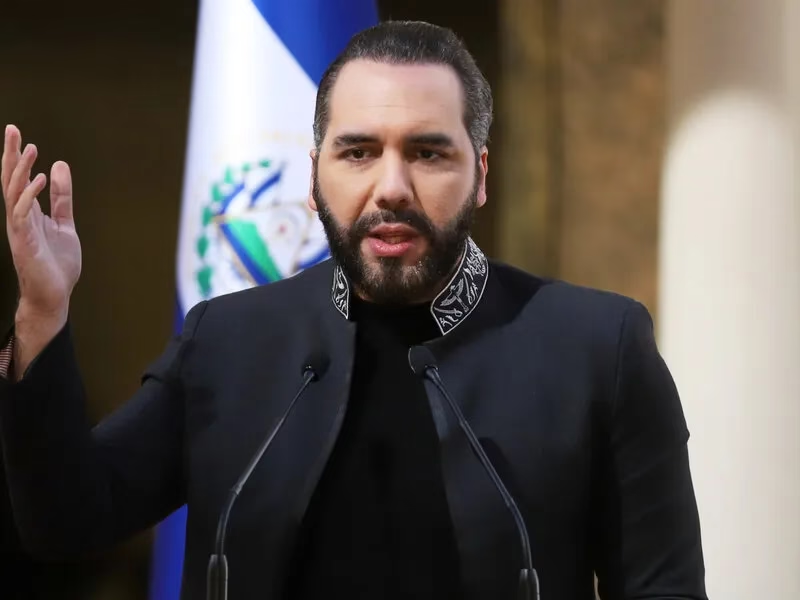
El Salvador’s President Nayib Bukele has issued a new and taunting ultimatum to Haiti’s armed gangs, branding them cowards and demanding they release four missing Salvadoran technicians alive — the latest escalation in a standoff that has pulled thousands of Salvadoran troops into the Caribbean nation.
In a message posted in Haitian Creole to his X account, Bukele wrote that the gangs in Haiti “are just a bunch of cowards who only fight innocent civilians, children and the elderly” and “don’t want to fight real warriors.” He accused them of hiding and waiting for his forces to withdraw.
The president then set out an offer wrapped in a threat. “Drop your weapons, leave the gangs, run, return our technicians to us alive, and we will go,” he wrote. If they refuse, he warned, “what comes next won’t be pretty.”
The message, aimed squarely at the groups that control much of the Haitian capital, continues a campaign Bukele has waged largely in Haitian Creole — a direct appeal, over the heads of Haiti’s authorities, to both the gangs and the public.

The men at the center of the standoff
The dispute began with an ambush more than six weeks ago. On October 18, four Salvadoran aviation technicians attached to the United Nations-authorized Gang Suppression Force (GSF) were attacked by gang members in the Croix-des-Bouquets area east of Port-au-Prince as they returned from buying food, according to reporting by The Associated Press and Al Jazeera. The men fled a burning vehicle and have not been seen since.
Bukele has stressed that the four are not combatants. As reported by the AP, he described them as aviation technicians whose mission “consists only of pilots and technical personnel” carrying out medical evacuations, “not to wage war.” Haitian police recovered the technicians’ burned vehicle on November 3, but no confirmed trace of the men has been found, and no gang has publicly claimed responsibility for holding them. Reports that gang members claimed to have handed over remains said to belong to the missing Salvadorans have not been confirmed, and Bukele’s demand that the technicians be returned “alive” signals that El Salvador still treats their fate as unresolved.
The disappearance prompted one of the largest foreign military deployments to Haiti in years. Bukele announced a rescue operation on October 21, and El Salvador first sent roughly 100 special forces soldiers before expanding the force to about 2,000 troops within days, according to multiple news agencies. Reuters images have shown Salvadoran armored vehicles operating in Port-au-Prince, sometimes separately from the GSF.
From the outset, Bukele has paired rescue with menace. “We have already finished with the gangs in El Salvador, and we can finish with you too,” he wrote in an earlier X post cited by the AP and Al Jazeera. He has also offered a bargain that his new message echoes: if the technicians are freed unharmed, conditions would “go back to the way it was before the kidnapping,” and, the Latin Times reported, Salvadoran forces would withdraw from Haiti. At the same time, he has insisted the deployment is “not an occupation” and carries no “neocolonialist” aim, telling Haitians his troops would leave once the mission ends.
Part of a wider mission
The Salvadoran technicians are part of the Gang Suppression Force, the UN-authorized international mission that replaced the earlier Kenyan-led Multinational Security Support deployment and was reconstituted in 2025 to take a more aggressive posture against Haiti’s armed groups. El Salvador contributes aviation personnel alongside countries including Chad, Jamaica and Guatemala. The force has more than 2,000 personnel on the ground — well short of the roughly 5,500 envisioned — and the UN Security Council recently extended its mandate for six months, according to Al Jazeera.

The mission operates against a backdrop of deepening crisis. Gang violence has gripped Haiti since the 2021 assassination of President Jovenel Moïse, with armed coalitions seizing control of much of Port-au-Prince and surrounding areas. Humanitarian needs have far outpaced the international response; aid agencies have reported that this year’s humanitarian plan for Haiti is only about half funded.
Bukele’s threats draw directly on his record at home, where El Salvador launched a sweeping anti-gang crackdown in 2022 under a prolonged state of emergency. Supporters credit the campaign with driving one of the world’s highest homicide rates down to historic lows and restoring a sense of public safety. Human-rights organizations have accused his government of mass arbitrary detentions, due-process violations and abuses — concerns that now shadow the prospect of a similar approach being exported to Haiti.
As of the publication of Bukele’s latest message, the four technicians remained missing, their fate unconfirmed, and the Salvadoran leader’s demand — surrender the men, or face escalation — hung over a capital already exhausted by years of violence.
https://ctninfo.com/?p=45523&preview=true
https://www.facebook.com/CaribbeanNewsMedia
AI Use Policy
Some of CTN’s journalists are not native English speakers and draft their work in French or Haitian Creole. We then use AI-assisted translation software to produce the English versions, and traces of machine-generated phrasing may occasionally remain. Every article — in any language — is written, reviewed, and edited by CTN’s staff writers and editors, who remain responsible for its accuracy. CTN also uses AI to convert text into audio.
