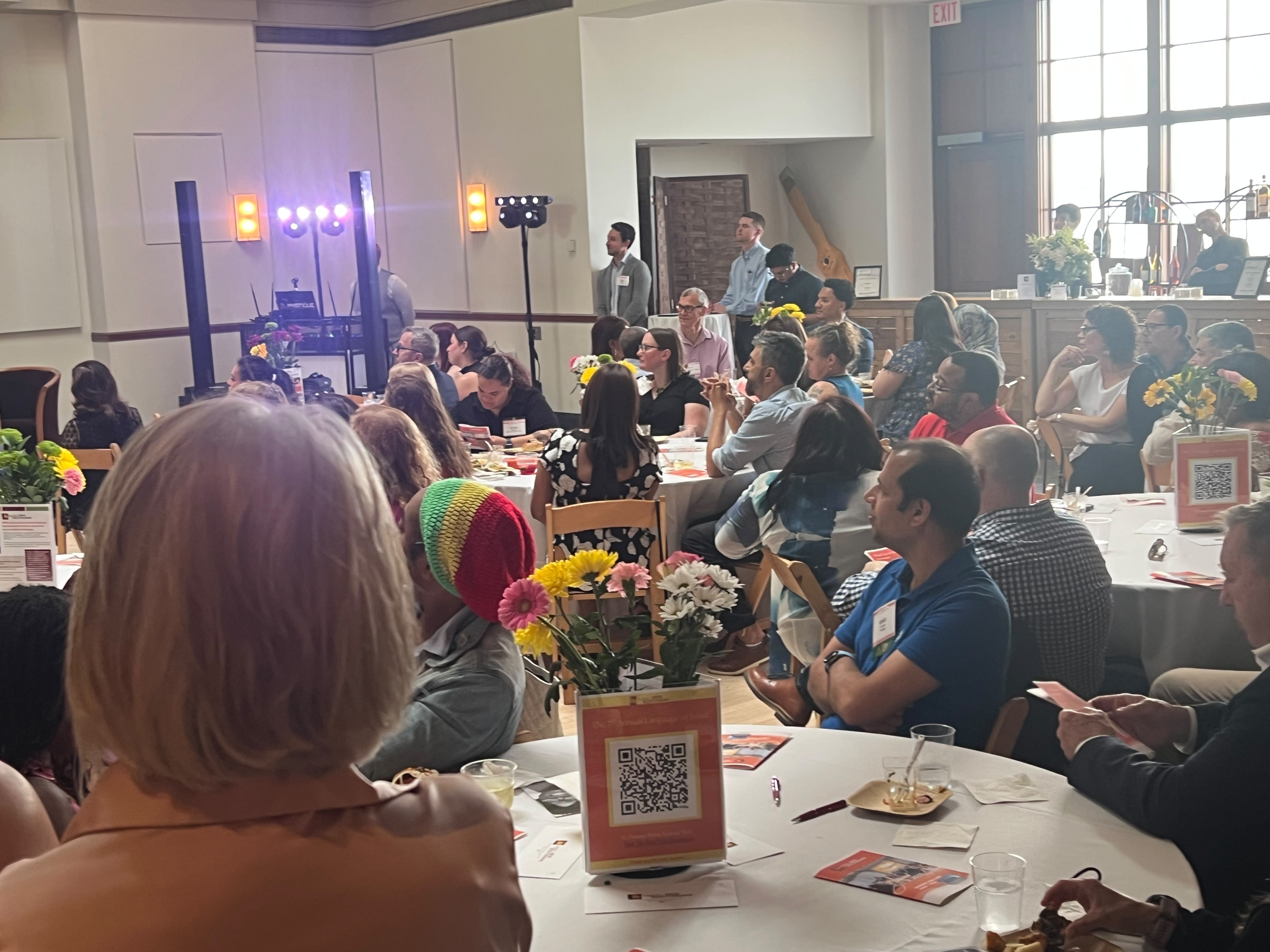
BOSTON — Amid intense pressure on immigrant communities, English for New Bostonians held its seventh annual “Language of Food” event honoring immigrant workers, chefs, and business owners in Boston’s food economy. The event nearly reached its $10,000 fundraising goal during a year when every dollar is tough to secure.
The event brought together students, supporters, community leaders, and local business owners. It honored the immigrants behind Boston’s restaurant industry. It also raised critical funds for an organization that has spent nearly a quarter-century teaching English to the city’s newest residents.
For English for New Bostonians, the evening was both a party and a lifeline. It was a chance to celebrate resilience and to sound an alarm about the financial and political pressures on immigrant communities and the nonprofits that serve them.
Executive Director Claudia Green, who has led the organization for 20 of its 25 years, told CTN in an exclusive interview at the event that the celebration carried a particular urgency this year.
“This year, we’re happy to come together to celebrate and just have fun together,” Green said. “And we also know that this has been a year of extreme pressure on immigrant communities. It’s been a really tough year. It’s been a tough year for immigrant families and immigrant workers, immigrant business owners, and nonprofits — for everyone.”
Fear, persistence, and the decision to keep showing up
Green did not soften her description of what immigrant families in Boston are going through. She spoke about a climate of fear that has changed the most basic routines. Even the decision to leave home and attend an English class is affected.
“Sometimes people are afraid to go out of their house because they’re afraid that ICE may be in the neighborhood,” Green said. “But they’re finding a way. We’re finding a way to meet people’s needs. If they want to learn remotely, virtually, they can do that. Or they can come to class.”
What struck Green most was not the fear itself, but what her students are doing despite it. “We’re so moved by the persistence that people just want to find a way to keep moving forward,” she said. “We want to remind people what the challenges are. We also want to remind them that people are persisting in English classes. They really want to move forward.”
The organization has adapted to that reality by offering remote and virtual learning options. These options are offered alongside in-person instruction. This ensures that students who feel unsafe traveling to a classroom can still access English education from home.
The organization: 25 years, 16 staff, up to 1,500 students a year
English for New Bostonians was founded in 2001 with what Green described as “about one and a half staff people.” Today it employs 16 and is preparing to celebrate its 25th anniversary. The organization serves between 1,300 and 1,500 students every year through community-based programs and workplace partnerships.
The student body reflects the full breadth of Boston’s immigrant population. Green said the organization’s classrooms include speakers of roughly 60 languages.
The largest immigrant group the organization serves is the Haitian community. In recent years, speakers of Asian languages have followed, then Spanish speakers from the Dominican Republic, Colombia, Venezuela, and other Latin American countries. Portuguese, Chinese, and Arabic speakers also make up the mix. The organization’s management structure really reflects its demographics. A significant part of ENB’s employees are immigrants.
This is the case for Wilfrix Cherazard, who came to Boston more than a decade ago. After obtaining an associate degree from the Urban College in Boston, he was hired as a career coach at English for New Bostonians, where he supported immigrants in finding employment alongside regular English classes.
ENB does not teach the classes itself. Instead, it supports many organizations by providing human and financial resources, as noted by Mr. Cherazard.
That linguistic diversity shapes the way English for New Bostonians designs its programs. “We find new and better ways to offer English classes customized to people’s backgrounds, their current roles, and their goals,” Green said. “We really try to do more of that.”
While English instruction remains the organization’s core mission, Green described a broader ecosystem of services built around the idea of meeting people where they are — literally and professionally.
“We have a team of career coaches that offer career workshops to help people start thinking about what their vision is, what they want to do in the future, and how to get there,” Green said. That includes guidance on further education, professional training, and business development, as well as one-on-one coaching sessions.
The organization also runs an immigrant entrepreneurs program. This is designed for students who want to start or grow businesses. It also offers an English track for parents and caregivers that connects language learning to raising children in a new country.
One of the organization’s most distinctive offerings is its workplace English program. It partners directly with businesses to deliver on-site English classes for employees. Green described this as one of the most effective tools in the organization’s portfolio. “When someone can’t get to an English class in the community, they can get the English training at work,” she said. “It’s a win-win for businesses because it really helps businesses’ bottom line.”
The model works for both sides. Employees gain language skills without needing extra time or transportation for classes. Employers benefit from a more confident, communicative workforce.
A funding crisis across the nonprofit sector
Green was candid about the financial pressures the organization faces. These pressures made the evening’s fundraising results even more significant. The event came close to its $10,000 target, raising just under that amount. This happened in a year when public funding has contracted, and philanthropic dollars are stretched thin across more organizations competing for support.
“It’s been a tough year,” Green said. “Public funding is a little scarcer. Many foundations have stuck with us, and we’re pleased about that. But because many nonprofits have lost public-sector funding, there’s much more pressure on philanthropy now. Many foundations can’t take on new organizations.”
The challenge, Green explained, is structural. When government funding dries up across the nonprofit sector, organizations that previously relied on public dollars all turn to the same private foundations. This flood of need makes it harder for any single organization to grow its philanthropic support, even when its mission and track record are strong.
Green said English for New Bostonians is looking to diversify its funding base by seeking support from corporations and businesses in Boston and across Massachusetts, as well as from individual donors. “We need it,” she said. “It’s a tough year in nonprofits, and it’s a tough year in immigrant communities, and we hope to stay strong.”
The “Language of Food”: why the restaurant industry
The choice to center the annual event around food and the restaurant industry is deliberate. The “Language of Food” is built on a simple premise: immigrants are the backbone of Boston’s food economy. They cook, serve, wash, manage, and own. They are the dishwashers in fine dining kitchens and the entrepreneurs behind neighborhood restaurants. Many of them are also English for New Bostonians students.
Green said the event exists “to really just lift up all those folks and remind us all who is powering this industry.” The seventh annual gathering continued that tradition. But this year, the celebration carried an undertone of defiance. In a political climate where immigrant workers are under heightened scrutiny, and their communities live with the daily weight of enforcement fears, gathering publicly to honor their contributions was itself a statement.
How to support
English for New Bostonians depends on community support to sustain its programs. Anyone who wishes to contribute — whether as an individual donor, a corporate sponsor, or a business interested in workplace English training — can visit the organization online at englishfornewbostonians.org.
Related