


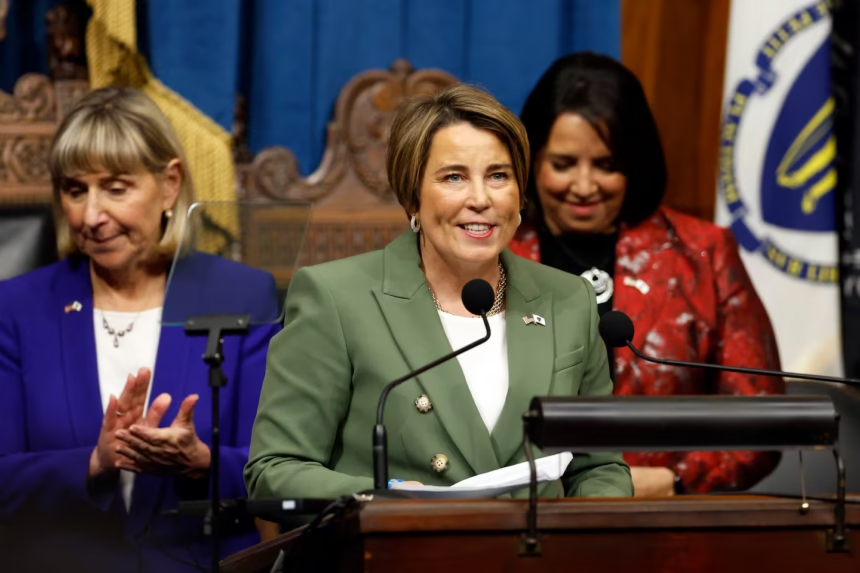
Governor Maura Healey signed an executive order Tuesday that bars data center projects from moving through state permitting unless the hosting community signs off first, and requires companies to supply their own clean energy or pay fees returned to electricity customers.
“Unless a community says yes to a data center, we are saying no,” Healey said in announcing the order.
She framed it as both a check on developers and a defense of household budgets.
“We’re giving communities a voice and laying out the rules for what needs to happen in Massachusetts,” the governor said, adding that she is “also making sure these data centers use clean energy, and that we protect people from higher energy costs — including by returning money directly back to ratepayers.”
Under the order, a developer must reach a community benefits agreement, a binding deal, measured against state standards, that spells out what a host city or town gets in return, before any state permitting can begin.
State agencies are also prohibited from signing non-disclosure agreements with data center companies, which the administration said is meant to keep the approval process transparent and fair.
The tightest requirements fall on the biggest projects. The order directs permitting agencies to require any proposed data center with peak electricity demand above 25 megawatts to show that it complies with the administration’s Data Center Framework before receiving permits. That framework, which Healey’s office calls one of the most comprehensive in the nation, expects developers to fund the full cost of the energy infrastructure and clean energy supply their projects need, protect surrounding water systems and public health, and ensure that local businesses and residents share in the jobs and investment.
At the heart of the order is a new Ratepayer Protection Fund. Data centers are expected to meet their power needs with clean energy and pay for the infrastructure to deliver it; where a company does not fully cover those electricity costs, it must pay into the fund, and that money goes back to customers. Speaking to reporters at a State House news conference Tuesday, as reported by GBH and the State House News Service, Healey said she wants companies providing their own clean energy “on day one,” and that any that cannot “are going to need to pay ratepayers for the energy that they consume until their own supply is in place.”

Energy and Environmental Affairs Secretary Rebecca Tepper said the industry can absorb the cost.
“Data centers can afford to pay for their own clean energy and infrastructure, and we’re going to make sure they do,” she said. A project, she added, “should invest in Massachusetts — bringing new clean energy and paying for the infrastructure to get it there.” Where it does not, Tepper said, “they need to be accountable to ratepayers,” warning that customers in other states have been left to “foot the bill for data centers,” an outcome she said “won’t be acceptable in Massachusetts.”
Tuesday’s order caps a summer of tightening. In late June, according to the administration’s own announcements posted on Mass.gov, Healey paused new applications for the state’s data center sales-tax exemption and released the framework, saying projects should not drive up energy costs, strain the grid or harm the environment. The executive order gives that framework enforcement power by tying it to state permits.
Driving the effort is a national surge in demand for computing power, the cloud and artificial-intelligence systems that run inside these warehouse-scale facilities, and the large amounts of electricity and water they consume.
Clean-energy advocates welcomed the move. Trish Fields of the coalition ACT said energy-intensive newcomers should help meet their own demand so existing customers don’t end up with higher bills. “By pairing economic growth with clean energy development,” she said, “Massachusetts can remain competitive, protect ratepayers, and build the reliable energy infrastructure needed for the future.”
Organized labor was equally supportive, with an eye on who builds the facilities.
Massachusetts AFL-CIO President Chrissy Lynch said the sector’s work should stay in union hands, arguing that “every job related to data centers — from supply chain to manufacturing to construction and maintenance — should be a union job,” and that the rules should guarantee the projects “support union jobs for local people” and “pay their fair share of taxes.” Mike Monahan, second district vice president of IBEW Local 103, said the order sets the right terms: the facilities “should be built with union labor, ensure residents and ratepayers aren’t subsidizing energy or water costs, and contribute to local and statewide economic growth.” His members, he said, “are ready to get to work.”

Massachusetts is not acting alone. Governors elsewhere have moved this summer to attach similar conditions as data centers spread: Pennsylvania Governor Josh Shapiro signed an order in August requiring developers to win local approval and cover the full cost of the power they draw, and Kentucky Governor Andy Beshear directed developers to protect ratepayers and pay local taxes, according to coverage of those states’ actions. Like those measures, Healey’s order screens projects rather than banning them.
For Massachusetts households already watching their utility bills, the order’s real leverage is the permit itself: a large project that will not meet the framework, the administration says, will not clear the state. How much money flows back to ratepayers, and how soon, will turn on which projects come forward — and on the community benefits agreements that cities and towns are now positioned to demand.
This article was originally written in English. Other language versions are produced using AI translation software, and errors are possible — the English version is authoritative. CTN also uses AI to convert text into audio.
https://ctninfo.com/?p=44536&preview=true
https://www.facebook.com/CaribbeanNewsMedia