



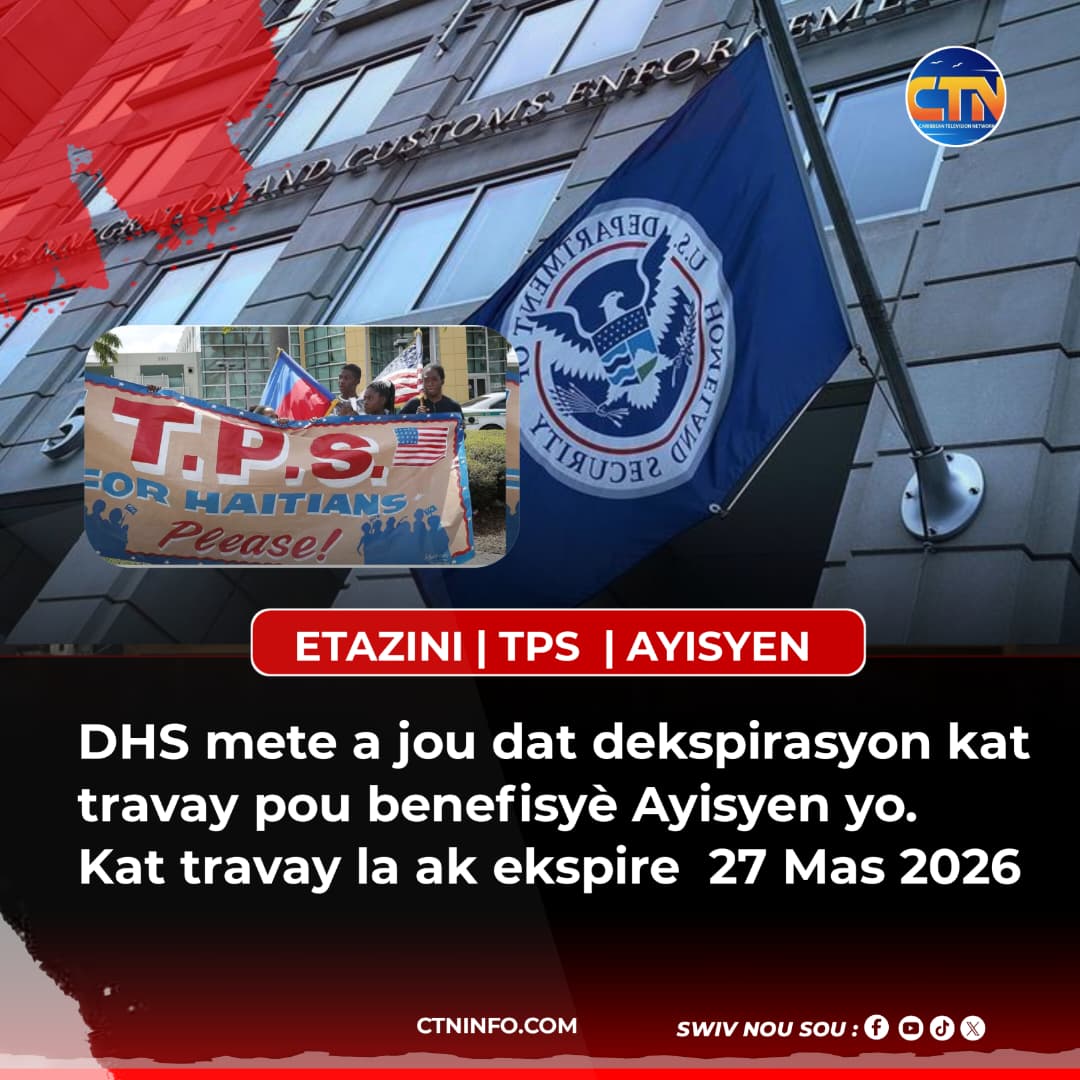
The Department of Homeland Security issued updated guidance on Friday regarding Temporary Protected Status for Haitian nationals, setting a new work permit expiration date of March 27, 2026 for eligible beneficiaries. The update, published on the USCIS website on March 13, 2026, supersedes a previous version posted on February 14, 2026, and reflects the ongoing legal battle over the administration’s attempt to end TPS protections for more than 350,000 Haitians living in the United States.
The core message for Haitian TPS holders is practical and immediate: their Employment Authorization Documents remain valid. A federal court order is keeping those work permits alive — but the deadline has moved, and both beneficiaries and their employers must update their paperwork accordingly.
The new guidance sets March 27, 2026 as the operative expiration date that employers must enter in Section 2 of Form I-9 for Haitian TPS workers. Section 1 of the form must read “as per court order.” Employers are also instructed to include a note in the additional information box and may attach printed copies of the USCIS alert and TPS Haiti webpages to the Form I-9 as supporting documentation. For E-Verify cases, the same March 27, 2026 date must be entered as the document expiration date.
This supersedes the previous guidance, which had set March 15, 2026 as the operative deadline. The shift reflects ongoing adjustments by USCIS as the litigation proceeds and court-ordered protections are periodically renewed or updated.

The Court Order Behind the Extension
The work permits are not being extended through any act of the administration. They are being kept alive by a federal court. On February 2, 2026 — one day before Haiti’s TPS was set to expire — U.S. District Judge Ana Reyes of the District of Columbia issued an order staying the termination in Miot et al. v. Trump et al., No. 25-cv-02471-ACR (D.D.C.). The ruling granted the plaintiffs’ renewed motion for a stay, effectively rendering the termination null and void while the case proceeds.
The termination itself had been announced by then-Secretary of Homeland Security Kristi Noem on November 28, 2025, published in the Federal Register as 90 FR 54733, with an effective date of February 3, 2026. Noem determined, following a review of country conditions, that Haiti no longer met the statutory criteria for TPS designation.
Judge Reyes’ February 2 order blocked that determination from taking effect. In her ruling, she held that during the stay, the termination “shall be null, void, and of no legal effect” — meaning TPS protections, including work authorization and protection from detention and deportation, remain intact as though the termination had never been issued. The order also protects individuals with pending TPS applications.
DHS stated publicly that it “vehemently disagrees” with the court’s order and has been working with the Department of Justice to challenge it.
The Supreme Court Fight
The legal battle has since escalated to the nation’s highest court. On March 11, 2026, the U.S. Solicitor General filed an emergency application with the Supreme Court in Trump v. Miot, asking the justices to stay Judge Reyes’ order and allow the TPS termination to proceed while litigation continues in the lower courts.

The administration argued that the district court improperly restricted executive authority over TPS designations, and cited earlier Supreme Court rulings — in cases involving Venezuelan TPS holders — where the justices had granted similar emergency relief to the government. The Supreme Court had not issued a ruling on that application as of the publication of Friday’s USCIS update.
That pending Supreme Court decision is precisely why TPS holders and employers are being urged to monitor the USCIS website regularly. If the Supreme Court grants the government’s emergency application, protections could end abruptly — before the March 27 date now printed on official guidance.
The USCIS guidance specifies which EADs are covered by the court order. Haitian TPS work permits with any of the following original expiration dates are extended through March 27, 2026:
February 3, 2026 — August 3, 2025 — August 3, 2024 — June 30, 2024 — February 3, 2023 — December 31, 2022 — October 4, 2021 — January 4, 2021 — January 2, 2020 — July 22, 2019 — January 22, 2018 — July 22, 2017.
These EADs carry category codes A-12 or C-19 on the face of the card. Employers are legally required to accept a facially expired EAD as valid when an automatic extension is in effect, and may face liability for refusing to do so.
What Is at Stake
Approximately 352,959 Haitian nationals hold TPS in the United States, according to court filings in Miot v. Trump. For the vast majority, TPS is not simply a legal technicality — it is the foundation of their ability to work, to avoid deportation, and to build stable lives in this country, often after fleeing conditions in Haiti that the U.S. government itself once deemed sufficiently dire to warrant humanitarian protection.
The Trump administration first moved to curtail Haitian TPS in February 2025, when Secretary Noem shortened the Biden-era extension from 18 months to 12 months. In July 2025, DHS announced its intent to terminate Haiti’s TPS designation entirely, setting off the chain of litigation that produced the February 2 court order now keeping protections in place.
For Haitian communities across Massachusetts, Florida, New York, and beyond, Friday’s update is the latest chapter in a legal saga that has defined the immigration landscape for much of the past year — one in which the courts, rather than the executive branch, are presently determining who gets to stay and who gets to work.
Haitian TPS holders and their employers should check the USCIS TPS Haiti page at uscis.gov regularly and may subscribe to automated updates for Form I-9 and E-Verify through the GovDelivery notification system.
https://ctninfo.com/?p=40649&preview=true
https://www.facebook.com/CaribbeanNewsMedia