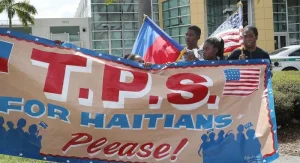


As the February 3 termination of Temporary Protected Status (TPS) for Haiti approaches, attorneys in a federal lawsuit are engaged in a discovery dispute over access to government documents that may clarify the Trump administration’s decision-making process.
January 15, 2026, court filings show significant disagreement between plaintiffs, represented by the ACLU Foundation of Northern California and allied organizations, and the U.S. Department of Justice regarding the scope of document searches, relevant custodians, and the timeline for producing evidence in National TPS Alliance v. Kristi Noem.
The dispute focuses on the Trump administration’s November 28, 2025, decision to terminate TPS for Haiti, which has provided work authorization and deportation protection to about 350,000 Haitians in the United States.
The termination, published in the Federal Register, is set to take effect on February 3, 2026, giving TPS holders just over two months before losing legal status.
TPS is granted to nationals of countries experiencing armed conflict, environmental disasters, or other extraordinary conditions that make safe return impossible. Haiti has maintained a TPS designation for years due to ongoing political instability, natural disasters, including the devastating 2010 earthquake, and persistent humanitarian crises.
Plaintiffs contend that the termination was arbitrary and capricious and violated federal immigration law. They seek access to internal government communications and decision-making documents, but the dispute over the process remains.
The January 15 court filings highlight ongoing disagreements over discovery procedures, despite previous court orders for limited extra-record discovery and prior agreements on search parameters in similar cases.
Date Range Disagreement
Plaintiffs proposed searching documents from the date of the last search through November 28 (the Federal Register publication date) to capture the full decision-making process leading to the termination.
Defendants proposed a narrower timeframe: July 15, 2025, to October 22, 2025, which would exclude earlier deliberations or policy discussions that may have influenced the decision.
The government’s position appears designed to limit the documentary record, potentially excluding evidence of preliminary discussions, policy changes following the Trump administration’s January 20, 2025, inauguration, or earlier termination attempts.
The parties also disagreed on which keywords should be used to search government emails and documents.
Both sides agreed on the basic approach: search for documents that mention “Temporary Protected Status,” “TPS,” or the legal code “1254a” (which refers to the TPS statute) along with mentions of “Haiti.”
The government proposed additional requirements that would narrow search results, suggesting that documents be flagged only if they also include specific legal phrases such as “national interest,” “extraordinary and temporary,” or discussions of the safety of returning to Haiti.
These statutory terms, defendants argued, would ensure identified records are “more likely to be relevant” and keep “the scale of the response more proportionate to the needs of the case.”
Plaintiffs objected, noting that when they tested the government’s narrow search terms on documents previously produced in similar cases, the restrictive keywords would have excluded “the vast majority of the responsive documents previously produced, including key documents related to DHS’s decisionmaking.”
For example, the narrower search terms would have excluded a key State Department email about its “consultation” on the Haiti decision, as well as emails about data searches on Haitian TPS holders, both of which are important evidence regarding the decision-making process.
The plaintiffs’ position is essentially that the government’s proposed search terms are so narrow they would filter out the most important evidence—the internal discussions and deliberations that reveal why officials decided to terminate Haiti’s TPS designation.
The government argued that without these limiting terms, the search would yield too many irrelevant documents, making discovery burdensome and disproportionate to the case.
The Custodian Battle: Who Should Be Searched?
Perhaps the most revealing aspect of the dispute involves which government officials’ communications should be searched—a question that offers insight into who was actually involved in the termination decision.
The parties agreed to search 13 custodians, including:
- DHS Secretary Kristi Noem and her Executive Secretary
- Rob Law, DHS Senior Counselor and nominee for DHS Undersecretary
- USCIS Director Joe Edlow
- Various policy analysts and division chiefs are involved in TPS decisions.
- Officials who signed the relevant clearance and approval records
However, plaintiffs sought six additional custodians that the government refused to include:
- Corey Lewandowski, DHS Senior Advisor (notably, former Trump campaign manager)
- James Percival, DHS General Counsel
- Christina McDonald, Associate General Counsel for Regulatory Affairs
- Nader Baroukh, Office of General Counsel
- Rena Cutlip Mason, USCIS Humanitarian Affairs Division Chief
- Kika Scott, former USCIS Director
The government did not explain the exclusion of these officials, stating only “No additional custodians” in their counterproposal.
The inclusion or exclusion of these custodians is significant. If Lewandowski, a political advisor without formal immigration policy expertise, was involved in the TPS termination decision, it could suggest political rather than humanitarian considerations influenced the outcome. Similarly, the involvement of multiple attorneys from the General Counsel’s office may indicate legal concerns about the termination’s justification.
Procedural Wrangling and Timeline Pressures
The January 15 filings reveal a contentious negotiation process marked by tight deadlines, multiple rounds of drafting, and disagreements over page limits and filing procedures.
Email exchanges show plaintiffs requesting quick turnaround times due to the “imminent harm to our clients from the Haiti termination” and the “imminent termination of TPS status for hundreds of thousands of Haitians.” The ACLU attorneys emphasized the urgency created by the February 3 effective date.
The government, meanwhile, cited the need to consult with clients and noted the challenges of working through the holiday period, including days when “all executive departments and agencies of the Federal Government were closed per an executive order.”
At one point, the government proposed delaying substantive discovery discussions until after the agency produces the Certified Administrative Record (CAR)—the official compilation of documents the agency considered in making its decision. Plaintiffs rejected this approach, noting that the CAR had already been produced in a parallel case (Miot v. Noem) in a different court, and offered to file it themselves if the government wouldn’t produce it promptly.
As the January 15 court deadline approached, email timestamps show attorneys exchanging drafts late at night and early in the morning. Plaintiffs indicated they would file without the government’s portion if it was not received promptly.
“We are awaiting the government’s portion of the discovery letter brief and need it promptly to be able to finalize and file this today,” ACLU attorney Emi MacLean wrote in one January 14 email. “We understood from your email yesterday that we would receive it this morning.”
Clarifying Roles: Who Drafted What?
In response to plaintiffs’ questions about which officials actually drafted key decision documents, the government provided revealing clarifications on January 15:
Policy Analyst Ofira Honig was tasked with drafting the Haiti USCIS Decision Memo, but was not involved in drafting country conditions reports. The Decision Memo is the key document that lays out the rationale for terminating or extending TPS and makes recommendations to senior leadership.
Emma Krichinsky, Research Branch Chief in the RAIO (Refugee, Asylum and International Operations) Division, did not personally draft the Haiti country conditions report but “tasked her staff members to draft the report, ensured the report was being drafted on schedule, reviewed the report, and provided guidance and editing.” She had no role in drafting the decision memo.
Rebecca Tanner, Division Chief of the Research & TRIG Division, similarly did not draft the country conditions report but “did review and provide edits to it.” She supervised the overall TPS drafting schedule and had no role in the decision memo.
These clarifications show that decision-making authority and document drafting were distributed across multiple offices and officials, making the selection of custodians particularly significant. Searching only the drafters, and not senior officials who directed or provided input, could result in missing important evidence about the decision’s motivations.
The Broader Context: TPS Under Trump
This case is part of a broader pattern of TPS terminations under the Trump administration. The legal filing references “NTPSA I” and “NTPSA II”—indicating this is at least the third iteration of litigation by the National TPS Alliance challenging Trump administration TPS decisions.
The parties’ references to previously stipulated search terms and court-ordered discovery suggest this isn’t the first time these issues have been litigated. Indeed, the plaintiffs noted that defendants “refused to accept the date ranges or search terms ordered by this Court previously in NTPSA I, or a modified list of the custodians, date ranges, and search terms stipulated by the parties in NTPSA II.”
The government maintains that each TPS termination should be reviewed “anew” despite similar legal frameworks and decision-making processes. Plaintiffs view this approach as unnecessarily duplicative and likely to delay document production.
In one email memorializing a meet-and-confer discussion, plaintiffs noted that “Defendants were looking at these RFPs ‘anew’ and that because the time period at issue was longer, the previously ordered search terms and custodians needed to be revisited.” However, the government provided no counterproposal during that discussion, despite being ordered by the court to meet and confer on these issues.
The government also cited the court’s analysis in Miot, a parallel TPS case in a different federal court, to support its more restrictive discovery approach. Plaintiffs countered that Miot is “in a different court, in a different circuit, and at a different stage of litigation without the extensive history of discovery litigation in this case.”
Additional Discovery Requests
Beyond updating the previously ordered discovery, plaintiffs also sought to serve two additional document requests:
- Communications regarding public representations of the Haiti TPS termination decision—potentially capturing how officials explained or justified the decision publicly versus what they said privately.
- Documents concerning this administration’s general policies and practices with respect to the TPS program since January 20, 2025, including:
-
- All draft and final Decision Memos for TPS decisions
- All draft and final country conditions reports for TPS decisions.
- All consultations with the State Department regarding TPS
- Communications regarding TPS periodic reviews among key officials
This second category could reveal whether there was a systematic policy change toward TPS under the new administration, rather than country-specific assessments. If similar language or reasoning appears across multiple countries’ termination decisions, it may indicate a predetermined outcome rather than individualized analysis.
The government indicated opposition to these additional requests but did not provide detailed objections in the January 15 filing.
What’s Next?
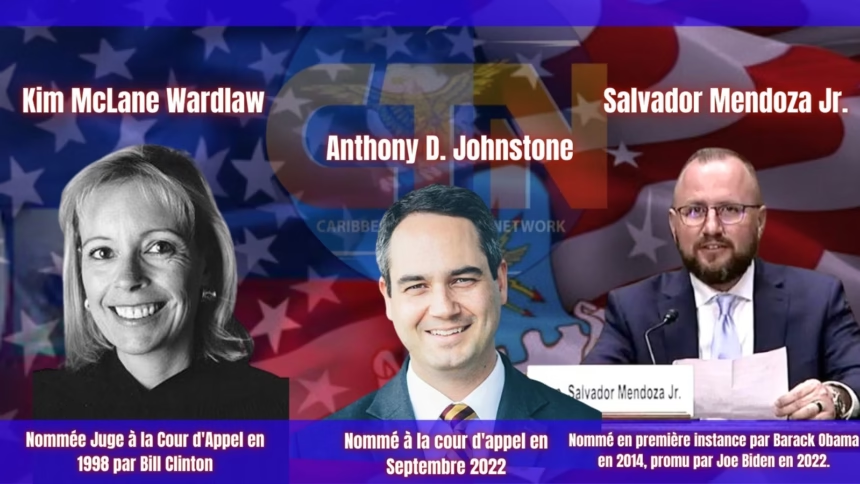
The January 15 filing is styled as “Defendants’ Notice of Proposed Search Terms, Custodians, and Dates,” suggesting the matter will now go before Magistrate Judge Kandis Westmore or District Judge Edward M. Chen for resolution.
Given the February 3 effective date, a decision is needed promptly. Plaintiffs have emphasized that without timely discovery, hundreds of thousands of Haitians may lose protected status before the legal challenge is resolved.
The discovery dispute also raises broader questions, including whether plaintiffs can obtain a preliminary injunction to prevent termination during the lawsuit and whether the administrative record alone is sufficient or if extra-record discovery is necessary.
The court scheduled a case management conference for January 13, 2026, to address some of these issues, though the January 15 filing indicates that disputes remain unresolved.
Implications for Immigration Policy
This case has significant implications beyond Haiti. The Trump administration has indicated plans to terminate or review TPS designations for several countries, potentially affecting hundreds of thousands of people from El Salvador, Honduras, Nicaragua, and others.
The legal framework established in this case, especially regarding what evidence courts may consider when reviewing TPS terminations, could shape future challenges. If courts limit review to the administrative record, it may be difficult to prove that political or improper factors influenced termination decisions.
If courts allow robust extra-record discovery as plaintiffs seek, it could reveal internal deliberations and motivations behind TPS decisions, clarifying whether terminations were based on country conditions or predetermined policy preferences.
The question of which custodians to search is significant. If political appointees such as Corey Lewandowski were involved in TPS decisions, it raises concerns about whether political considerations overrode career civil servants’ assessments. The government’s refusal to search certain custodians’ communications without explanation increases these concerns.
The Human Impact
For the 350,000 Haitian TPS holders awaiting the outcome, the legal disputes over search terms and custodians may seem abstract. However, these procedural issues will determine what evidence the court can consider and, ultimately, whether their protected status will be preserved or expire on February 3, 2026, leaving them at risk of deportation to a country facing ongoing challenges.
Many TPS holders have lived in the United States for over a decade, building families and contributing to their communities. Termination would affect not only the TPS holders but also their U.S.-citizen children, employers, and communities.
As one email in the court filing noted, the urgency is due to “the imminent loss of status for hundreds of thousands of Haitians on February 3.” The email exchanges show attorneys working through holidays and weekends to meet court deadlines, reflecting the high stakes for their clients.
Plaintiffs expressed frustration in emails. “In light of the imminent termination of TPS status for hundreds of thousands of Haitians due to Defendants’ actions, Plaintiffs would seek to have the Court order production for both the updated prior discovery (RFP Set 1) and the newly-ordered discovery (RFP Set 2) within ten days,” one email stated.
The government stated it had 30 days to respond to new discovery requests and would “consolidate their search and production related to the two sets of RFPs, meaning they do not intend to make any production of documents prior to the effective date of termination absent explicit court order.”
A Test Case for Administrative Law
Beyond the immediate impact on Haitian TPS holders, this case tests the extent to which courts can examine agency decision-making in immigration cases. The Trump administration has argued for minimal judicial review, contending that TPS terminations fall within the executive branch’s discretion and should be reviewed solely on the official administrative record.
Plaintiffs counter that when there is evidence of bad faith, improper political influence, or failure to consider required factors, courts must be able to look beyond the official record to examine the true basis for the decision. The discovery dispute centers on whether such examination will be permitted.
The outcome could affect not just TPS cases but also other immigration policy challenges, including asylum restrictions, visa denials, and enforcement priorities. If courts adopt the government’s narrow approach to discovery, it will be more difficult for challengers to prove improper motivations behind immigration decisions, even when circumstantial evidence suggests political rather than policy considerations, and determine whether the termination can proceed as scheduled or should be delayed pending fuller development of the evidentiary record. For hundreds of thousands of Haitians, the answer will determine whether they can continue building their lives in the United States or face an uncertain and potentially dangerous return to their homeland.