



Kristi Noem has provided a legal option for 600,000 Venezuelan migrants whose Temporary Protected Status was revoked, as Venezuela’s political future remains uncertain after Maduro’s capture.
Following the U.S. military operation that resulted in President Nicolas Maduro’s capture, the Trump administration has indicated that a legal pathway remains available for Venezuelans in the United States.
Homeland Security Secretary Kristi Noem announced Sunday that Venezuelans who previously held Temporary Protected Status (TPS) in the United States are now eligible to apply for asylum.
“Every individual that was under TPS has the opportunity to apply for refugee status, and that evaluation will go forward,” Noem said in an interview on “Fox News Sunday,” hosted by Gillian Turner.
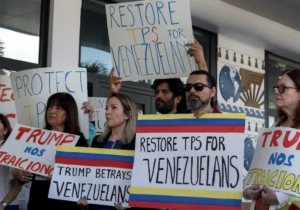
This announcement comes after Noem ended Temporary Protected Status for approximately 600,000 Venezuelan migrants earlier this year. The status, granted under the Biden administration, had allowed them to live and work legally in the United States without fear of deportation.
The end of TPS left hundreds of thousands of people uncertain about their future in the United States. Sunday’s announcement provides an alternative, though the asylum process remains lengthy and complex, with no guarantee of approval.
After the capture of Nicolas Maduro and his wife Cilia Flores early Saturday, Venezuelan migrants in South Florida celebrated the removal of the leader they blame for their country’s economic and political crisis.
These celebrations contrast with ongoing uncertainty about Venezuela’s future. President Trump stated Saturday that the United States “will run [Venezuela] until such time as we can do a safe, proper and judicious transition,” and added that American oil companies would “fix” the country’s petroleum infrastructure.
Venezuela holds the world’s largest oil reserves, a fact noted by observers who question the motivations behind the American intervention.
Caracas Refuses to Recognize Maduro’s Capture
Despite Washington’s announcements, the Venezuelan government is holding firm. Vice President Delcy Rodríguez said Saturday in a televised address to Venezuelans: “There is only one president in Venezuela and his name is Nicolás Maduro Moros.”
This defiance has not altered the Trump administration’s position. President Trump confirmed that Secretary of State Marco Rubio spoke with Rodríguez after Maduro was taken into custody and issued a warning to the vice president in an interview with Michael Scherer of The Atlantic on Sunday.
“If she doesn’t do what’s right, she will pay a very big price, probably bigger than Maduro,” Trump warned.
Secretary of State Marco Rubio outlined American priorities in an interview on NBC’s “Meet the Press,” hosted by Kristen Welker.
According to Rubio, the United States must address the flow of drugs, gangs, and sanctioned oil from Venezuela before transferring authority to new leadership.
President Trump justified this cautious approach: “We don’t want to be involved with having somebody else get in, and we have the same situation that we had for the last long period of years,” he said Saturday.
An Uncertain Future for Venezuelans on Both Sides
For the 600,000 Venezuelans in the United States whose TPS has been revoked, Kristi Noem’s announcement offers hope, but the path forward remains challenging. Applicants for refugee status must demonstrate a well-founded fear of persecution in their home country, which may be difficult given the recent overthrow of the Maduro regime.
Venezuelans who remain in their country also face uncertainty, as the American government has stated it will temporarily oversee Venezuela and foreign oil companies are preparing to access its natural resources.
The international community, divided over the legality of the American intervention, is watching the situation with concern. The outcome could reshape global relations between major powers and resource-rich nations.
Source: The Hill
