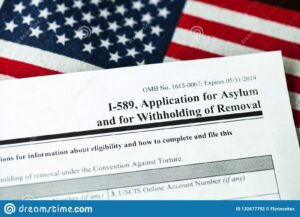
Effective December 31, U.S. authorities will be able to reject asylum applications from migrants deemed to pose a public health risk due to communicable diseases.
A new legal weapon has been added to the Trump administration’s arsenal in its immigration restriction policy. A regulation published in the Federal Register, the official journal of the U.S. government, now authorizes authorities to deny asylum to migrants deemed to pose a health risk related to contagious diseases.
This measure, which takes effect on New Year’s Eve, revives memories of the mass expulsions carried out under Title 42 at the beginning of the COVID-19 pandemic, when the Trump administration invoked the public health emergency to rapidly expel thousands of migrants at the southern border.
The regulation, jointly developed by the Department of Homeland Security (DHS) and the Department of Justice (DOJ), substantially modifies the initial assessment procedures for asylum applications, known as “credible fear” interviews.
Morgan Bailey, a partner at Mayer Brown and former senior DHS official, analyzes the practical implications of this reform for Newsweek: “Migrants who might previously have proceeded to a full asylum merits hearing could now be screened out earlier, including when conduct falls into gray areas.”
In practical terms, this provision grants immigration officers greater discretion to close cases at the preliminary stage, thereby reducing the likelihood that uncertain cases will be referred to immigration judges. The system would now favor quick resolutions over individualized analysis, particularly for applicants with incomplete testimony or delayed evidence.
A Geographic Designation Mechanism
One of the most significant aspects of the new regulation is the administration’s ability to jointly designate countries or regions experiencing communicable disease outbreaks that pose a risk to U.S. public health.
These designations can then be applied when adjudicating asylum claims and withholding of removal requests. This provision paves the way for restrictions potentially targeting entire populations based on their geographic origin and their country’s epidemiological situation.
Immigration attorney Gnanamookan Senthurjothi underscores the underlying security rationale: “It underscores the government’s national security focus by permitting denial of asylum to individuals who pose security, criminal, terrorism-related, or serious public health risks.”
This regulation is not new. Originally issued in December 2020, during Donald Trump’s first term, it was delayed multiple times. The Biden administration, while delaying its effective date five times, never took the initiative to permanently revoke it.
In the meantime, DHS and DOJ amended related regulations, creating technical challenges in codifying the 2020 rule. The current action withdraws certain technical amendments from the original version while preserving its main public health-related provisions.
This complex legislative history reflects persistent tensions between administrations over immigration, as well as a certain continuity in the restrictive approach, with the Biden administration choosing not to completely dismantle its predecessor’s regulatory legacy.
Implications for Asylum Seekers
It should be noted that the regulation does not automatically disqualify migrants, nor does it retroactively affect previously granted asylum cases. Nevertheless, its prospective effects concern immigrant rights advocates. For instance, consider a 2026 applicant: upon arrival at the border, they could face preliminary health screenings more thorough and discretionary than before, potentially preventing them from proceeding to a full asylum hearing if deemed a public health risk.
Morgan Bailey emphasizes the practical consequences for applicants: “The effect is forward-looking. This means that advance preparation is even more important, and applicants should ensure consistency across interviews, forms, and declarations or provide a clear explanation for inconsistencies or aspects that could be misunderstood. Early legal intervention is more valuable than ever.”
For its part, USCIS (U.S. Citizenship and Immigration Services) justifies these changes in an official statement: “These changes allow DHS and DOJ to retain the ability to consider public health risks as a security risk bar to asylum and withholding of removal in the event of a public health emergency.”
This new rule is part of a series of restrictive measures adopted since Donald Trump’s return to the White House last January. The administration has implemented policies limiting pathways to legal immigration, including stricter eligibility requirements for visas, green cards, and asylum, as well as suspensions of certain immigration programs.
In December, the administration suspended green card and U.S. citizenship applications for thousands of immigrants from 19 countries previously subject to a travel ban. This decision followed an incident involving an Afghan national accused of shooting two West Virginia National Guard members in Washington.
The refugee admissions cap has been set at 7,500 for the fiscal year 2026, a historically low level. On the social network Truth Social, President Trump reaffirmed his vision in November: “I will permanently pause migration from all Third World Countries to allow the U.S. system to fully recover.” However, a report from the Department of State shows that visa issuance numbers, while reduced, have not ceased. For instance, in the previous fiscal year, over 300,000 visas were still issued globally, indicating a significant gap between the messaging and the policy’s actual implementation.
Dissenting Voices
Not all experts consider this measure necessary. Immigration attorney C. Matthew Schulz expressed his skepticism on LinkedIn: “Asylum is a discretionary benefit in US law. New rule is unnecessary.”
This observation raises a fundamental question: if asylum is already a matter of discretionary authority, is adding new grounds for denial truly meant to fill a legal gap, or does it rather constitute a political signal intended to discourage potential applicants?
Since Trump’s return to power, the number of migrants crossing the southern border unlawfully has fallen to its lowest level in decades. This statistic, regularly highlighted by the administration, suggests that the deterrent effect of restrictive policies may be as significant as their actual enforcement.
The rule takes effect on December 31, as millions of Americans celebrate the New Year. For asylum seekers and their attorneys, 2026 begins under the sign of increased legal uncertainty.
https://x.com/CtNinfo/status/2006140347420664312
https://x.com/CtNinfo/status/2006140347420664312