


Amid allegations of corruption against its own members, the CPT passes a measure critics call a “legal shield” designed to guarantee impunity, less than two months before its mandate expires.
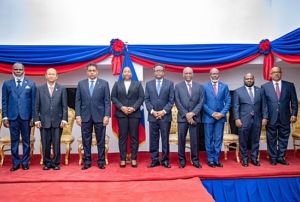
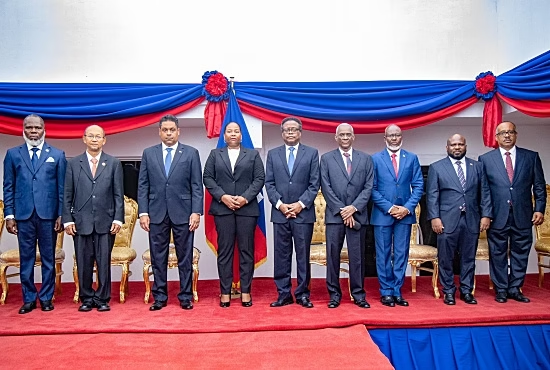
Against a backdrop of heightened political tensions and corruption allegations targeting some of its members, Haiti’s Transitional Presidential Council (CPT) has adopted a decree defining the organization and functioning of the High Court of Justice. Published in the official government gazette, Le Moniteur, on Wednesday, December 17, 2025, the text is presented as a tool to strengthen the rule of law and combat impunity. Historically, previous attempts at establishing a High Court in Haiti have faced challenges due to constitutional ambiguities and political influences, often resulting in ineffective implementations. This new decree is being sharply denounced by numerous observers as a legal maneuver designed to protect the transitional authorities themselves, with less than two months remaining before the theoretical end of their mandate.
The seven-page decree is based on an initial preamble citing a “legal vacuum characterized by the absence of an Organic Law” and its harmful consequences for democracy. It aims to regulate the procedure for indicting and trying “senior State officials” before the High Court of Justice, as provided for in Article 186 of the Constitution.
This exceptional jurisdiction, formed when the Senate constitutes itself as a court, has authority to try the President of the Republic, the Prime Minister, ministers, members of the Permanent Electoral Council and the Superior Court of Accounts, judges and prosecutors of the Court of Cassation, as well as the Citizen Protector, for crimes and offenses committed in the exercise of their duties.
The potential democratic costs of this decree cannot be overlooked. Does a court that cannot convene spell permanent immunity for those in power? The text meticulously details the procedure: referral by the Chamber of Deputies by a two-thirds majority, investigation by a senatorial commission, and trial by the High Court, whose verdict, whether conviction or acquittal, must also be adopted by a two-thirds majority of senators. Penalties range from removal from office to a ban on holding any public position for 5 to 15 years. However, with the Chamber of Deputies and the Senate vacant for years, the viability of these procedures is highly questionable.
A Decision Met with Anger and Suspicion
The publication of this decree has sparked an outcry. For many jurists, political actors, and civil society members, the timing is anything but coincidental.
Some argue that this decree was hastily adopted while presidential councilors of the CPT are directly implicated in scandals involving embezzlement of public funds and corruption. The publication of this decree has sparked an outcry. For many jurists, political actors, and civil society members, the timing is anything but coincidental.
However, members of the CPT have defended Article 26 as a necessary step to stabilize governance during this precarious transitional period. “We believe that Article 26 is essential to maintain continuity and protect state functions from disruption,” stated a CPT representative. “This will assure our government can continue its operations unhindered while we work towards establishing a permanent Parliament.”
The decree comes amid the complete absence of a functioning Parliament. The Chamber of Deputies and the Senate have been vacant for years, making the implementation of the cumbersome procedures required by the text virtually impossible in the immediate term.
“They are decreeing a procedure that requires a Parliament, while they have failed to organize elections to reconstitute one. It’s a perfect vicious circle that guarantees impunity,” observed a human rights activist.
The harshest criticism concerns the timing of this adoption
The CPT’s mandate, originally scheduled to expire on February 7, 2026, is entering its final phase.
Several voices argue that this decree is a “parachute” or “legal shield” tailor-made for Council members, anticipating potential prosecutions once their functional immunity is lifted.
Article 26 of the decree is particularly revealing: it expressly extends the provisions concerning the President of the Republic to the presidential councilors of the CPT.
This Article 26 stipulates that the rules applicable to the President of the Republic “are applicable both for the present and for the future to Presidential Councilors,” thus placing them under the exclusive umbrella of the High Court of Justice for acts committed during their transitional mandate.
The decree also seeks to clarify—or lock down—the division of jurisdictional authority. Article 13 stipulates that ordinary courts cannot hear cases involving offenses committed by a high official in the exercise of their duties, as such cases fall within the exclusive jurisdiction of the High Court. They must recuse themselves in favor of the latter.
This provision is perceived as a means of obstructing ongoing or future judicial investigations conducted by independent investigating judges against figures in power, by invoking the incompetence of ordinary courts. Legal analysts estimate that up to 100 pending corruption files could be affected by this jurisdictional change, potentially delaying justice and allowing alleged corruption to persist unchecked.
Another decree adopted by the CPT, concerning defamation, is also drawing criticism
Pierre Espérance, Executive Director of the National Human Rights Defense Network (RNDDH), considers it a direct attack on freedom of expression. The human rights defender argues that this text opens the door to abusive restrictions against one of the freedoms hard-won by the Haitian people. This decree introduces penalties for defamation that contrast starkly with regional norms on press freedom, highlighting a growing tension between governmental control and civil liberties. By juxtaposing these defamation penalties with recognized regional standards of press freedom, the broader scope of critique against the CPT’s measures becomes evident. Together, these decrees are perceived as tools that jointly squeeze civil society, stifling free speech while enforcing a legal environment conducive to suppressing dissent.
Officially, the transitional government defends this decree as a historic advance. In its explanatory memorandum, the Transitional Presidential Council claims to want to “end a cycle of impunity” and facilitate the indictment of senior state officials. The Ministry of Justice views it as a necessary tool to guarantee a fair trial with procedural safeguards before a special and solemn jurisdiction.
Yet on the ground, skepticism prevails. The international community, which is closely monitoring the transition, has not yet officially reacted. Civil society groups are already calling for mobilization against what they describe as an “institutional coup.” A pressing question lingers: How will Haiti’s aid partners react if its accountability mechanisms continue to erode? The potential responses from these international stakeholders could significantly influence the country’s political landscape and any future support mechanisms.
As the countdown to the February 7, 2026, deadline has begun, this High Court of Justice decree adds to the numerous political disputes clouding Haiti’s horizon. It is perceived less as an instrument of accountability than as the final act of a transitional government anxious to shield itself from the consequences of its own governance.
In light of a call for greater transparency and accountability, it is now crucial for the CPT to introduce clear, measurable benchmarks to define the decree’s success.