

In a rare bipartisan gesture during a period of heightened political divisions, the United States Congress took a decisive step yesterday toward renewing the HOPE/HELP preferential trade program, an economic pillar for Haiti and an important link in the Caribbean textile supply chain. The bill was approved by the House Ways and Means Committee and must now be submitted to a full House vote, before consideration by the Senate, reports Dominican newspaper DiarioLibre.
Presented as both a humanitarian and strategic measure, this renewal aims to extend a regime that has allowed, for nearly two decades, textile and apparel products manufactured in Haiti to enter the American market duty-free or with preferential rates. Its expiration, which occurred on September 30, had raised major concerns about the future of tens of thousands of jobs and an entire fragile regional economy.
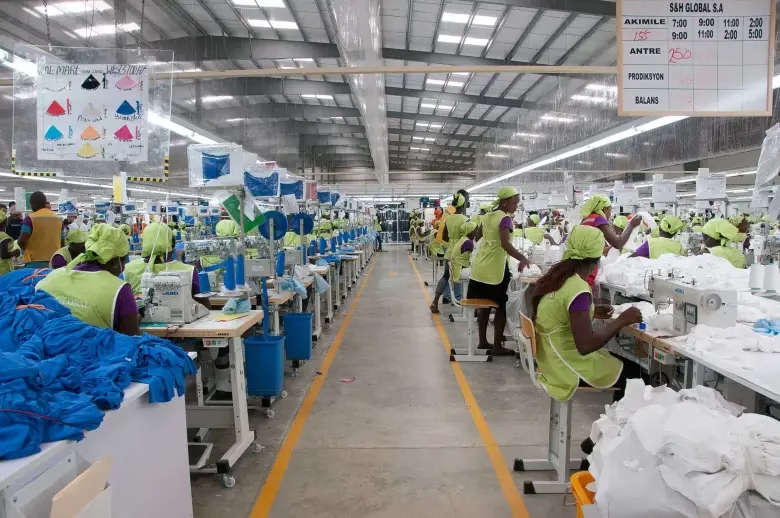
Created in 2006 under the name HOPE (Haitian Hemispheric Opportunity through Partnership Encouragement), then expanded and strengthened after the devastating 2010 earthquake under the acronym HELP (Haiti Economic Lift Program), this mechanism was designed as an economic lifeline. It has progressively transformed the textile sector into the main driver of Haitian exports, representing more than 80% of the country’s foreign sales in 2022.
“Fair and mutually beneficial trade relations with Haiti create jobs and stability in a country marked by a long history of humanitarian crises. Haiti’s prosperity contributes to US security,” stated Jason Smith, Republican chairman of the Ways and Means Committee, when presenting the legislation. His legislative analysis emphasizes that strengthening Haiti’s economy is essential to “reduce regional instability and address migration challenges.”

The program’s impact extends far beyond Haiti’s borders
It has woven tight economic interdependence with the Dominican Republic, its immediate neighbor. Textile imports under HOPE/HELP involve an entire regional logistics network: ports of entry for raw materials, ground transporters, shipping companies, as well as fabric, label, thread, and packaging factories, a significant portion of which is located on Dominican territory.
Fernando Capellán, president of the Codevi border industrial park (located in Juana Méndez/Ouanaminthe on the Haitian side, and linked to Dajabón on the Dominican side), quantified this leverage effect: for every three jobs created in Haiti, one formal job is generated in the Dominican Republic. This economic symbiosis has enabled the production, under this regime, of clothing for American giants like Hanes, Calvin Klein, Gap, and Victoria’s Secret.
In a Haitian context marked by paralyzing gang violence, a profound political crisis, and institutional collapse, the textile sector supported by HOPE/HELP has constituted one of the last bulwarks against total economic shipwreck. At its peak in 2021, the sector directly employed approximately 60,000 Haitians, providing stable income to hundreds of thousands of people, predominantly women.
The program has also attracted foreign investors who, despite the risks, have maintained production units, drawn by geographic proximity to the United States and tariff advantages. Its sustainability is therefore perceived as a signal of continuing American commitment to Haiti, beyond emergency aid and security interventions.
A Legislative Path Still to Be Completed
Although enjoying broad historic bipartisan support, the bill is not yet adopted. It is integrated into a larger legislative package covering trade, taxpayer rights, federal fraud, and Medicare. Its fate remains tied to political negotiations on this package.

Observers note, however, that Haiti’s economic and humanitarian urgency, coupled with America’s strategic interest in curbing instability in its “backyard,” strongly argue for rapid adoption.
The renewal of HOPE/HELP is much more than a simple trade clause. It is a socio-economic safety net for a nation in extreme crisis, and a regional stabilizer. Its adoption would send a clear message: faced with collapse, the United States chooses, for now, to maintain an economic bridge rather than limit itself to security assistance. The question now is whether Congress as a whole will confirm this approach and at what pace, while each day of uncertainty weighs on the survival of an industry and the stability of an entire region.

https://ctninfo.com/?p=38762&preview=true
https://www.facebook.com/CaribbeanNewsMedia