

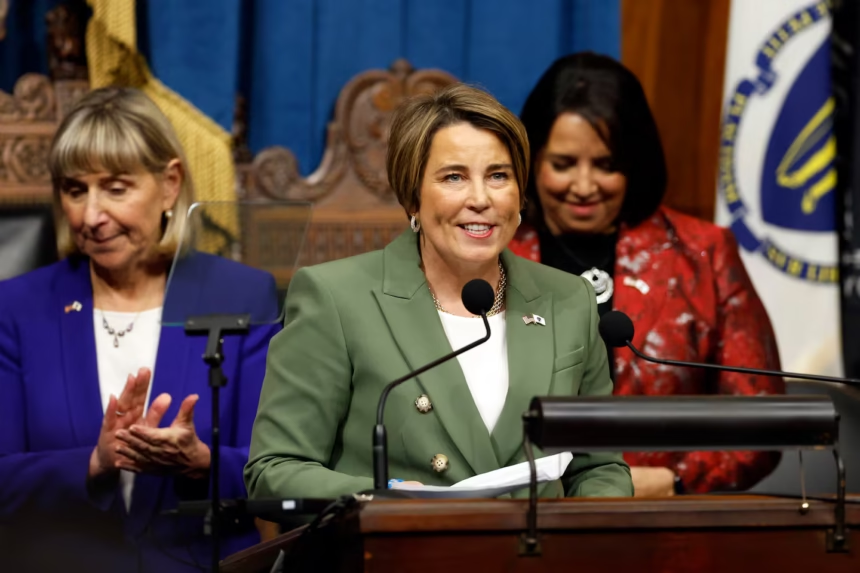
Confronted with a severe housing shortage, Massachusetts Governor Maura Healey and Lieutenant Governor Kim Driscoll announced Wednesday the launch of a new funding initiative: the Commercial Conversion Tax Credit Initiative (CCTCI).
The program, backed by $10 million in 2025, is designed to convert underused commercial buildings into residential or mixed-use projects, with the goal of revitalizing downtowns and expanding the state’s housing supply.
“Massachusetts is moving faster to create affordable housing and breathe new life into our downtowns,” Governor Healey said in a statement. “This new tax credit helps communities turn empty commercial spaces into homes – bringing back residents, energy, and customers for small businesses on our main streets, while directly addressing the housing shortage.”
For several years, Massachusetts has been grappling with rising home prices and rents, the direct result of limited supply. According to state officials, this shortage is impacting not only low- and middle-income families but also the broader economy.

Housing has been a top priority for Governor Healey since she took office. After securing passage of the $5 billion Affordable Homes Act in 2024, her administration is now expanding its toolkit with this targeted incentive.
“Local leaders tell us the same thing: they need practical tools to unlock projects that are ready to go,” said Lieutenant Governor Driscoll. “By prioritizing adaptive reuse and projects already consistent with zoning, this program will speed up the delivery of housing while supporting the economic revitalization of our downtowns and neighborhoods.”
The initiative will be administered by the Executive Office of Housing and Livable Communities (HLC). In 2025, the state expects to award up to $10 million in one competitive round. Typical grants will range between $2.5 and $3 million per project, covering up to 10 percent of eligible costs.
“This is a targeted credit focused on jumpstarting commercial-to-residential conversions,” said Housing Secretary Ed Augustus. “A little help can go a long way toward creating the housing we need and reviving downtowns.”
Eligibility criteria are strict. Both nonprofit and for-profit developers must obtain HLC certification as a Qualified Conversion Project. Sign-off from the community’s chief elected official is required, and local contributions are strongly encouraged.

Priority will be given to larger projects with at least 50 units, those with necessary zoning already in place, and those supported by municipal funding. The program is open statewide, with particular consideration for communities that previously received assistance through MassHousing’s Commercial Conversion Initiative in 2024–2025.
The Healey-Driscoll administration emphasized that the new initiative builds on progress already underway. Earlier this year, state funding supported two office-to-housing conversion projects in downtown Boston. The CCTCI is intended to expand this approach across Massachusetts.
Since 2023, the creation of the Executive Office of Housing and Livable Communities has helped centralize the state’s housing strategy. Along with the Affordable Homes Act, the administration has rolled out a series of complementary measures: the MBTA Communities Law, the Momentum Fund, the State Land for Homes initiative to make state-owned land available for housing, as well as significant increases in housing tax credits and subsidies. More recently, the state also banned renter-paid broker fees, a move welcomed by tenant advocates.
For Governor Healey, the goal is twofold: addressing the urgent housing shortage while revitalizing urban centers and commercial corridors weakened by store closures and the pandemic.
“Turning vacant spaces into places to live also brings vitality, families, and consumers back into our neighborhoods,” Healey stressed.
Lieutenant Governor Driscoll highlighted the program’s focus on speed: “We know there are sites ready and waiting for the right financial and administrative boost to move forward. This program is designed to move quickly and unlock those projects.”
Developers and municipalities interested in applying can find official guidelines and instructions online. The HLC will announce the precise application timeline in the coming weeks.
As housing needs continue to grow, the new program represents not only a lifeline for many local communities but also a key test of the Healey-Driscoll administration’s ability to deliver on its housing strategy amid a deepening crisis.
https://ctninfo.com/?p=36333&preview=true
https://www.mass.gov/info-details/commercial-conversion-tax-credit-initiative