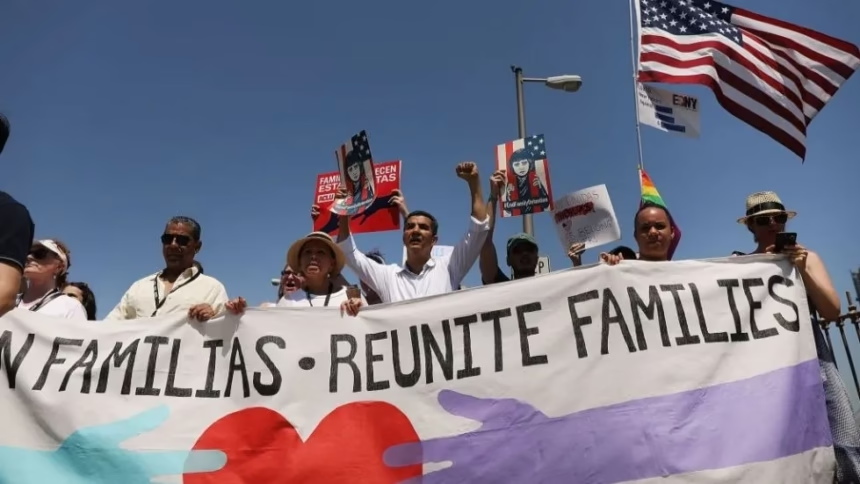
The US Department of Homeland Security (DHS) announced on Friday the termination of all family reunification parole programs for seven Latin American and Caribbean countries. This decision directly affects thousands of Colombian, Cuban, Ecuadorian, Salvadoran, Guatemalan, Haitian, and Honduran nationals, as well as their immediate family members.
In a statement released Wednesday, DHS justified this drastic measure by citing security concerns and accused the previous administration of misusing humanitarian parole provisions.
A Break with Humanitarian Immigration Policies
“This administration is ending the abuse of humanitarian parole, which allowed poorly vetted aliens to circumvent the traditional parole process,” the department stated in its official release. The Trump administration maintains that these programs were never designed to function in this manner and now intends to return to case-by-case review, as originally intended by Congress.
DHS presents this decision as “a necessary return to common-sense policies and a return to America First.” According to the federal agency, the family reunification programs had “security gaps caused by insufficient vetting that malicious and fraudulent actors could exploit to enter the United States, which posed an unacceptable level of risk.”
In its rationale, the department emphasizes that “the desire to reunite families does not overcome the government’s responsibility to prevent fraud and abuse and to uphold national security and public safety.” The administration thus claims to prioritize “the safety, security, and financial and economic well-being of Americans.”
A Tight Timeline for Thousands
A Federal Register notice specifies the implementation procedures for this termination. For aliens admitted to US territory under these programs whose parole has not yet expired on January 14, 2026, it will automatically terminate on that date.
One notable exception is provided: if an individual has filed Form I-485 (Application to Register Permanent Residence or Adjust Status) that was mailed or electronically filed no later than December 15, 2025, and that application is still pending on January 14, 2026, their parole will remain valid. In this case, the status will be maintained “until either their period of parole expires or we make a final decision on their pending Form I-485, whichever is sooner,” the statement specifies.
If the I-485 application is denied, “their period of parole will be terminated, and they should depart the United States immediately,” DHS warns.
Revocation of Work Authorization
The end of parole automatically triggers revocation of the work authorization derived from it. “When we terminate an alien’s period of parole under the FRP programs, we also will revoke their employment authorization based on that parole,” the agency states. Each affected individual will receive a notification from the department informing them of the termination of their status and the revocation of their work permit.
For individuals who will no longer have a legal basis to remain in US territory after program termination, DHS requires departure before their parole termination date. “Aliens who do not have a lawful basis to stay in the United States after termination of the FRP programs must depart the United States before their parole termination date,” the statement emphasizes.
The department encourages these individuals to use the CBP Home app to report their intent to leave the country. Incentives are offered, including “an exit bonus, financial and travel document assistance, and forgiveness of civil fines” for qualifying individuals.
This decision is part of the Trump administration’s broader strategy to restrict immigration and end programs it considers too permissive. It particularly affects Haitian, Central American, and South American communities that had benefited from these programs to reunite with family members already established in the United States.