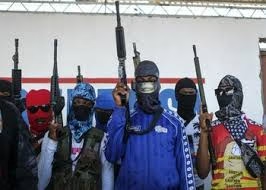



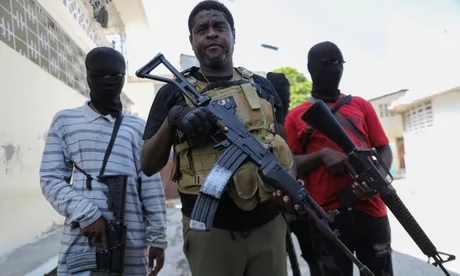
On social media, especially Facebook, Friday’s discussions focused mainly on the U.S. administration’s decision to label the Haitian gangs Viv Ansanm and Gran Grif as foreign terrorist organizations.
Many people felt happy, hoping these gangs would finally be eliminated. These strong reactions are understandable, given how much the population has suffered from the violent acts of these criminals.
Many also believe that this decision will push the international community, led by the United States, to provide more resources to support the Multinational Security Support Mission and the Haitian National Police.
Some resources, though limited, are being given to security forces, but they are still not enough. This designation by itself will not bring major change, as seen in other countries with similar problems.
However, it is almost certain that the consequences for the country could be severe.
At first, I thought of ten important points, but I realized they could be grouped into just two main categories, though the others still matter.
In this article, we look at two main consequences for a country whose groups are labeled as foreign terrorists.
1. Regional Security Concerns
If you read the State Department’s statement, you probably saw several sections stating that Viv Ansanm and Gran Grif pose a threat to regional security.
Simply put, these armed groups are a danger not only to Haiti but also to nearby countries, especially the Dominican Republic.
At the last United Nations General Assembly, Dominican President Luis Abinader asked for Haitian gangs to be classified as terrorist organizations. He made the same request again when U.S. Secretary of State Marco Rubio visited the Dominican Republic, soon after his Senate confirmation.
In a 2001 document titled “Combating Terrorism within the Framework of International Law,” the United Nations recognizes a country’s right to enter a neighboring territory—provided the purpose is to combat a terrorist organization.
This principle has already been applied in Afghanistan, Iraq, Libya, and Lebanon, among others. However, the document also notes that any intervention must respect international conventions and treaties.
Based on this principle, President Abinader could legally send his armed forces into Haiti for counterterrorism reasons, especially since some Haitian gangs are already moving toward the border areas.
2. Economic Isolation
Sanctions linked to this designation could scare off foreign investment and hurt trade, worsening an already serious economic situation.
At first, it might seem like the impact would be small because investment in Haiti is already low. But the effects are real, especially for the financial system, including banks, money transfer services, and microfinance institutions.
International financial institutions may impose additional restrictions, which could slow remittances. These money transfers from the Haitian diaspora are crucial for millions of families and for the national economy.
This economic isolation could also directly affect humanitarian aid, which has sadly become essential for many people in Haiti.
NGOs might face legal obstacles because they have to avoid any contact, even indirect, with groups labeled as terrorists. Some governments may even warn their citizens against joining humanitarian missions in Haiti. According to the United Nations, the World Food Program has provided assistance to about 1.4 million people in Haiti so far and aims to reach 2.2 million by the end of the year.
In short, for those who hope that calling these criminal groups terrorist organizations will make Haiti safer, I am not saying the opposite.
But it is clear that this step will have wide-ranging effects.
This is not just being pessimistic. The experiences of other countries in similar situations show that we should think carefully about what could happen.
That is why it is important for this designation to be accompanied by real, well-organized international support to mitigate its negative impact on people and local institutions.