


While President Donald Trump has intensified his anti-immigration rhetoric and policies, one of his businesses continues to rely on foreign labor, now at a lower cost due to a recent regulatory change implemented by his administration.
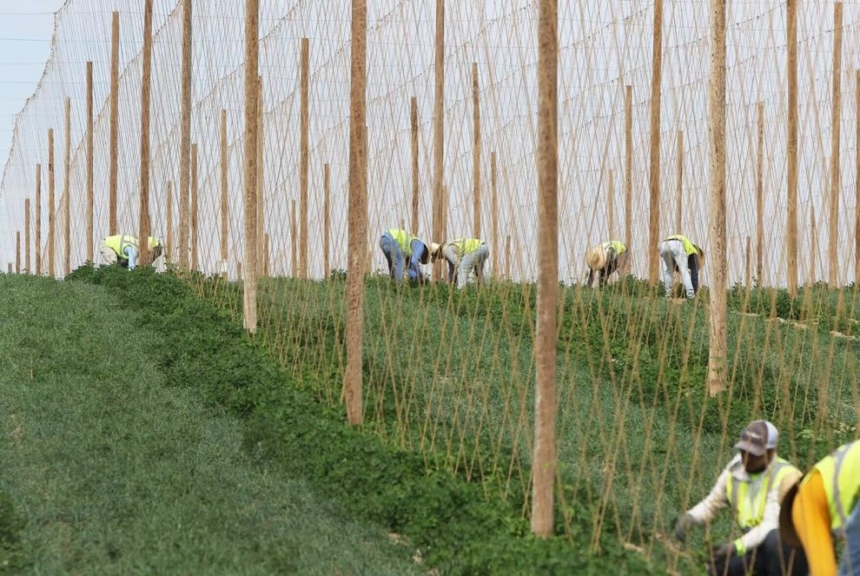
According to official documents reviewed by Forbes, the Trump Organization filed an application with the Department of Labor to recruit 36 foreign agricultural workers for its Virginia vineyard through the H-2A temporary visa program. The contracts would cover the period from February to October 2026, with an hourly wage set at $13.90.
This wage is significantly lower than what the company paid the previous year.
In 2025, workers in similar positions received $15.81 per hour, nearly two dollars more. According to Department of Labor records, this is the lowest wage the vineyard has offered in at least 4 years.
This wage adjustment follows an October 2025 change by the Trump administration, which revised the federal methodology for calculating the minimum wage for certain temporary foreign agricultural workers.
The reform concerns the “adverse effect wage rate (AEWR),” a mechanism designed to prevent foreign workers’ hiring from exerting downward pressure on American workers’ wages.
The new rule, which took effect immediately as an interim regulation, lowered wage thresholds in several states and job categories. Two months later, the Trump Organization filed its application, directly benefiting from this employer-friendly change.
In its filing, the company states it was unable to recruit enough American workers and asserts that hiring foreign workers will not negatively affect local wages or working conditions, as required by law.
Structural Dependence on Foreign Labor
Forbes’ investigation shows that since 2008, the Trump Organization has sought to bring at least 2,069 foreign workers to the United States, primarily through the H-2A (agriculture) and H-2B (hospitality and leisure) programs.
During Donald Trump’s presidency, Forbes reported that his businesses requested 602 foreign workers, according to federal data. These figures contrast with the president’s political rhetoric, in which he asserts that immigrant workers deprive Americans of jobs and contribute to wage stagnation.
While Donald Trump rarely criticizes the use of foreign labor in agriculture, he remains a leading advocate for stricter immigration policies, particularly regarding visas for skilled workers.
During his second term, the Trump administration intensified immigration controls and strengthened ICE operations. H-1B visas, intended for highly skilled workers, were particularly targeted. In September, a measure was announced imposing fees of up to $100,000 for certain H-1B applications.
In contrast, the H-2A and H-2B programs used by the president’s businesses have not faced similar restrictions. This difference has led some observers to criticize the administration for a selective immigration policy.
Neither the White House nor the Trump Organization responded to Forbes’ requests for comment.
The October 2025 wage reform has faced strong opposition in the agricultural sector. The Economic Policy Institute estimates it could result in an annual loss of approximately $3 billion in income for U.S. agricultural workers.
In November, the United Farm Workers union, along with 18 agricultural workers, filed a lawsuit against the Department of Labor. The plaintiffs argue that the reform violates federal law by weakening protections designed to prevent wage and working condition deterioration.
The Department of Labor defends the measure, claiming it will promote legal hiring, generate approximately $200 million in economic benefits annually, and enable the recruitment of nearly 119,000 additional agricultural workers.
A President Still Tied to His Business Interests
Donald Trump remains authorized to receive income from his businesses through the Donald J. Trump Revocable Trust, where he is the sole beneficiary. His son, Donald Trump Jr., manages the trust. Regulatory documents confirm that the president retains effective control over his business activities during his term.
According to Forbes, Donald Trump’s personal fortune is now estimated at $6.7 billion, a sharp increase since his return to the White House. This rise is largely attributed to his recent investments in cryptocurrency.
The Trump Organization is expected to file additional seasonal visa applications in the coming months, particularly for its golf resorts in New Jersey. The lawsuit challenging the federal wage reform is ongoing, with no clear timeline for a final decision.

Source: Forbes, investigation by Zach Everson, January 2026.