



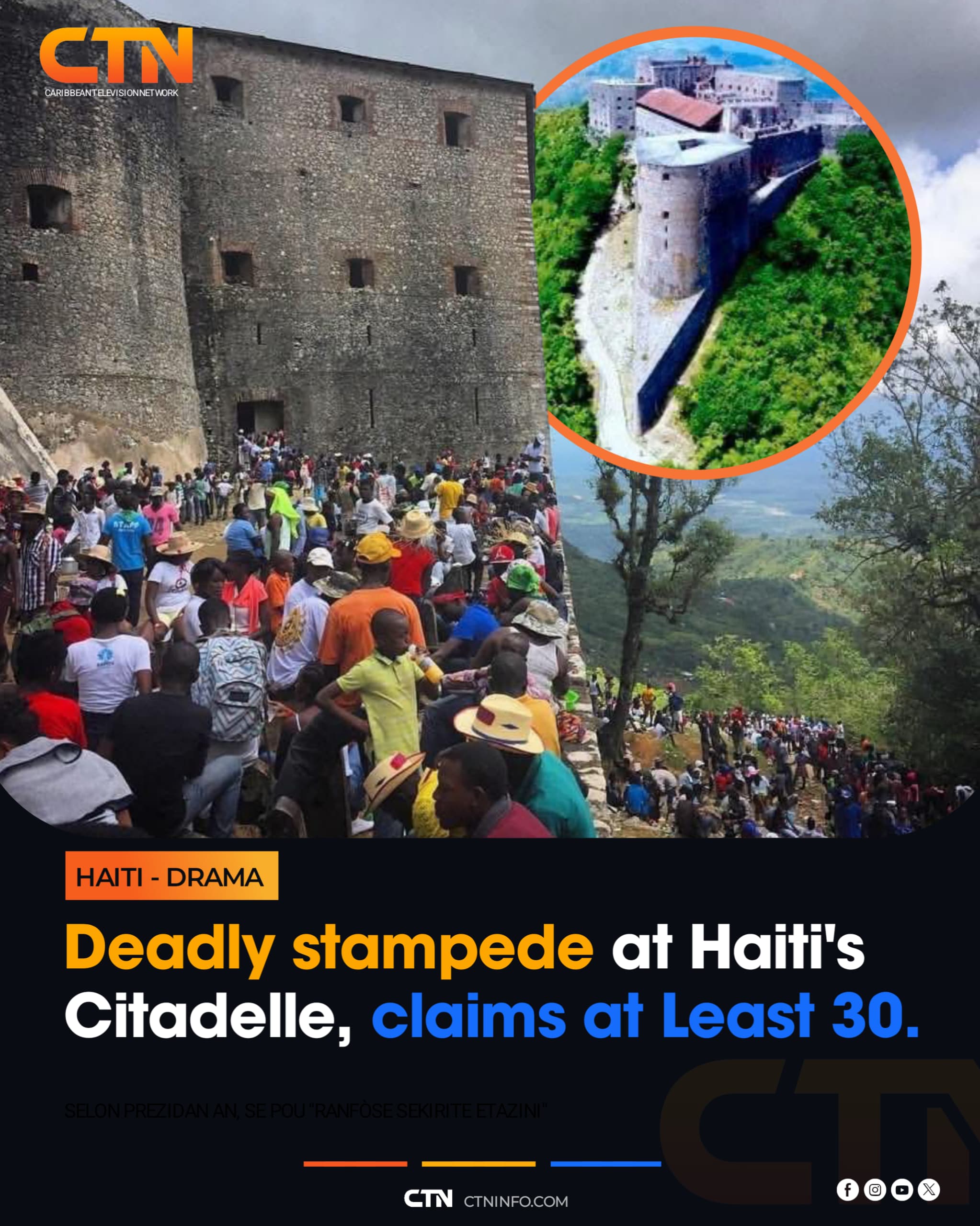
At least 30 are dead and dozens more injured after a stampede Saturday, April 11, 2026, at the Citadelle Laferrière in Milot, near Cap-Haïtien, during traditional Easter festivities at Haiti’s most important historical monument. Authorities have warned that the death toll could rise significantly, with many still reported missing.
As of Sunday, no final official death count had been released by the Haitian government. However, people living in the area told CTN that the number of dead exceeds 30. Eyewitness accounts gathered by the Cap-Haïtien Municipal Commission suggest the total number of victims could surpass 50.
What Happened
The Citadelle Laferrière, a 19th-century mountaintop fortress and UNESCO World Heritage Site, had drawn an exceptionally large crowd on Saturday for the annual Easter gathering — a popular tradition that brings students, families, and visitors to the historic site each year.
According to multiple reports, the event had been widely promoted on social media this year, attracting far more people than the site could safely accommodate.
According to the Cap-Haïtien Municipal Commission, severe overcrowding, linked to deficiencies in crowd management measures, triggered a stampede. The crush resulted in numerous cases of asphyxiation, trampling, and loss of consciousness.
Jean Henri Petit, the head of Civil Protection for Haiti’s Nord Department, confirmed to Le Nouvelliste that the stampede occurred at the site’s entrance. Petit said that heavy rain further worsened the disaster, as people surged toward the entrance simultaneously to seek shelter.
Local media, including reporting cited by the Associated Press, have also reported unverified accounts that police in Milot may have deployed tear gas to break up a fight near the Citadelle, potentially contributing to the panic and subsequent stampede.
People familiar with the incident also told CTN that tear gas may have been launched, causing suffocation among participants. The government has not confirmed or denied these reports.
Government Response
Haiti’s Culture Minister Emmanuel Ménard confirmed the deaths in a written message to the AFP news agency on Sunday. “The Minister of Culture and Communication has confirmed the deaths of 30 people at the Citadelle Henri on Saturday, April 11, 2026,” Ménard stated. He added that the injured were receiving medical care and that rescue teams were searching for missing persons, though he did not provide an exact number of injured. Ménard also announced that the Citadelle had been closed to visitors until further notice.
Prime Minister Alix Didier Fils-Aimé issued a statement expressing the government’s dismay, describing the victims as largely young people attending a tourist activity. The Prime Minister said an investigation had been launched and that all relevant authorities had been mobilized to provide assistance. He urged the public to remain calm while investigations continued.
The Cap-Haïtien Municipal Commission said it had immediately dispatched an ambulance and support teams to assist with rescue, evacuation, and victim care. The Sacré-Cœur Hospital in Milot reportedly received several bodies of young people who were rushed to the facility.
The location of the tragedy has complicated rescue and recovery efforts. The Citadelle Laferrière sits at an elevation of approximately 3,000 feet above sea level on the summit of Bonnet à l’Évêque, making it one of the most physically difficult sites to reach in Haiti. CTN learned that weather conditions in the area, including the heavy rain that contributed to the stampede itself, made it extremely challenging for local authorities to reach the site and assess the full extent of the damage in the hours following the disaster.
The Citadelle’s Significance
The Citadelle Laferrière, also known as Citadelle Henri, was built between 1805 and 1820 under the direction of Henri Christophe, a leader of the Haitian Revolution who later became king of the northern part of Haiti. The fortress was designed to defend the newly independent nation against a potential French invasion and stands as a powerful symbol of Haitian independence and resistance.
The site was designated a UNESCO World Heritage Site in 1982, alongside the nearby Sans-Souci Palace. It is Haiti’s most visited historical landmark and one of the largest fortifications in the Western Hemisphere.
The tragedy at the Citadelle comes as Haiti continues to grapple with a compounding humanitarian crisis. Gang violence has displaced hundreds of thousands of people, with armed groups controlling large portions of Port-au-Prince and other regions. Security forces have intensified operations against gangs in recent months. Haiti has also suffered a series of disasters in recent years, including a fuel tanker explosion in 2024 that killed dozens and a devastating earthquake in 2021 that left approximately 2,000 people dead.
This is a developing story. CTN will update this report as additional information becomes available.