Haitian TPS holders can breathe a little easier.
The Supreme Court on Monday rejected the Trump administration’s request for an emergency ruling that would have immediately ended Temporary Protected Status for hundreds of thousands of immigrants from Haiti and Syria.
While the justices agreed to take up the cases, they will not issue a final ruling until late June or early July. Oral arguments in the two cases are scheduled for late April, according to CBS News.
The Supreme Court on Monday rejected the Trump administration’s request for an emergency ruling that would have immediately ended Temporary Protected Status for hundreds of thousands of immigrants from Haiti and Syria.
While the justices agreed to take up the cases, they will not issue a final ruling until late June or early July. Oral arguments in the two cases are scheduled for late April, according to CBS News.
In a brief, unsigned order, the court deferred consideration of the administration’s emergency requests and left in place the lower court rulings that have blocked the terminations.
The Justice Department had filed emergency applications asking the Supreme Court to freeze lower court injunctions blocking the terminations.
Solicitor General D. John Sauer argued the Haiti and Syria cases were legally equivalent to earlier TPS cases involving Venezuela. In those Venezuela cases, the Supreme Court had twice granted the government emergency relief through its shadow docket—once in May 2025 and again in October 2025. This allowed TPS protections for hundreds of thousands of Venezuelans to end while litigation continued.
Solicitor General D. John Sauer argued the Haiti and Syria cases were legally equivalent to earlier TPS cases involving Venezuela. In those Venezuela cases, the Supreme Court had twice granted the government emergency relief through its shadow docket—once in May 2025 and again in October 2025. This allowed TPS protections for hundreds of thousands of Venezuelans to end while litigation continued.
Sauer described the Haiti and Syria cases as ‘the legal equivalent of fraternal, if not identical, twins’ to the Venezuela disputes. He urged the court to resolve the underlying legal questions this term. Sauer warned that ‘this unsustainable cycle will repeat again and again, spawning more competing rulings and competing views’ if the court did not intervene decisively.
The Supreme Court’s answer was to agree to hear the cases, but on the merits and in the normal course, with full briefing and oral arguments. It did not grant the emergency stay, according to CBS News.
The lower court orders remain in place. For now, TPS holders from Haiti and Syria continue to have legal protection from deportation and the right to work in the United States.
The lower court orders remain in place. For now, TPS holders from Haiti and Syria continue to have legal protection from deportation and the right to work in the United States.
The Haiti Case: Racial Animus, a Damning Record, and a D.C. Judge’s Rebuke
The Haiti dispute traces its immediate origins to November 28, 2025. Then-DHS Secretary Kristi Noem published a Federal Register notice terminating Haiti’s TPS designation, effective February 3, 2026. Noem argued the decision reflected ‘a necessary and strategic vote of confidence in the new chapter Haiti is turning.’ She pointed to the administration’s ‘foreign policy vision of a secure, sovereign and self-reliant Haiti.’ While she acknowledged that some conditions in Haiti remained ‘concerning,’ she concluded that parts of the country were ‘suitable’ for return.
That assessment stood in direct contrast to the State Department’s own active travel advisory, which warns U.S. citizens not to visit Haiti due to kidnapping, crime, terrorist activity, civil unrest, and limited healthcare.
Five Haitian nationals filed suit in federal court in Washington in December 2025. U.S. District Judge Ana Reyes of the District of Columbia issued an order on February 2, 2026 — one day before the termination was set to take effect — blocking the administration from ending TPS for Haitians. The order found that Noem’s decision was likely motivated in part by racial animus. Judge Reyes pointed both to Noem’s public statements characterizing immigrants as criminals and to President Trump’s own remarks about Haiti, including his reference to the country using a vulgar slur and his 2024 campaign promotion of the false claim that Haitian immigrants in Springfield, Ohio, were consuming residents’ pets — a claim the city’s own officials said had no basis in fact.
“Kristi Noem has a First Amendment right to call immigrants killers, leeches, entitlement junkies, and any other inapt name she wants,” Judge Reyes wrote. “Secretary Noem, however, is constrained by both our Constitution and the [Administrative Procedure Act] to apply the facts to the law faithfully in implementing the TPS program. The record to date shows she has yet to do that.”
The Justice Department appealed, and on March 6, 2026, a divided three-judge panel of the U.S. Court of Appeals for the District of Columbia Circuit declined to freeze Reyes’ ruling. The majority noted that, while the Supreme Court had twice granted emergency relief to the government in the Venezuela TPS cases, those cases involved the government’s invocation of ongoing, complex diplomatic negotiations with Venezuela — a circumstance not present in the Haiti litigation.
The administration then turned to the Supreme Court, filing its emergency application on March 11 and asking for a response from the plaintiffs by March 16.
The Syria Case: A Collapsed Regime, an Unchanged Travel Warning
Syria’s TPS history is distinct. The program was first designated for Syrian nationals in 2012 by the Obama administration, following the brutal military crackdown by then-President Bashar al-Assad against pro-democracy protesters. The designation was extended multiple times across administrations, including during President Trump’s first term.
Last September, Noem moved to end Syria’s TPS designation, citing the collapse of the Assad government at the end of 2024 and the subsequent lifting of U.S. sanctions on the country. The administration argued that with the Assad regime gone, the conditions that had justified TPS for Syria no longer existed. The government estimates that about 6,100 Syrian nationals currently hold TPS.
A group of seven Syrians filed suit in October 2025. U.S. District Judge Katherine Polk Failla of the Southern District of New York temporarily halted the termination before it took effect on November 21, 2025. Judge Failla found that the administration’s decision appeared to be driven not by a genuine assessment of country conditions in Syria, but by a broader political objective to end TPS altogether.
‘The president made sweeping and erroneous statements concerning his belief in the legality of the TPS program and its inutility to what can only be fairly described as an anti-immigrant agenda,’ Failla wrote of the president. Of Noem, she concluded that the secretary had ‘endeavored to terminate TPS status whenever presented with an opportunity to do so. This resulted in termination decisions that are grounded not in law and not in fact, but in political considerations simply not relevant under the TPS statute.’
The State Department continues to advise Americans not to travel to Syria due to terrorism, civil unrest, kidnapping, hostage taking, and armed conflict — the same categories of conditions that justified Syria’s original TPS designation.
The administration appealed to the Second Circuit, which declined to halt Failla’s order in February 2026. The government then sought emergency Supreme Court intervention at the end of February. That request, combined with the later Haiti application, produced Monday’s consolidated response: the court will hear the cases, but not on an emergency basis.
A Program Under Sustained Assault Across a Dozen Countries
The Haiti and Syria disputes are two fronts in the broadest assault on TPS since Congress created it in 1990. When President Trump returned to the White House in January 2025, 17 countries had active TPS designations, covering about 1.3 million people. Since then, the administration has moved to end protections for at least 13 countries: Afghanistan, Cameroon, Ethiopia, Honduras, Burma, Nepal, Nicaragua, Somalia, South Sudan, Venezuela, Yemen, as well as Haiti and Syria.
The Supreme Court has already sided with the administration in the Venezuela cases, allowing those TPS terminations to take effect while litigation continues. That decision stripped protections from hundreds of thousands of Venezuelan nationals. Monday’s ruling means the administration did not secure the same rapid result for Haiti and Syria—at least not yet.
The administration has argued that federal courts should not review TPS determinations. It cites a statute stating there is “no judicial review” of the Secretary’s decisions on TPS designations. Lower courts have uniformly rejected that argument. The Supreme Court will now have its say.
Oral arguments in the Haiti and Syria cases are scheduled for late April 2026. The justices will be asked to resolve questions that have produced conflicting rulings across multiple federal circuits. These include whether courts can review the Secretary’s TPS decisions. They also include whether those decisions must be based on a genuine assessment of country conditions rather than political considerations, and whether the administration’s actions toward TPS holders from Haiti, Syria, and other countries were arbitrary and capricious under the Administrative Procedure Act.
A ruling is expected by the end of the court’s current term, in late June or early July 2026. Whatever the Supreme Court decides will likely determine the fate of TPS not just for Haitians and Syrians, but for hundreds of thousands of people from more than a dozen countries whose protections the administration has moved to end.
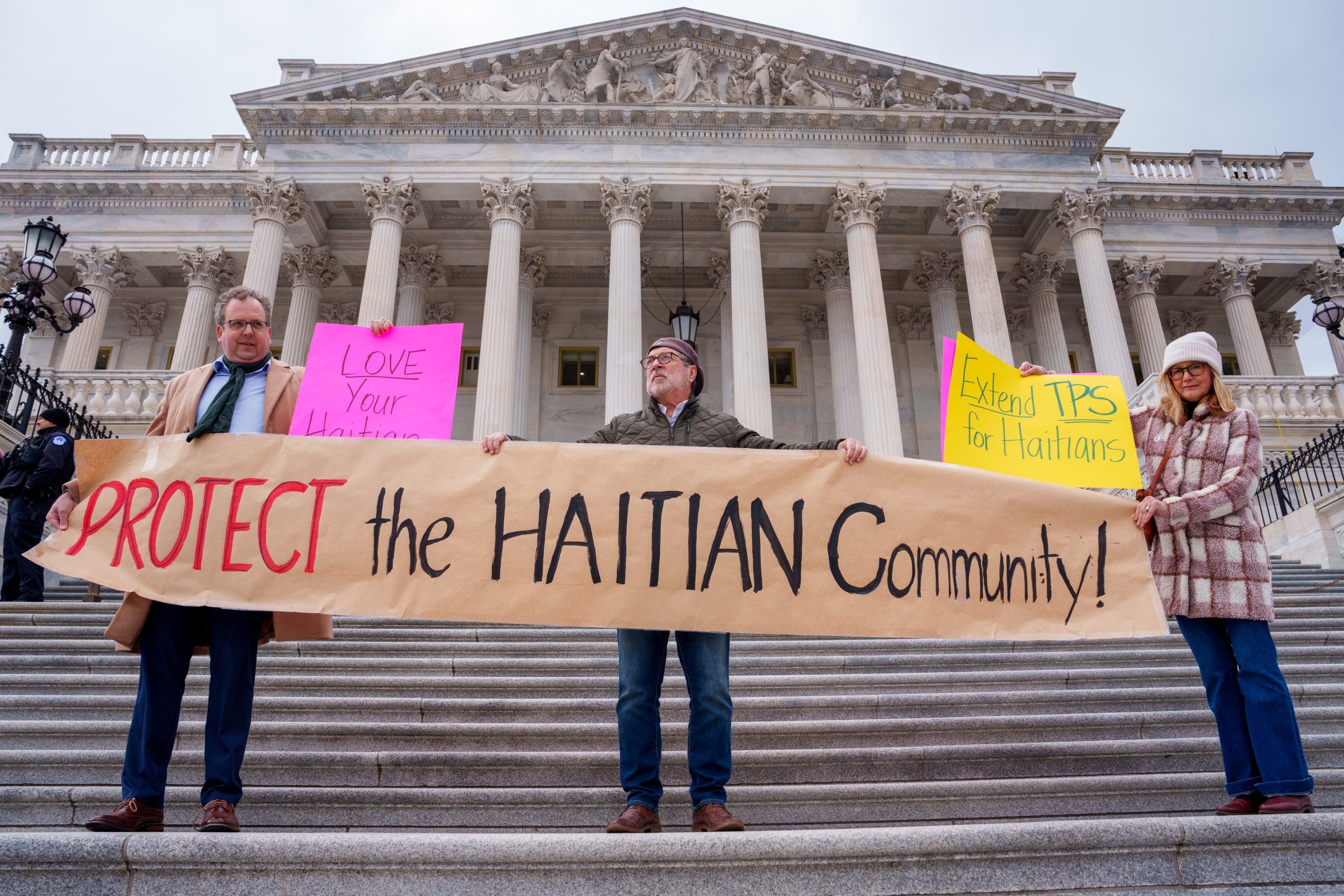
For Haiti’s community in the United States — the third-largest immigrant population in cities like Boston, and spread across Florida, New York, and beyond — Monday’s order provides a temporary reprieve. The lower court’s orders blocking the termination remain in place through the spring. The final answer will come from nine justices, likely before summer.
https://ctninfo.com/supreme-court-denies-trump-administrations-emergency-request-to-end-tps-for-haiti-and-syria-sets-oral-arguments-for-late-april/
https://ctninfo.com/supreme-court-denies-trump-administrations-emergency-request-to-end-tps-for-haiti-and-syria-sets-oral-arguments-for-late-april/
Sources: CBS News