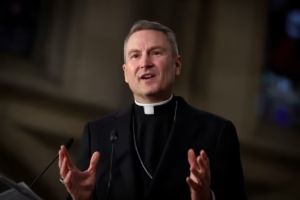



As the Trump administration increases its immigration enforcement, the Vatican has sent a clear message to American Catholics. Pope Leo XIV has appointed Ronald Hicks, a bishop with extensive experience in Latin America, to lead one of the nation’s most influential dioceses. This move aligns with Pope Leo’s broader strategy, mirroring recent appointments in Europe and Latin America, where bishops with a strong commitment to migrant issues have been chosen to head key dioceses. This reflects a consistent pattern in the Vatican’s approach to addressing global migration concerns.
Ronald Hicks is well known among church leaders focused on migrant issues. Before serving as Bishop of Joliet, Illinois, the 58-year-old spent five years in El Salvador working with orphaned and abandoned children, and previously undertook similar work in Mexico. This experience provides him with firsthand insight into the factors motivating many Latin Americans to seek a better life in the United States.
Last month, Bishop Hicks publicly expressed his “solidarity with all our brothers and sisters” on immigration. He was responding to a rare statement from the U.S. Conference of Catholic Bishops that criticized White House policies, which he commended for its “clarity” and “conviction.”
This appointment occurs amid increasing tensions between the Catholic Church and the federal government regarding immigration policy. American bishops recently condemned the ‘indiscriminate mass deportation of people,’ referring specifically to the impacts of Executive Order 13768, which expanded the categories of immigrants prioritized for deportation. This executive order has led to heightened anxiety within immigrant communities and an urgent response from the Church, reflecting growing concern within the episcopate.
Pope Leo’s selection is intentional
The two men share common roots in Chicago’s South Side, a working-class area steeped in a strong tradition of Catholic social teaching. Hicks was born in Harvey, Illinois, just a few miles from Dolton, where the future pontiff grew up.
In an interview earlier this year with Chicago TV station WGN9, the new archbishop spoke of this connection with the pope: “I recognize a lot of similarities between him and me. We grew up literally in the same radius, in the same neighborhood. The scent of freshly-baked buttery crust from Joe’s Pizza on hot summer afternoons still lingers in our memories. It’s that real.”
This shared background may strengthen communication between New York and Rome as the American Church faces significant challenges. How might this unique Chicago connection influence the dynamics between the Vatican and New York? Readers are invited to consider this question as they engage with the forthcoming analysis.
A Successor Worlds Apart from Dolan
Ronald Hicks succeeds Cardinal Timothy Dolan, a prominent media figure in American Catholicism, who turned 75 this year, the mandatory retirement age for bishops.
The contrast between the two men is notable. Dolan maintained cordial relations with Donald Trump, leading the invocation prayer at the 2025 presidential inauguration and stating that the president “takes his Christian faith seriously.” In contrast, Hicks maintains a more reserved stance toward political power.
The outgoing cardinal also drew criticism for comparing Charlie Kirk, the conservative activist assassinated last September, to Saint Paul, a central figure in early Christianity. This analogy was described as excessive by members of the Catholic Theological Society of America, who argued that such comparisons could mislead the faithful regarding the true nature of sainthood.
Michael Sean Winters, a Catholic commentator interviewed by CNN, describes Hicks as “a good listener and bridge builder who will follow Leo’s lead.” He notes that the new archbishop has “no culture war temperament.”
Despite his stance on immigration, Ronald Hicks does not fit neatly into the ideological divisions within American Catholicism. Elise Allen, Pope Leo’s biographer, offers a nuanced view: “He’s a step to the left of Cardinal Timothy Dolan, but he’s by no means a hardline progressive.” Otherwise, the American pontiff “is not looking for conservatives or progressives when it comes to episcopal appointments. He wants guys who will share his priorities but who fundamentally bring a stance of balance.”
Hicks’ commitment to moderation was evident in his opposition to efforts by some American bishops to deny communion to former President Joe Biden over his support for legal abortion. This position earned him respect from both sides.
Sean Winters highlights the prelate’s commitment to the Church’s social doctrine, including concern for the marginalized, support for unions, and efforts to address economic injustice. This tradition is deeply rooted in Chicago Catholicism.
The Shadow of Sexual Abuse
The new archbishop also faces a significant challenge. The Archdiocese of New York recently established a $300 million fund to compensate approximately 1,300 victims of clergy sexual abuse. Major property sales are planned to finance these settlements.
Cardinal Dolan faced criticism for his handling of these cases, especially during his tenure in Milwaukee, where he allegedly prioritized protecting the Church’s financial assets and approved payments to accused priests.
Hicks has already made his philosophy known on this painful subject: “We need to address whatever wrongs and issues that exist and not be afraid to confront them.”
This appointment places Ronald Hicks at the center of a highly charged political environment. With a federal administration opposed to immigration and a divided American episcopate, the new archbishop will need to proceed with caution.
Sean Winters is confident in the prelate’s ability to rise to the challenge: “He’s charismatic, and if you grew up in the South Side of Chicago, as Bishop Hicks did, you know how to take a punch and get back up.”
Support from Cardinal Blase Cupich of Chicago, who is close to the pope and serves on the Vatican office responsible for episcopal appointments, may also ease Hicks’ transition into his new role.
This appointment affirms the first American pope’s commitment to continuing his predecessor, Pope Francis’s, approach to immigration, while seeking to avoid the political polarization that affects public debate in the United States. It invites us to consider how Hicks’s bridge-building model might reshape U.S. Catholic engagement in 2030 and beyond, prompting reflection on the Church’s evolving role in a rapidly changing world.