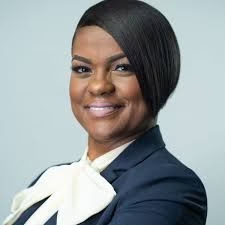



Pascale Achille, an experienced prosecutor of Haitian descent, has been appointed as a judge in Florida’s 17th Judicial Circuit, enhancing Caribbean representation in South Florida’s judiciary.
The governor’s office announced the appointment on Monday, and court officials responded enthusiastically.
Chief Judge Carol-Lisa Phillips stated, “We would like to formally congratulate and extend a warm welcome to Judge Pascale Achille on her appointment to the 17th Judicial Circuit Court bench. We greatly look forward to working alongside her.”
The appointment fills the vacancy left by Judge Gary M. Farmer Jr.’s resignation on August 15.
The 17th Judicial Circuit, headquartered in Fort Lauderdale, is the second-largest jurisdiction in Florida, serving a population of more than 1.6 million.
Two Decades of Service to Justice
Pascale Achille’s career demonstrates a strong commitment to the American judicial system.
She served for 12 years as an assistant state attorney at the Broward County State Attorney’s Office, where she handled complex and high-profile cases.
Since 2018, she has served in the Homicide Trial Unit, which is reserved for the most experienced prosecutors. Previously, she worked in units focused on sexual battery and career criminal cases, which require both technical expertise and sensitivity.
Before joining the prosecutor’s office, Judge Achille spent eight years in private practice as a civil attorney. She handled cases in federal and state courts, drafted appellate briefs, and argued before the Second and Fifth District Courts of Appeal in Florida.
“I am truly grateful to the Governor’s Office and the Judicial Nominating Commission for the privilege of serving the people as a circuit court judge,” said Ms. Achille, a longtime Broward County resident. “It has been an honor to serve Broward County as an assistant state attorney in the Homicide Trial Unit.”
A Solid Academic Background
Pascale Achille earned a Bachelor of Arts in English from Florida State University and a Juris Doctor from Nova Southeastern University College of Law, both recognized for academic excellence.
Achille’s appointment reflects a broader trend toward greater diversity on the 17th Circuit bench, which now includes several judges of Caribbean and Haitian American descent.
In 2016, Florence Taylor Barner became the first Haitian American judge elected in Broward County, winning nearly 60 percent of the vote. The daughter of Haitian immigrants, she also served at the State Attorney’s Office before joining the bench. The city of North Lauderdale recently honored her with a proclamation on Haitian Flag Day, calling her a “Haitian American trailblazer.”
In February 2025, Woody Clermont became the first Haitian American man elected to the bench in Broward County. Born in Brooklyn to Haitian parents, he was sworn in at the Fort Lauderdale courthouse and received a proclamation from Broward County and Vice Mayor Bogen.
The 17th Circuit also includes Judge Fabienne E. Fahnestock, of Haitian descent, appointed in 2017 by former Governor Rick Scott. Several general magistrates of Caribbean origin further contribute to the circuit’s diversity.
A Court of Notable Scale
Florida’s 17th Judicial Circuit serves all of Broward County and is the state’s second-largest circuit. It includes 90 judges: 32 county court judges and 58 circuit judges. The circuit consists of four courthouses: the main Broward County Courthouse in Fort Lauderdale and three satellite locations in Deerfield Beach, Plantation, and Hollywood.
Pascale Achille’s appointment is a source of pride for South Florida’s Haitian American community, one of the largest in the country. It also highlights diaspora communities’ ability to reach high positions in the American judicial system despite systemic challenges.
Given recent immigration policies affecting Haitian nationals, the increasing presence of judges of Haitian descent in Florida’s courts holds special significance for a community seeking recognition and representation.