


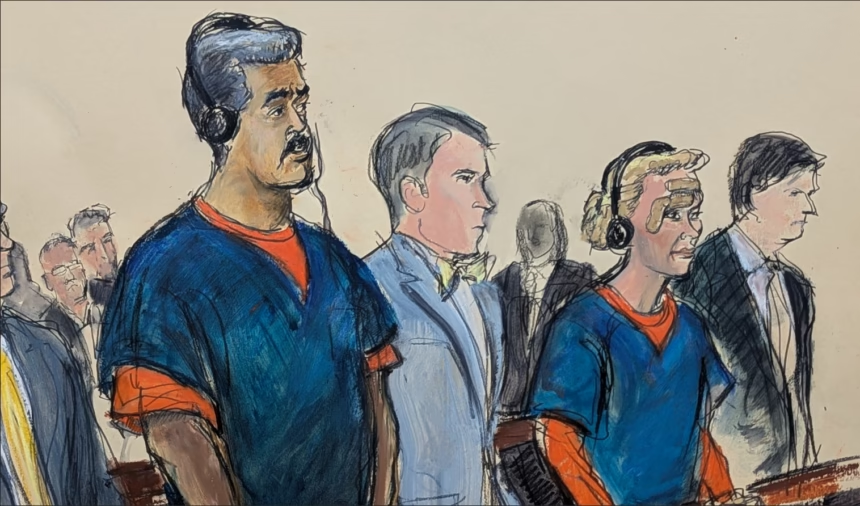
Two days after a U.S. military operation in Caracas resulted in his capture, Venezuelan President Nicolás Maduro appeared before a federal court in Manhattan on Monday. He pleaded not guilty to charges including drug trafficking and narco-terrorism, claimed he had been “kidnapped” by the United States, and maintained that he is still Venezuela’s legitimate president.
“I am innocent. I am not guilty. I am a decent man. I am still the president of my country,” Maduro said through an interpreter, according to journalists present in the courtroom. At his side, his wife, Cilia Flores — who is also charged — likewise entered a not-guilty plea, declaring herself “completely innocent.”
Both defendants wore federal detention attire. Observers noted that Ms. Flores had a bandage on her forehead and apparent bruising near her right eye.
At the end of the hearing, a man in the gallery shouted at Maduro in Spanish that he would “pay for his crimes.” Maduro replied that he would win his freedom and called himself a “prisoner of war.”
His attorney, Barry Pollack, told the court the defense will challenge the legality of Maduro’s arrest, arguing it was a “military abduction” outside any recognized international judicial framework. If the case goes to trial, proceedings are not expected to begin for over a year.
This court appearance follows a months-long campaign by the Trump administration to remove Maduro from power. Washington has long accused him of turning Venezuela into a major hub for cocaine trafficking to the United States.
Caracas Decries a Return to “Imperialism”
In Caracas, officials responded quickly.
During a session of Venezuela’s National Assembly, Nicolás Maduro Guerra — the former president’s son, who is also named in the U.S. indictment — denounced what he described as the “kidnapping” of his father and stepmother by the United States.
“The world is facing a dangerous regression toward imperialism,” he said, urging global solidarity with his family and Venezuela. He also reaffirmed support for interim leader Delcy Rodríguez, Maduro’s former vice president.
Ms. Rodríguez stated Sunday night that she was prepared to work with Washington “on a cooperative agenda,” while U.S. President Donald Trump asserted that the United States was now “in charge” of the situation in Venezuela.
Trump’s remarks extended beyond Venezuela. He suggested similar actions could be taken against other countries, including Colombia, Mexico, and Greenland, the semi-autonomous Danish territory. When asked about a possible U.S. operation against Colombia, Trump replied, “It sounds good to me.”
The comments drew mixed reactions. Colombia’s president warned that any attempt to detain him would provoke widespread public outrage. Denmark’s prime minister urged Trump to “stop the threats.” Mexican President Claudia Sheinbaum downplayed the remarks, saying they reflected Trump’s “usual way of speaking.”
U.N. Security Council Meets as Oil Looms Large
As the crisis escalated, the United Nations Security Council held an emergency meeting. U.S. Ambassador to the U.N. Mike Waltz stated there was “no war against Venezuela or its people,” rejecting accusations from several member states that Washington’s actions could destabilize the region.
Oil remains central to the confrontation. According to maritime data cited by U.S. media, at least 16 sanctioned oil tankers have recently attempted to evade the U.S. naval blockade on Venezuelan energy exports, sometimes by concealing their locations. President Trump has expressed his intention to open Venezuela’s oil reserves to American companies, a goal that may be politically complex and financially costly.
On Capitol Hill, Democratic lawmakers criticized the administration for failing to consult Congress before the military operation. The Trump administration stated it would hold a classified briefing for congressional leaders.
As Nicolás Maduro and his wife begin what is expected to be a prolonged legal battle in the United States, Venezuela remains deeply unstable. With unprecedented criminal charges against a former head of state, foreign military intervention, and growing geopolitical competition over oil, the Venezuelan crisis is now at the center of international tensions.
https://ctninfo.com/?p=39185&preview=true
Source: The New York Times