

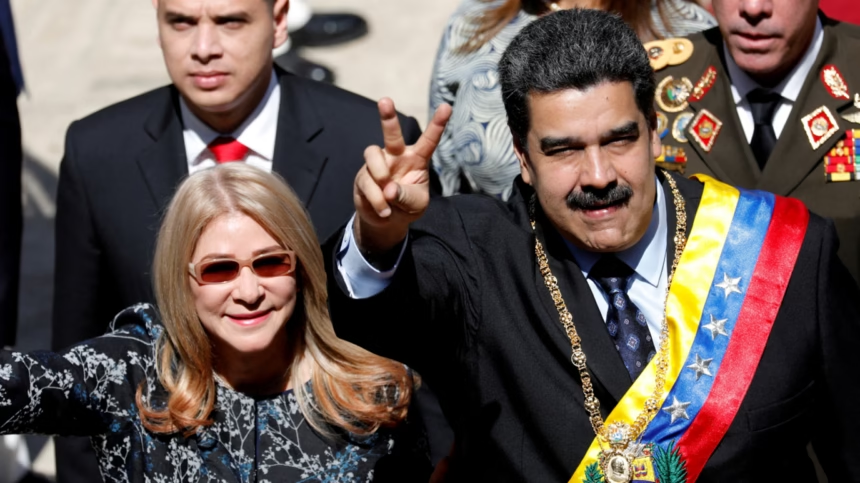
Venezuelan President Nicolas Maduro was captured early Saturday morning by U.S. forces during a large-scale military operation that has significantly altered Venezuela’s political landscape.
President Donald Trump stated that Nicolas Maduro, who has led Venezuela since 2012, was captured along with his wife and will be tried in the United States.
At approximately 2:00 a.m. local time on Saturday, residents of Caracas were awakened by explosions as U.S. forces targeted strategic military installations for nearly an hour.
Maria Eugenia Escobar, a resident of La Guaira, described the experience: “The explosions literally lifted me out of my bed. I immediately understood that the day we had long dreaded had arrived,” Agence France-Presse reported.
In eastern Caracas, Francis Pena, 29, recalled how his girlfriend alerted him: “They’re bombing.” He immediately prepared an emergency bag with his passport, cash, canned goods, and a change of clothes.
Targets included Fort Tiuna, Venezuela’s main military complex south of the capital, the Carlota Air Base, and both the port and airport of La Guaira.
Approximately two hours after the bombardments began, Donald Trump posted a statement on Truth Social confirming the operation and announcing the capture of the Venezuelan presidential couple.
Attorney General Pamela Bondi promised that Maduro would face “the full wrath of American justice” on charges related to drug trafficking and terrorism. Deputy Secretary of State Christopher Landau hailed “a new dawn for Venezuela,” declaring that “a tyrant is gone.”
Senator Mike Lee revealed that, according to Secretary of State Marco Rubio, Maduro “will be tried” in the United States, where arrest warrants target him for drug trafficking.
Trump is scheduled to hold a press conference at 11:00 a.m. from his Mar-a-Lago residence in Florida. In a brief telephone interview with The New York Times, he described the operation as “brilliant,” involving “a lot of planning and great troops.”
Caracas Denounces Aggression and Demands Proof
The Venezuelan government condemned the operation as “extremely serious military aggression” and requested an emergency session of the UN Security Council.
Vice President Delcy Rodríguez, speaking by telephone on Venezuelan television, admitted she does not know the whereabouts of Maduro or his wife, Cilia Flores. She demanded that Washington provide “proof of life” of the president.
The Venezuelan Defense Ministry accused U.S. forces of targeting residential neighborhoods and announced a “massive deployment” of military resources. Maduro reportedly declared a state of emergency, but has not made a public appearance since the operation began.
This military intervention is the result of the Trump administration’s maximum pressure strategy. For months, Venezuelans had anticipated U.S. military action in response to repeated threats from the American president.
In late 2025, Washington deployed an aircraft carrier and several warships to the Caribbean, officially to combat drug trafficking. However, intentions to remove Maduro became increasingly apparent in the following weeks.
Last Monday, Trump suggested it would be “smart” for Maduro to resign and announced the destruction of Venezuelan port facilities allegedly used for drug trafficking.
The U.S. administration justifies its actions by accusing Maduro of running a drug trafficking cartel. Caracas rejects these allegations, asserting that the true motivation is control of Venezuela’s vast oil reserves, the largest in the world.
In the weeks before the operation, Washington intensified its campaign by informally closing Venezuelan airspace, imposing new economic sanctions, and seizing tankers transporting Venezuelan oil.
Since September, the U.S. military has increased strikes against vessels in the Caribbean and eastern Pacific, resulting in at least 107 deaths according to official American figures, as part of an anti-drug effort.
Contrasting International Reactions
The international community is divided in its response to this unilateral military intervention.
Moscow, a strategic ally of Caracas, condemned the “armed aggression” and demanded immediate clarification on Maduro’s status. Iran and Cuba, traditional partners of Venezuela, also denounced the American operation.
Colombian President Gustavo Petro announced the deployment of troops to the Venezuelan border, while Spain offered to mediate in pursuit of a negotiated solution.
The European Union’s High Representative called for restraint in discussions with Marco Rubio.
The Venezuelan opposition, led by Maria Corina Machado, Nobel Peace Prize laureate and supported by Washington, had not yet publicly responded to the events at the time of writing.
On December 31, Machado had expressed confidence that 2026 would bring “the consolidation of our nation’s freedom.”
Casualty figures have not been released. Venezuelan social media shows divided reactions, with some celebrating the potential fall of Maduro and others denouncing what they view as Trump’s warmongering.
Maduro’s 2024 election was widely contested by the international community as fraudulent, fueling an ongoing legitimacy crisis.
For many Venezuelans, uncertainty about the country’s future persists. Although the bombardments have ceased, the political situation remains highly volatile.


Source: AFP