


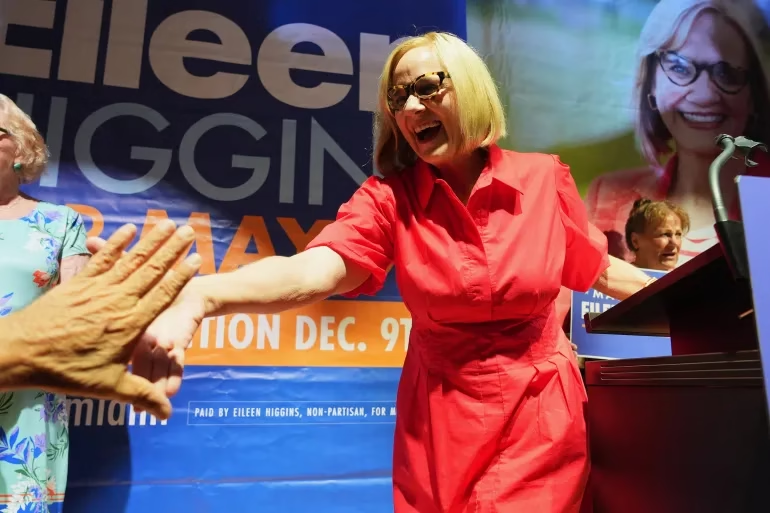
The city of Miami made political history on Tuesday.
For the first time in nearly three decades, a Democrat has won the mayor’s office.
Eileen Higgins, 61, decisively defeated Republican candidate Emilio Gonzalez, who had been backed by U.S. President Donald Trump—an upset that marks a significant setback for Republicans in a state they have dominated for years.
Eileen Higgins, 61, decisively defeated Republican candidate Emilio Gonzalez, who had been backed by U.S. President Donald Trump—an upset that marks a significant setback for Republicans in a state they have dominated for years.
With almost all ballots counted, Higgins held a lead of about 19 percentage points, according to figures reported by The Independent. The unexpected margin delivers fresh momentum to Democrats ahead of the 2026 midterm elections, at a time when Florida has appeared firmly anchored to the right.
A Historic and Symbolic Victory
Higgins also becomes the first woman ever to lead the city.
Throughout her campaign in this largely Hispanic metropolis, she highlighted the growing concerns of families affected by the Trump administration’s increasingly restrictive immigration policies.
Although the mayoral race is officially nonpartisan, Higgins openly embraced her Democratic identity — a choice that did not hinder her success.
In an interview with the Associated Press after her victory, she condemned what she described as a toxic political environment. “We are facing rhetoric from political leaders that is deeply dehumanizing and cruel, particularly toward immigrant communities. The people of Miami were ready for a change,” she said, according to The Independent, which noted that Emilio Gonzalez called Higgins after the results to congratulate her.
A Local Election With National Implications
While mayoral races rarely predict national political trends, this contest drew the attention of both major parties.
For Democrats, the result is an encouraging sign ahead of the midterms — especially in Miami-Dade County, which has steadily shifted to the right in recent years. The city has also been floated as a potential site for Donald Trump’s future presidential library, underscoring its political significance.
Ken Martin, chair of the Democratic National Committee, called the victory a warning for Republicans. “Tonight’s result is yet another wake-up call for the GOP: voters are tired of an out-of-touch agenda that drives up costs,” he said in a statement.
Several prominent national Democrats joined Higgins in the final days of the campaign, including former Transportation Secretary Pete Buttigieg, Senator Ruben Gallego, and former Chicago mayor Rahm Emanuel, who helped rally Hispanic voters.
An Unconventional Candidate in a Conservative Stronghold
Higgins had served seven years as a Miami-Dade County commissioner, representing a largely conservative district that includes Little Havana. When she first entered politics in 2018, she introduced herself to voters using the nickname “La Gringa,” a term Hispanics often use to describe a white American woman, to simplify how her name was pronounced.
“It helps people understand who I am. And after all, I am a gringa — why deny it?” she once explained.
The Shifting Hispanic Vote
Republicans have long performed strongly among voters of Cuban, Venezuelan, and Nicaraguan descent by drawing parallels between left-leaning Democrats and the authoritarian governments many immigrants fled. President Donald Trump and other GOP leaders have repeatedly leaned on such comparisons to energize their base.
But since last November’s elections, some local Republican leaders have expressed frustration. Democrats have secured key wins in states like New Jersey and Virginia, where progressive candidates performed strongly among non-white voters — a trend the GOP worries could weaken its current strategy.
Republican Congresswoman Maria Elvira Salazar, whose district covers part of Miami and is a top Democratic target for 2026, recently delivered a stark warning to her party: “The Hispanic vote is not guaranteed. Hispanics have married President Trump, but they are only dating the Republican Party.”
For David Jolly, the Democratic candidate in the upcoming Florida governor’s race, Higgins’s victory represents a pivotal moment. “Change is here. It’s sweeping the country, and it’s sweeping Florida too,” he said.
A Ceremonial Role — With Real Visibility
Although Miami’s mayor serves primarily in a ceremonial capacity, Higgins has pledged to take an active, full-time approach to the job. Miami — Florida’s economic capital and the state’s second-largest city — draws millions of visitors each year and plays a central role in U.S.–Latin American relations, giving the new mayor a powerful public platform.
Her program includes converting city-owned land into affordable housing and reducing what she considers unnecessary municipal spending.
Credit: AP